

138
Pesticides, Organic Contaminants, and Pathogens in Air
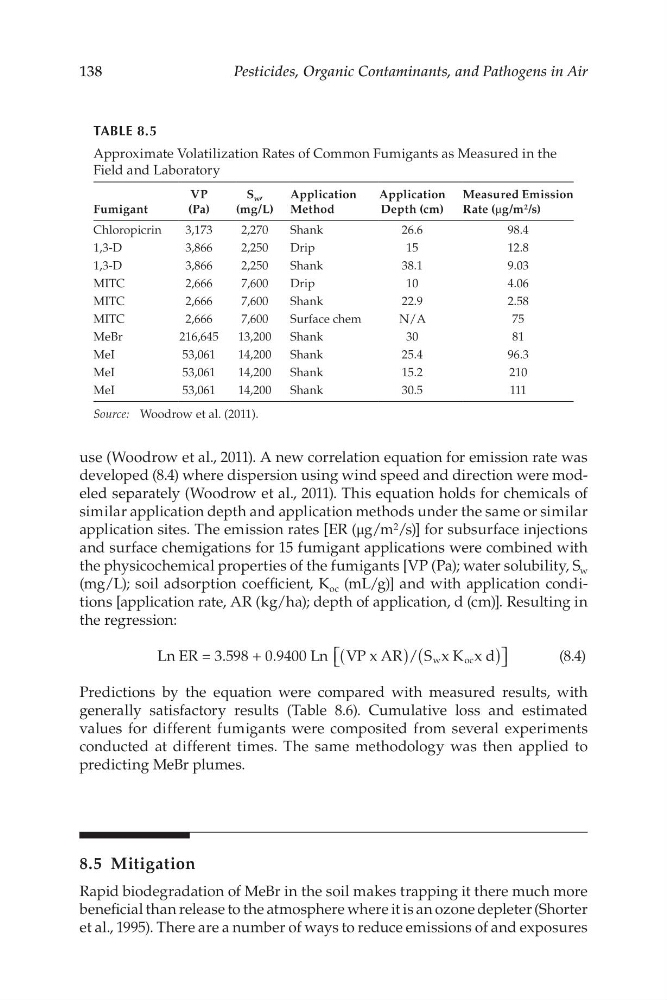
TABLE 8.5
Approximate Volatilization Rates of Common Fumigants as Measured in the
Field and Laboratory
VP
S w ,
Application
Application Measured Emission
Fumigant
(Pa)
(mg/L) Method
Depth (cm)
Rate (µg/m 2 /s)
Chloropicrin
3,173
2,270
Shank
26.6
98.4
1,3-D
3,866
2,250
Drip
15
12.8
1,3-D
3,866
2,250
Shank
38.1
9.03
MITC
2,666
7,600
Drip
10
4.06
MITC
2,666
7,600
Shank
22.9
2.58
MITC
2,666
7,600
Surface chem
N/A
75
MeBr
216,645
13,200
Shank
30
81
MeI
53,061
14,200
Shank
25.4
96.3
MeI
53,061
14,200
Shank
15.2
210
MeI
53,061
14,200
Shank
30.5
111
Source: Woodrow et al. (2011).
use (Woodrow et al., 2011). A new correlation equation for emission rate was
developed (8.4) where dispersion using wind speed and direction were modeled separately (Woodrow et al., 2011). This equation holds for chemicals of
similar application depth and application methods under the same or similar
application sites. The emission rates [ER (μg/m 2 /s)] for subsurface injections
and surface chemigations for 15 fumigant applications were combined with
the physicochemical properties of the fumigants [VP (Pa); water solubility, S w
(mg/L); soil adsorption coeffcient, K oc (mL/g)] and with application conditions [application rate, AR (kg/ha); depth of application, d (cm)]. Resulting in
the regression:
Ln ER = 3.598 + 0.9400 Ln (VP x AR /
) (S x K x d)
(8.4)
˛ ˝
w
o c
˙ ˆ
Predictions by the equation were compared with measured results, with
generally satisfactory results (Table 8.6). Cumulative loss and estimated
values for different fumigants were composited from several experiments
conducted at different times. The same methodology was then applied to
predicting MeBr plumes.
8.5 Mitigation
Rapid biodegradation of MeBr in the soil makes trapping it there much more
benefcial than release to the atmosphere where it is an ozone depleter (Shorter
et al., 1995). There are a number of ways to reduce emissions of and exposures
Pesticides, Organic Contaminants, and Pathogens in Air
TABLE 8.5
Approximate Volatilization Rates of Common Fumigants as Measured in the
Field and Laboratory
VP
S w ,
Application
Application Measured Emission
Fumigant
(Pa)
(mg/L) Method
Depth (cm)
Rate (µg/m 2 /s)
Chloropicrin
3,173
2,270
Shank
26.6
98.4
1,3-D
3,866
2,250
Drip
15
12.8
1,3-D
3,866
2,250
Shank
38.1
9.03
MITC
2,666
7,600
Drip
10
4.06
MITC
2,666
7,600
Shank
22.9
2.58
MITC
2,666
7,600
Surface chem
N/A
75
MeBr
216,645
13,200
Shank
30
81
MeI
53,061
14,200
Shank
25.4
96.3
MeI
53,061
14,200
Shank
15.2
210
MeI
53,061
14,200
Shank
30.5
111
Source: Woodrow et al. (2011).
use (Woodrow et al., 2011). A new correlation equation for emission rate was
developed (8.4) where dispersion using wind speed and direction were modeled separately (Woodrow et al., 2011). This equation holds for chemicals of
similar application depth and application methods under the same or similar
application sites. The emission rates [ER (μg/m 2 /s)] for subsurface injections
and surface chemigations for 15 fumigant applications were combined with
the physicochemical properties of the fumigants [VP (Pa); water solubility, S w
(mg/L); soil adsorption coeffcient, K oc (mL/g)] and with application conditions [application rate, AR (kg/ha); depth of application, d (cm)]. Resulting in
the regression:
Ln ER = 3.598 + 0.9400 Ln (VP x AR /
) (S x K x d)
(8.4)
˛ ˝
w
o c
˙ ˆ
Predictions by the equation were compared with measured results, with
generally satisfactory results (Table 8.6). Cumulative loss and estimated
values for different fumigants were composited from several experiments
conducted at different times. The same methodology was then applied to
predicting MeBr plumes.
8.5 Mitigation
Rapid biodegradation of MeBr in the soil makes trapping it there much more
benefcial than release to the atmosphere where it is an ozone depleter (Shorter
et al., 1995). There are a number of ways to reduce emissions of and exposures