

•
•
126
Pesticides, Organic Contaminants, and Pathogens in Air
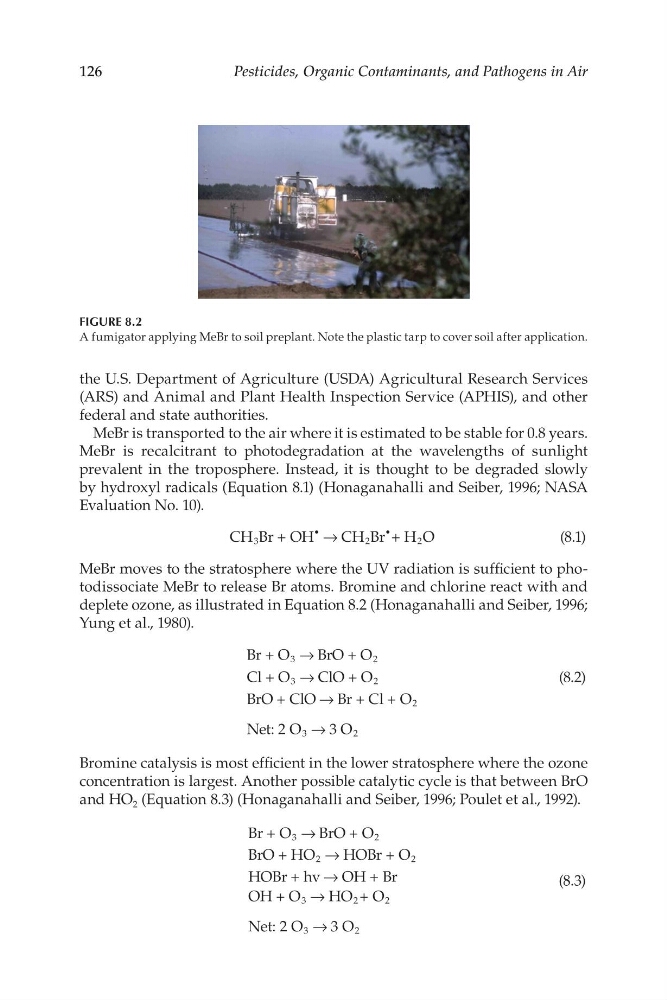
FIGURE 8.2
A fumigator applying MeBr to soil preplant. Note the plastic tarp to cover soil after application.
the U.S. Department of Agriculture (USDA) Agricultural Research Services
(ARS) and Animal and Plant Health Inspection Service (APHIS), and other
federal and state authorities.
MeBr is transported to the air where it is estimated to be stable for 0.8 years.
MeBr is recalcitrant to photodegradation at the wavelengths of sunlight
prevalent in the troposphere. Instead, it is thought to be degraded slowly
by hydroxyl radicals (Equation 8.1) (Honaganahalli and Seiber, 1996; NASA
Evaluation No. 10).
CH Br + OH ˜ CH Br + H O
(8.1)
3
2
2
MeBr moves to the stratosphere where the UV radiation is suffcient to photodissociate MeBr to release Br atoms. Bromine and chlorine react with and
deplete ozone, as illustrated in Equation 8.2 (Honaganahalli and Seiber, 1996;
Yung et al., 1980).
Br + O 3 ˜ BrO + O 2
Cl + O 3 ˜ ClO + O 2
(8.2)
BrO + ClO ˜ Br + Cl + O 2
Net: 2 O 3 ˜ 3 O 2
Bromine catalysis is most effcient in the lower stratosphere where the ozone
concentration is largest. Another possible catalytic cycle is that between BrO
and HO 2 (Equation 8.3) (Honaganahalli and Seiber, 1996; Poulet et al., 1992).
Br + O 3 ˜ BrO + O 2
BrO + HO 2 ˜ HOBr + O 2
HOBr + hv ˜ OH + Br
(8.3)
OH + O 3 ˜ HO 2 + O 2
Net: 2 O 3 ˜ 3 O 2
•
126
Pesticides, Organic Contaminants, and Pathogens in Air
FIGURE 8.2
A fumigator applying MeBr to soil preplant. Note the plastic tarp to cover soil after application.
the U.S. Department of Agriculture (USDA) Agricultural Research Services
(ARS) and Animal and Plant Health Inspection Service (APHIS), and other
federal and state authorities.
MeBr is transported to the air where it is estimated to be stable for 0.8 years.
MeBr is recalcitrant to photodegradation at the wavelengths of sunlight
prevalent in the troposphere. Instead, it is thought to be degraded slowly
by hydroxyl radicals (Equation 8.1) (Honaganahalli and Seiber, 1996; NASA
Evaluation No. 10).
CH Br + OH ˜ CH Br + H O
(8.1)
3
2
2
MeBr moves to the stratosphere where the UV radiation is suffcient to photodissociate MeBr to release Br atoms. Bromine and chlorine react with and
deplete ozone, as illustrated in Equation 8.2 (Honaganahalli and Seiber, 1996;
Yung et al., 1980).
Br + O 3 ˜ BrO + O 2
Cl + O 3 ˜ ClO + O 2
(8.2)
BrO + ClO ˜ Br + Cl + O 2
Net: 2 O 3 ˜ 3 O 2
Bromine catalysis is most effcient in the lower stratosphere where the ozone
concentration is largest. Another possible catalytic cycle is that between BrO
and HO 2 (Equation 8.3) (Honaganahalli and Seiber, 1996; Poulet et al., 1992).
Br + O 3 ˜ BrO + O 2
BrO + HO 2 ˜ HOBr + O 2
HOBr + hv ˜ OH + Br
(8.3)
OH + O 3 ˜ HO 2 + O 2
Net: 2 O 3 ˜ 3 O 2