

Fumigants
125
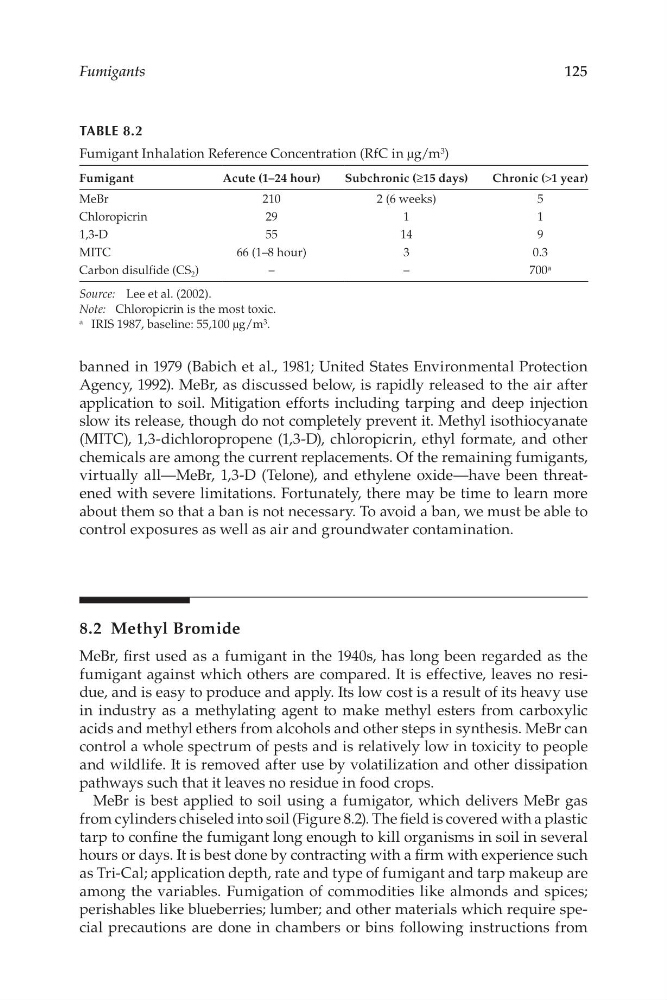
TABLE 8.2
Fumigant Inhalation Reference Concentration (RfC in µg/m 3 )
Fumigant
Acute (1–24 hour)
Subchronic (≥15 days)
Chronic (>1 year)
MeBr
210
2 (6 weeks)
5
Chloropicrin
29
1
1
1,3-D
55
14
9
MITC
66 (1–8 hour)
3
0.3
Carbon disulfde (CS 2 )
–
–
700 a
Source: Lee et al. (2002).
Note: Chloropicrin is the most toxic.
a IRIS 1987, baseline: 55,100 µg/m 3 .
banned in 1979 (Babich et al., 1981; United States Environmental Protection
Agency, 1992). MeBr, as discussed below, is rapidly released to the air after
application to soil. Mitigation efforts including tarping and deep injection
slow its release, though do not completely prevent it. Methyl isothiocyanate
(MITC), 1,3-dichloropropene (1,3-D), chloropicrin, ethyl formate, and other
chemicals are among the current replacements. Of the remaining fumigants,
virtually all—MeBr, 1,3-D (Telone), and ethylene oxide—have been threatened with severe limitations. Fortunately, there may be time to learn more
about them so that a ban is not necessary. To avoid a ban, we must be able to
control exposures as well as air and groundwater contamination.
8.2 Methyl Bromide
MeBr, frst used as a fumigant in the 1940s, has long been regarded as the
fumigant against which others are compared. It is effective, leaves no residue, and is easy to produce and apply. Its low cost is a result of its heavy use
in industry as a methylating agent to make methyl esters from carboxylic
acids and methyl ethers from alcohols and other steps in synthesis. MeBr can
control a whole spectrum of pests and is relatively low in toxicity to people
and wildlife. It is removed after use by volatilization and other dissipation
pathways such that it leaves no residue in food crops.
MeBr is best applied to soil using a fumigator, which delivers MeBr gas
from cylinders chiseled into soil (Figure 8.2). The feld is covered with a plastic
tarp to confne the fumigant long enough to kill organisms in soil in several
hours or days. It is best done by contracting with a frm with experience such
as Tri-Cal; application depth, rate and type of fumigant and tarp makeup are
among the variables. Fumigation of commodities like almonds and spices;
perishables like blueberries; lumber; and other materials which require special precautions are done in chambers or bins following instructions from
125
TABLE 8.2
Fumigant Inhalation Reference Concentration (RfC in µg/m 3 )
Fumigant
Acute (1–24 hour)
Subchronic (≥15 days)
Chronic (>1 year)
MeBr
210
2 (6 weeks)
5
Chloropicrin
29
1
1
1,3-D
55
14
9
MITC
66 (1–8 hour)
3
0.3
Carbon disulfde (CS 2 )
–
–
700 a
Source: Lee et al. (2002).
Note: Chloropicrin is the most toxic.
a IRIS 1987, baseline: 55,100 µg/m 3 .
banned in 1979 (Babich et al., 1981; United States Environmental Protection
Agency, 1992). MeBr, as discussed below, is rapidly released to the air after
application to soil. Mitigation efforts including tarping and deep injection
slow its release, though do not completely prevent it. Methyl isothiocyanate
(MITC), 1,3-dichloropropene (1,3-D), chloropicrin, ethyl formate, and other
chemicals are among the current replacements. Of the remaining fumigants,
virtually all—MeBr, 1,3-D (Telone), and ethylene oxide—have been threatened with severe limitations. Fortunately, there may be time to learn more
about them so that a ban is not necessary. To avoid a ban, we must be able to
control exposures as well as air and groundwater contamination.
8.2 Methyl Bromide
MeBr, frst used as a fumigant in the 1940s, has long been regarded as the
fumigant against which others are compared. It is effective, leaves no residue, and is easy to produce and apply. Its low cost is a result of its heavy use
in industry as a methylating agent to make methyl esters from carboxylic
acids and methyl ethers from alcohols and other steps in synthesis. MeBr can
control a whole spectrum of pests and is relatively low in toxicity to people
and wildlife. It is removed after use by volatilization and other dissipation
pathways such that it leaves no residue in food crops.
MeBr is best applied to soil using a fumigator, which delivers MeBr gas
from cylinders chiseled into soil (Figure 8.2). The feld is covered with a plastic
tarp to confne the fumigant long enough to kill organisms in soil in several
hours or days. It is best done by contracting with a frm with experience such
as Tri-Cal; application depth, rate and type of fumigant and tarp makeup are
among the variables. Fumigation of commodities like almonds and spices;
perishables like blueberries; lumber; and other materials which require special precautions are done in chambers or bins following instructions from