

117
Pesticides in Fog
(Seiber et al., 1993). The higher concentrations recorded, 100 ng/m 3 in air and
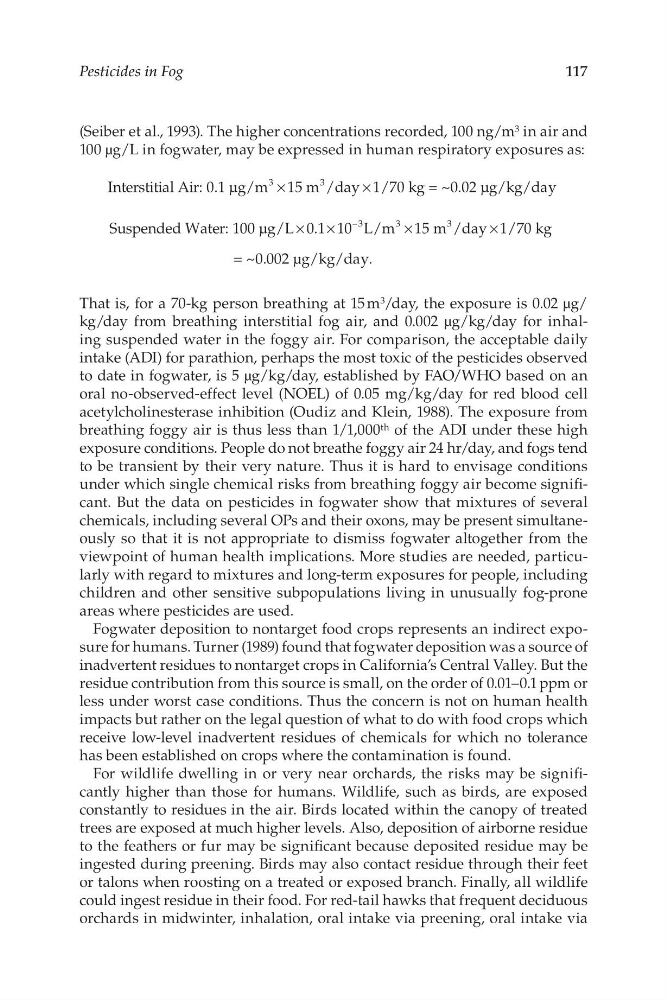
100 µg/L in fogwater, may be expressed in human respiratory exposures as:
3
3
Interstitial Air: 0.1 µg/m × 15 m /day 1/70 kg = ~0.02 µg/kg/day
×
–3
3
3
Suspended Water: 100 µg/L × 0.1× 10 L/m × 15 m /day × 1/70 kg
= ~0.002 µg/kg/day.
That is, for a 70-kg person breathing at 15 m 3 /day, the exposure is 0.02 µg/
kg/day from breathing interstitial fog air, and 0.002 µg/kg/day for inhaling suspended water in the foggy air. For comparison, the acceptable daily
intake (ADI) for parathion, perhaps the most toxic of the pesticides observed
to date in fogwater, is 5 µg/kg/day, established by FAO/WHO based on an
oral no-observed-effect level (NOEL) of 0.05 mg/kg/day for red blood cell
acetylcholinesterase inhibition (Oudiz and Klein, 1988). The exposure from
breathing foggy air is thus less than 1/1,000 th of the ADI under these high
exposure conditions. People do not breathe foggy air 24 hr/day, and fogs tend
to be transient by their very nature. Thus it is hard to envisage conditions
under which single chemical risks from breathing foggy air become signifcant. But the data on pesticides in fogwater show that mixtures of several
chemicals, including several OPs and their oxons, may be present simultaneously so that it is not appropriate to dismiss fogwater altogether from the
viewpoint of human health implications. More studies are needed, particularly with regard to mixtures and long-term exposures for people, including
children and other sensitive subpopulations living in unusually fog-prone
areas where pesticides are used.
Fogwater deposition to nontarget food crops represents an indirect exposure for humans. Turner (1989) found that fogwater deposition was a source of
inadvertent residues to nontarget crops in California’s Central Valley. But the
residue contribution from this source is small, on the order of 0.01–0.1 ppm or
less under worst case conditions. Thus the concern is not on human health
impacts but rather on the legal question of what to do with food crops which
receive low-level inadvertent residues of chemicals for which no tolerance
has been established on crops where the contamination is found.
For wildlife dwelling in or very near orchards, the risks may be signifcantly higher than those for humans. Wildlife, such as birds, are exposed
constantly to residues in the air. Birds located within the canopy of treated
trees are exposed at much higher levels. Also, deposition of airborne residue
to the feathers or fur may be signifcant because deposited residue may be
ingested during preening. Birds may also contact residue through their feet
or talons when roosting on a treated or exposed branch. Finally, all wildlife
could ingest residue in their food. For red-tail hawks that frequent deciduous
orchards in midwinter, inhalation, oral intake via preening, oral intake via
Pesticides in Fog
(Seiber et al., 1993). The higher concentrations recorded, 100 ng/m 3 in air and
100 µg/L in fogwater, may be expressed in human respiratory exposures as:
3
3
Interstitial Air: 0.1 µg/m × 15 m /day 1/70 kg = ~0.02 µg/kg/day
×
–3
3
3
Suspended Water: 100 µg/L × 0.1× 10 L/m × 15 m /day × 1/70 kg
= ~0.002 µg/kg/day.
That is, for a 70-kg person breathing at 15 m 3 /day, the exposure is 0.02 µg/
kg/day from breathing interstitial fog air, and 0.002 µg/kg/day for inhaling suspended water in the foggy air. For comparison, the acceptable daily
intake (ADI) for parathion, perhaps the most toxic of the pesticides observed
to date in fogwater, is 5 µg/kg/day, established by FAO/WHO based on an
oral no-observed-effect level (NOEL) of 0.05 mg/kg/day for red blood cell
acetylcholinesterase inhibition (Oudiz and Klein, 1988). The exposure from
breathing foggy air is thus less than 1/1,000 th of the ADI under these high
exposure conditions. People do not breathe foggy air 24 hr/day, and fogs tend
to be transient by their very nature. Thus it is hard to envisage conditions
under which single chemical risks from breathing foggy air become signifcant. But the data on pesticides in fogwater show that mixtures of several
chemicals, including several OPs and their oxons, may be present simultaneously so that it is not appropriate to dismiss fogwater altogether from the
viewpoint of human health implications. More studies are needed, particularly with regard to mixtures and long-term exposures for people, including
children and other sensitive subpopulations living in unusually fog-prone
areas where pesticides are used.
Fogwater deposition to nontarget food crops represents an indirect exposure for humans. Turner (1989) found that fogwater deposition was a source of
inadvertent residues to nontarget crops in California’s Central Valley. But the
residue contribution from this source is small, on the order of 0.01–0.1 ppm or
less under worst case conditions. Thus the concern is not on human health
impacts but rather on the legal question of what to do with food crops which
receive low-level inadvertent residues of chemicals for which no tolerance
has been established on crops where the contamination is found.
For wildlife dwelling in or very near orchards, the risks may be signifcantly higher than those for humans. Wildlife, such as birds, are exposed
constantly to residues in the air. Birds located within the canopy of treated
trees are exposed at much higher levels. Also, deposition of airborne residue
to the feathers or fur may be signifcant because deposited residue may be
ingested during preening. Birds may also contact residue through their feet
or talons when roosting on a treated or exposed branch. Finally, all wildlife
could ingest residue in their food. For red-tail hawks that frequent deciduous
orchards in midwinter, inhalation, oral intake via preening, oral intake via