

116
Pesticides, Organic Contaminants, and Pathogens in Air
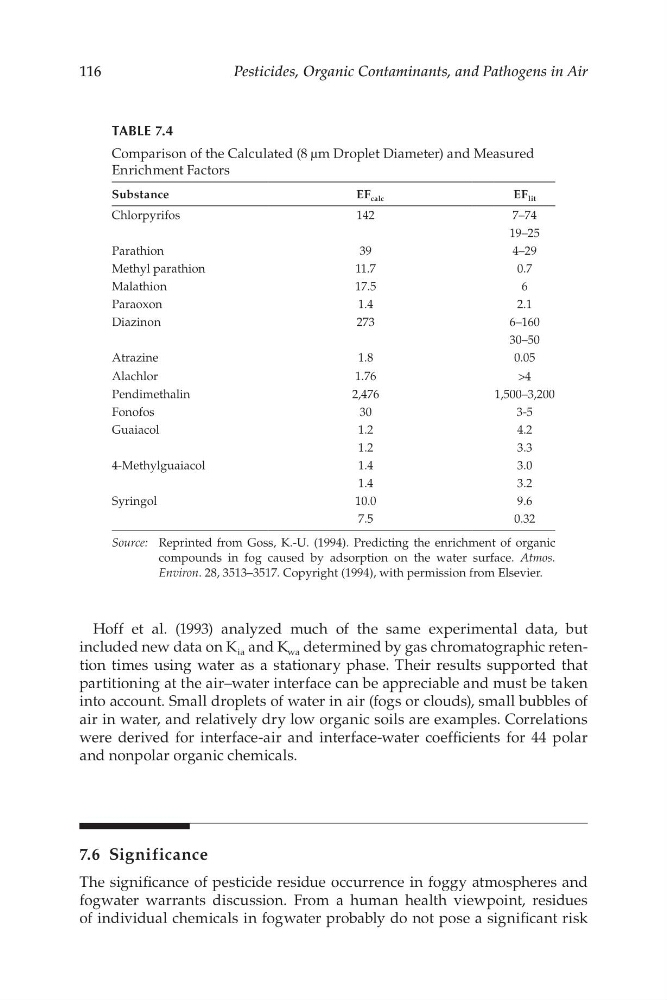
TABLE 7.4
Comparison of the Calculated (8 µm Droplet Diameter) and Measured
Enrichment Factors
Substance
EF calc
EF lit
Chlorpyrifos
142
7–74
19–25
Parathion
39
4–29
Methyl parathion
11.7
0.7
Malathion
17.5
6
Paraoxon
1.4
2.1
Diazinon
273
6–160
30–50
Atrazine
1.8
0.05
Alachlor
1.76
>4
Pendimethalin
2,476
1,500–3,200
Fonofos
30
3-5
Guaiacol
1.2
4.2
1.2
3.3
4-Methylguaiacol
1.4
3.0
1.4
3.2
Syringol
10.0
9.6
7.5
0.32
Source: Reprinted from Goss, K.-U. (1994). Predicting the enrichment of organic
compounds in fog caused by adsorption on the water surface. Atmos.
Environ. 28, 3513–3517. Copyright (1994), with permission from Elsevier.
Hoff et al. (1993) analyzed much of the same experimental data, but
included new data on K ia and K wa determined by gas chromatographic retention times using water as a stationary phase. Their results supported that
partitioning at the air–water interface can be appreciable and must be taken
into account. Small droplets of water in air (fogs or clouds), small bubbles of
air in water, and relatively dry low organic soils are examples. Correlations
were derived for interface-air and interface-water coeffcients for 44 polar
and nonpolar organic chemicals.
7.6 Significance
The signifcance of pesticide residue occurrence in foggy atmospheres and
fogwater warrants discussion. From a human health viewpoint, residues
of individual chemicals in fogwater probably do not pose a signifcant risk