

94
Pesticides, Organic Contaminants, and Pathogens in Air
samplers, such as impactors (cascade, dichotomous; see Chapter 7 on fog)
and cyclone separators. If the vapor pressure is in the range of 10 −5 to 0.1 Pa,
both vapor and aerosol forms will be found in air, and a combination of the
two sampling methods will be needed.
In most cases, samplers are equipped to capture both vapor and aerosols to assess an exposure event. For one, many pesticides are found in
both vapor and aerosol phases. Also, the partitioning of chemicals between
vapor and particulate phases depends on the particulate matter in the air.
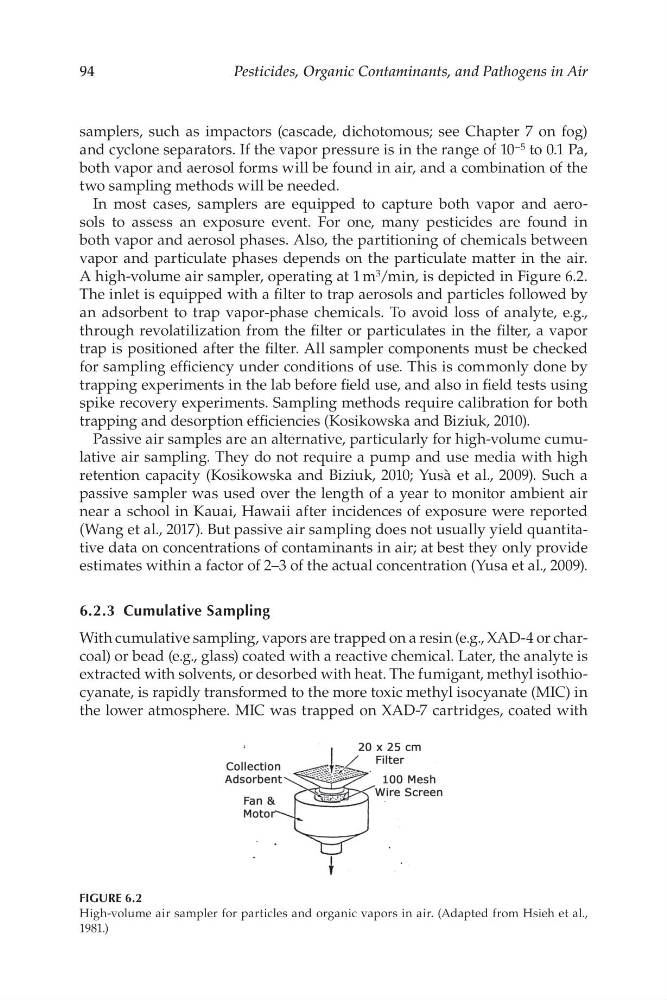
A high-volume air sampler, operating at 1 m 3 /min, is depicted in Figure 6.2.
The inlet is equipped with a flter to trap aerosols and particles followed by
an adsorbent to trap vapor-phase chemicals. To avoid loss of analyte, e.g.,
through revolatilization from the flter or particulates in the flter, a vapor
trap is positioned after the flter. All sampler components must be checked
for sampling effciency under conditions of use. This is commonly done by
trapping experiments in the lab before feld use, and also in feld tests using
spike recovery experiments. Sampling methods require calibration for both
trapping and desorption effciencies (Kosikowska and Biziuk, 2010).
Passive air samples are an alternative, particularly for high-volume cumulative air sampling. They do not require a pump and use media with high
retention capacity (Kosikowska and Biziuk, 2010; Yusà et al., 2009). Such a
passive sampler was used over the length of a year to monitor ambient air
near a school in Kauai, Hawaii after incidences of exposure were reported
(Wang et al., 2017). But passive air sampling does not usually yield quantitative data on concentrations of contaminants in air; at best they only provide
estimates within a factor of 2–3 of the actual concentration (Yusa et al., 2009).
6.2.3 Cumulative Sampling
With cumulative sampling, vapors are trapped on a resin (e.g., XAD-4 or charcoal) or bead (e.g., glass) coated with a reactive chemical. Later, the analyte is
extracted with solvents, or desorbed with heat. The fumigant, methyl isothiocyanate, is rapidly transformed to the more toxic methyl isocyanate (MIC) in
the lower atmosphere. MIC was trapped on XAD-7 cartridges, coated with
FIGURE 6.2
High-volume air sampler for particles and organic vapors in air. (Adapted from Hsieh et al.,
1981.)
Pesticides, Organic Contaminants, and Pathogens in Air
samplers, such as impactors (cascade, dichotomous; see Chapter 7 on fog)
and cyclone separators. If the vapor pressure is in the range of 10 −5 to 0.1 Pa,
both vapor and aerosol forms will be found in air, and a combination of the
two sampling methods will be needed.
In most cases, samplers are equipped to capture both vapor and aerosols to assess an exposure event. For one, many pesticides are found in
both vapor and aerosol phases. Also, the partitioning of chemicals between
vapor and particulate phases depends on the particulate matter in the air.
A high-volume air sampler, operating at 1 m 3 /min, is depicted in Figure 6.2.
The inlet is equipped with a flter to trap aerosols and particles followed by
an adsorbent to trap vapor-phase chemicals. To avoid loss of analyte, e.g.,
through revolatilization from the flter or particulates in the flter, a vapor
trap is positioned after the flter. All sampler components must be checked
for sampling effciency under conditions of use. This is commonly done by
trapping experiments in the lab before feld use, and also in feld tests using
spike recovery experiments. Sampling methods require calibration for both
trapping and desorption effciencies (Kosikowska and Biziuk, 2010).
Passive air samples are an alternative, particularly for high-volume cumulative air sampling. They do not require a pump and use media with high
retention capacity (Kosikowska and Biziuk, 2010; Yusà et al., 2009). Such a
passive sampler was used over the length of a year to monitor ambient air
near a school in Kauai, Hawaii after incidences of exposure were reported
(Wang et al., 2017). But passive air sampling does not usually yield quantitative data on concentrations of contaminants in air; at best they only provide
estimates within a factor of 2–3 of the actual concentration (Yusa et al., 2009).
6.2.3 Cumulative Sampling
With cumulative sampling, vapors are trapped on a resin (e.g., XAD-4 or charcoal) or bead (e.g., glass) coated with a reactive chemical. Later, the analyte is
extracted with solvents, or desorbed with heat. The fumigant, methyl isothiocyanate, is rapidly transformed to the more toxic methyl isocyanate (MIC) in
the lower atmosphere. MIC was trapped on XAD-7 cartridges, coated with
FIGURE 6.2
High-volume air sampler for particles and organic vapors in air. (Adapted from Hsieh et al.,
1981.)