

288
Subtle Agroecologies
suitable gearings, but this will have a more mechanical rhythm. Since the 1980s, dynamisation has
also been undertaken in various countries using Flowform water sculptures. We will now look into
what happens in this method of engendering movement in water.
FLOWFORM MOVEMENT: AN ALTERNATIVE METHOD OF DYNAMISATION
Flowforms are vessels specifcally designed for water to embody rhythmic fow patterns. They
are usually designed in clay with water fowing through them in an interactive way. The potential
for such resonant water movements was discovered by John Wilkes while working with Theodor
Schwenk in 1970 (Wilkes, 2003). They have been used for dynamisation among many other
uses.
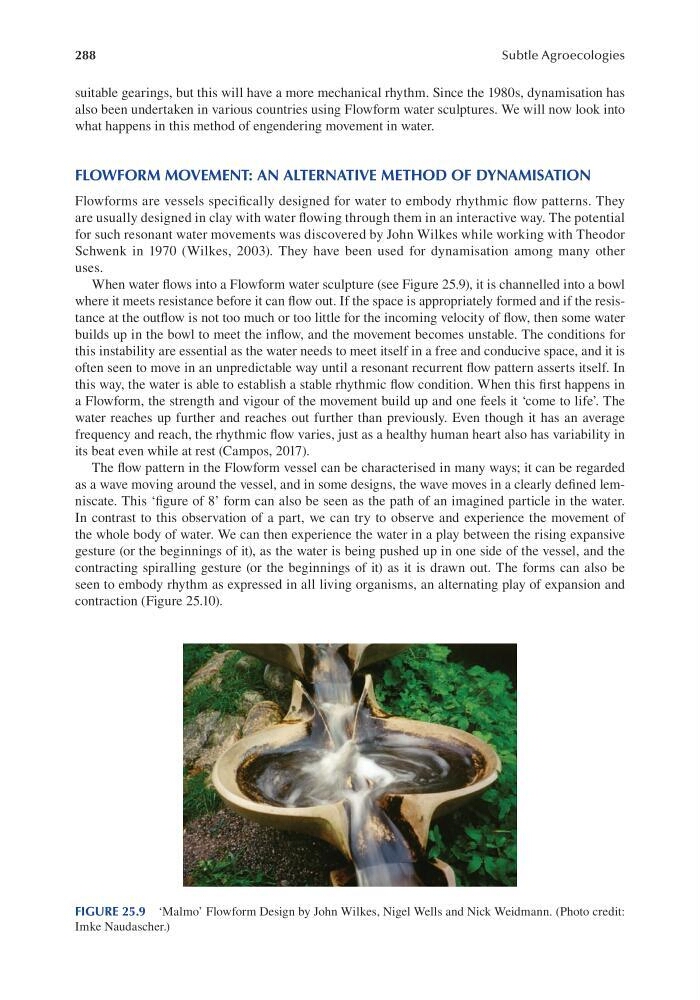
When water fows into a Flowform water sculpture (see Figure 25.9), it is channelled into a bowl
where it meets resistance before it can fow out. If the space is appropriately formed and if the resistance at the outfow is not too much or too little for the incoming velocity of fow, then some water
builds up in the bowl to meet the infow, and the movement becomes unstable. The conditions for
this instability are essential as the water needs to meet itself in a free and conducive space, and it is
often seen to move in an unpredictable way until a resonant recurrent fow pattern asserts itself. In
this way, the water is able to establish a stable rhythmic fow condition. When this frst happens in
a Flowform, the strength and vigour of the movement build up and one feels it ‘come to life’. The
water reaches up further and reaches out further than previously. Even though it has an average
frequency and reach, the rhythmic fow varies, just as a healthy human heart also has variability in
its beat even while at rest (Campos, 2017).
The fow pattern in the Flowform vessel can be characterised in many ways; it can be regarded
as a wave moving around the vessel, and in some designs, the wave moves in a clearly defned lemniscate. This ‘fgure of 8’ form can also be seen as the path of an imagined particle in the water.
In contrast to this observation of a part, we can try to observe and experience the movement of
the whole body of water. We can then experience the water in a play between the rising expansive
gesture (or the beginnings of it), as the water is being pushed up in one side of the vessel, and the
contracting spiralling gesture (or the beginnings of it) as it is drawn out. The forms can also be
seen to embody rhythm as expressed in all living organisms, an alternating play of expansion and
contraction (Figure 25.10).
FIGURE 25.9 ‘Malmo’ Flowform Design by John Wilkes, Nigel Wells and Nick Weidmann. (Photo credit:
Imke Naudascher.)