

286
Subtle Agroecologies
they have a ‘birth’, a rhythmic ‘life’ and eventually a ‘death’, a dissolution of the form. The spiral
vortex might also be referred to in the same way, but its form extends into the whole body of fuid
so it does not have the same self-maintaining, independent existence we usually associate with the
term ‘organism’.
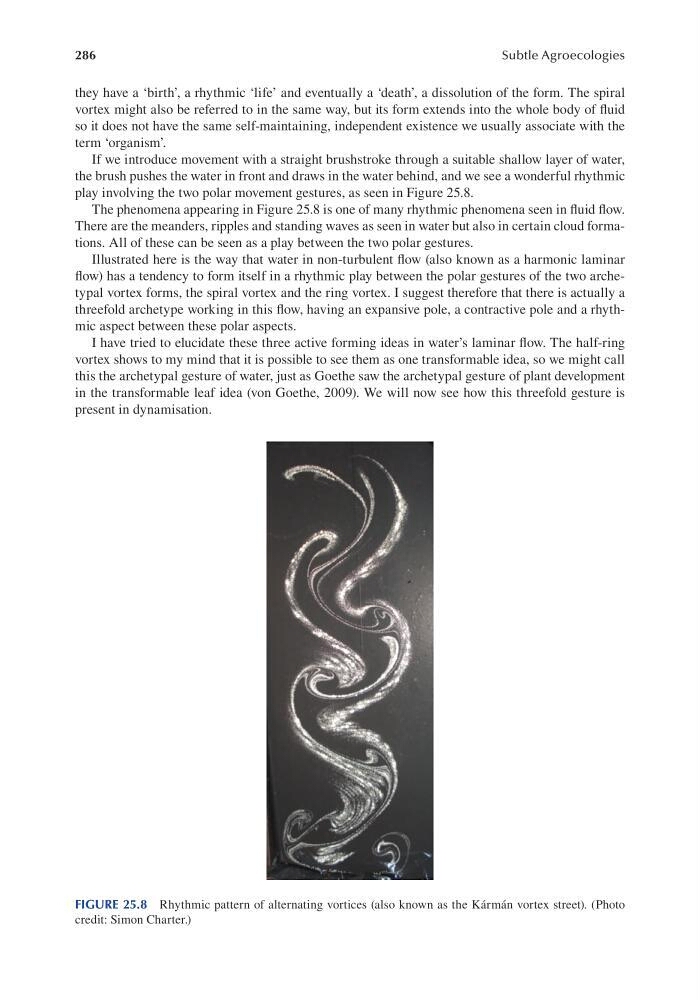
If we introduce movement with a straight brushstroke through a suitable shallow layer of water,
the brush pushes the water in front and draws in the water behind, and we see a wonderful rhythmic
play involving the two polar movement gestures, as seen in Figure 25.8.
The phenomena appearing in Figure 25.8 is one of many rhythmic phenomena seen in fuid fow.
There are the meanders, ripples and standing waves as seen in water but also in certain cloud formations. All of these can be seen as a play between the two polar gestures.
Illustrated here is the way that water in non-turbulent fow (also known as a harmonic laminar
fow) has a tendency to form itself in a rhythmic play between the polar gestures of the two archetypal vortex forms, the spiral vortex and the ring vortex. I suggest therefore that there is actually a
threefold archetype working in this fow, having an expansive pole, a contractive pole and a rhythmic aspect between these polar aspects.
I have tried to elucidate these three active forming ideas in water’s laminar fow. The half-ring
vortex shows to my mind that it is possible to see them as one transformable idea, so we might call
this the archetypal gesture of water, just as Goethe saw the archetypal gesture of plant development
in the transformable leaf idea (von Goethe, 2009). We will now see how this threefold gesture is
present in dynamisation.
FIGURE 25.8 Rhythmic pattern of alternating vortices (also known as the Kármán vortex street). (Photo
credit: Simon Charter.)