

285
A Dynamic Role for Water in Agriculture
If one observes gently fowing water in a river with these two archetypal gestures in mind, one
can see there is always a play between the two in the way it moves, with underwater obstructions
pushing into the fow and expansive welling up occurring in front. Then behind an obstruction, little
contracting eddies can be seen, associated with the drawing down of the water. The water, under
push or draw, acts accordingly with either the expansive gesture (towards the ring vortex) or the
contractive one (towards the spiral vortex).
In conclusion to this discussion of the phenomena, it is clear that that water is sensitive to the forces
of pressure and suction. These are invisible forming forces of which we do have a direct experience.
RHYTHM – ANOTHER GESTURE OF FLOW
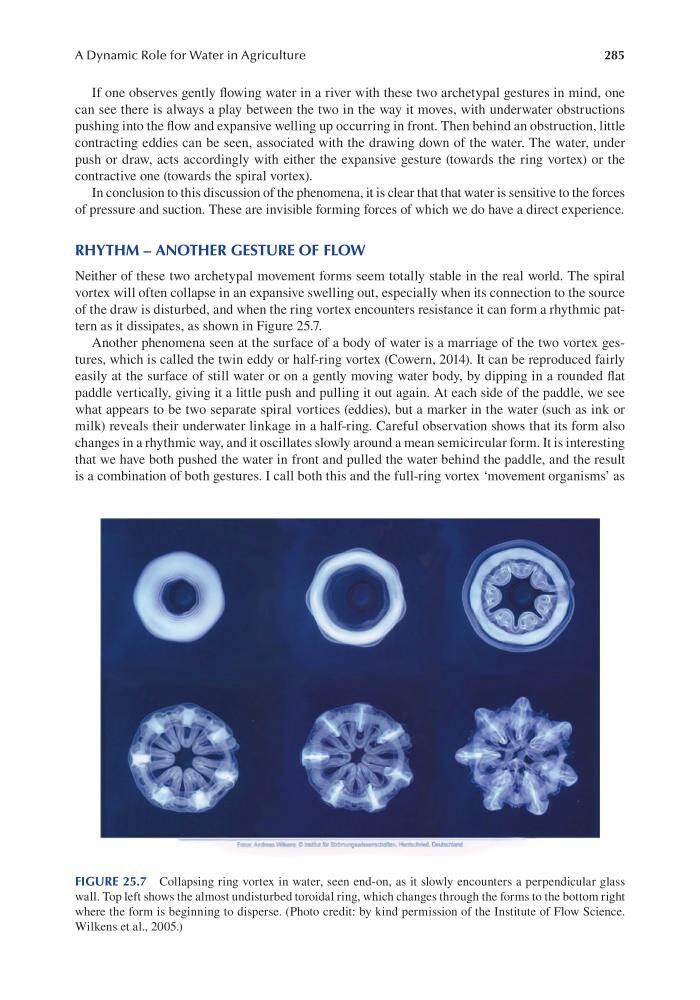
Neither of these two archetypal movement forms seem totally stable in the real world. The spiral
vortex will often collapse in an expansive swelling out, especially when its connection to the source
of the draw is disturbed, and when the ring vortex encounters resistance it can form a rhythmic pattern as it dissipates, as shown in Figure 25.7.
Another phenomena seen at the surface of a body of water is a marriage of the two vortex gestures, which is called the twin eddy or half-ring vortex (Cowern, 2014). It can be reproduced fairly
easily at the surface of still water or on a gently moving water body, by dipping in a rounded fat
paddle vertically, giving it a little push and pulling it out again. At each side of the paddle, we see
what appears to be two separate spiral vortices (eddies), but a marker in the water (such as ink or
milk) reveals their underwater linkage in a half-ring. Careful observation shows that its form also
changes in a rhythmic way, and it oscillates slowly around a mean semicircular form. It is interesting
that we have both pushed the water in front and pulled the water behind the paddle, and the result
is a combination of both gestures. I call both this and the full-ring vortex ‘movement organisms’ as
FIGURE 25.7 Collapsing ring vortex in water, seen end-on, as it slowly encounters a perpendicular glass
wall. Top left shows the almost undisturbed toroidal ring, which changes through the forms to the bottom right
where the form is beginning to disperse. (Photo credit: by kind permission of the Institute of Flow Science.
Wilkens et al., 2005.)