

253
Sustainable Yogic Agriculture
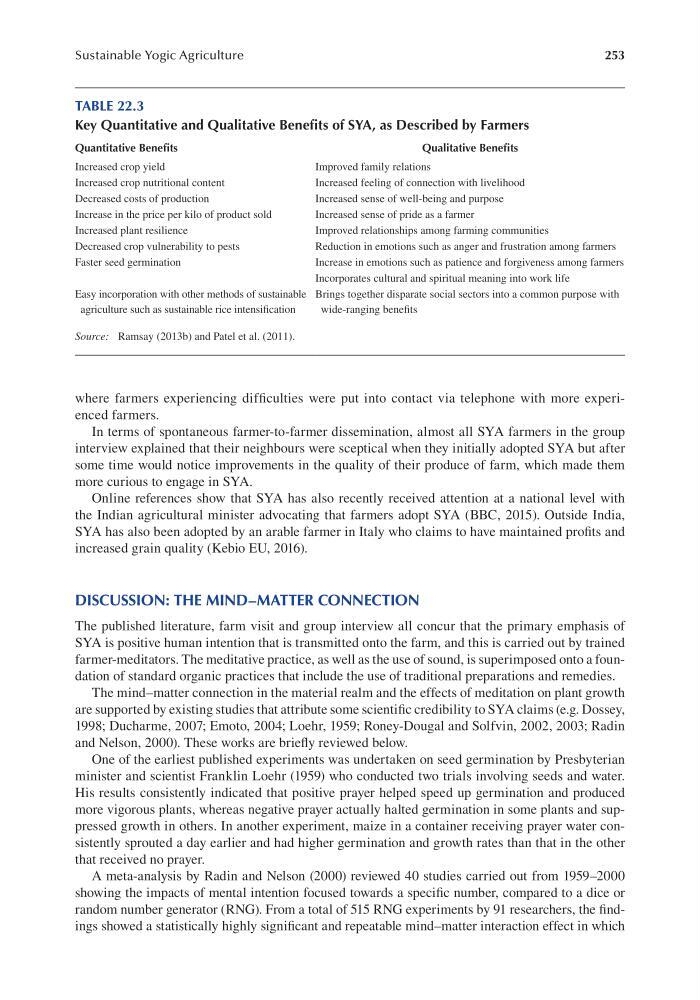
TABLE 22.3
Key Quantitative and Qualitative Benefts of SYA, as Described by Farmers
Quantitative Benefts
Qualitative Benefts
Increased crop yield
Improved family relations
Increased crop nutritional content
Increased feeling of connection with livelihood
Decreased costs of production
Increased sense of well-being and purpose
Increase in the price per kilo of product sold
Increased sense of pride as a farmer
Increased plant resilience
Improved relationships among farming communities
Decreased crop vulnerability to pests
Reduction in emotions such as anger and frustration among farmers
Faster seed germination
Increase in emotions such as patience and forgiveness among farmers
Incorporates cultural and spiritual meaning into work life
Easy incorporation with other methods of sustainable Brings together disparate social sectors into a common purpose with
agriculture such as sustainable rice intensifcation
wide-ranging benefts
Source: Ramsay (2013b) and Patel et al. (2011).
where farmers experiencing diffculties were put into contact via telephone with more experienced farmers.
In terms of spontaneous farmer-to-farmer dissemination, almost all SYA farmers in the group
interview explained that their neighbours were sceptical when they initially adopted SYA but after
some time would notice improvements in the quality of their produce of farm, which made them
more curious to engage in SYA.
Online references show that SYA has also recently received attention at a national level with
the Indian agricultural minister advocating that farmers adopt SYA (BBC, 2015). Outside India,
SYA has also been adopted by an arable farmer in Italy who claims to have maintained profts and
increased grain quality (Kebio EU, 2016).
DISCUSSION: THE MIND–MATTER CONNECTION
The published literature, farm visit and group interview all concur that the primary emphasis of
SYA is positive human intention that is transmitted onto the farm, and this is carried out by trained
farmer-meditators. The meditative practice, as well as the use of sound, is superimposed onto a foundation of standard organic practices that include the use of traditional preparations and remedies.
The mind–matter connection in the material realm and the effects of meditation on plant growth
are supported by existing studies that attribute some scientifc credibility to SYA claims (e.g. Dossey,
1998; Ducharme, 2007; Emoto, 2004; Loehr, 1959; Roney-Dougal and Solfvin, 2002, 2003; Radin
and Nelson, 2000). These works are briefy reviewed below.
One of the earliest published experiments was undertaken on seed germination by Presbyterian
minister and scientist Franklin Loehr (1959) who conducted two trials involving seeds and water.
His results consistently indicated that positive prayer helped speed up germination and produced
more vigorous plants, whereas negative prayer actually halted germination in some plants and suppressed growth in others. In another experiment, maize in a container receiving prayer water consistently sprouted a day earlier and had higher germination and growth rates than that in the other
that received no prayer.
A meta-analysis by Radin and Nelson (2000) reviewed 40 studies carried out from 1959–2000
showing the impacts of mental intention focused towards a specifc number, compared to a dice or
random number generator (RNG). From a total of 515 RNG experiments by 91 researchers, the fndings showed a statistically highly signifcant and repeatable mind–matter interaction effect in which
Sustainable Yogic Agriculture
TABLE 22.3
Key Quantitative and Qualitative Benefts of SYA, as Described by Farmers
Quantitative Benefts
Qualitative Benefts
Increased crop yield
Improved family relations
Increased crop nutritional content
Increased feeling of connection with livelihood
Decreased costs of production
Increased sense of well-being and purpose
Increase in the price per kilo of product sold
Increased sense of pride as a farmer
Increased plant resilience
Improved relationships among farming communities
Decreased crop vulnerability to pests
Reduction in emotions such as anger and frustration among farmers
Faster seed germination
Increase in emotions such as patience and forgiveness among farmers
Incorporates cultural and spiritual meaning into work life
Easy incorporation with other methods of sustainable Brings together disparate social sectors into a common purpose with
agriculture such as sustainable rice intensifcation
wide-ranging benefts
Source: Ramsay (2013b) and Patel et al. (2011).
where farmers experiencing diffculties were put into contact via telephone with more experienced farmers.
In terms of spontaneous farmer-to-farmer dissemination, almost all SYA farmers in the group
interview explained that their neighbours were sceptical when they initially adopted SYA but after
some time would notice improvements in the quality of their produce of farm, which made them
more curious to engage in SYA.
Online references show that SYA has also recently received attention at a national level with
the Indian agricultural minister advocating that farmers adopt SYA (BBC, 2015). Outside India,
SYA has also been adopted by an arable farmer in Italy who claims to have maintained profts and
increased grain quality (Kebio EU, 2016).
DISCUSSION: THE MIND–MATTER CONNECTION
The published literature, farm visit and group interview all concur that the primary emphasis of
SYA is positive human intention that is transmitted onto the farm, and this is carried out by trained
farmer-meditators. The meditative practice, as well as the use of sound, is superimposed onto a foundation of standard organic practices that include the use of traditional preparations and remedies.
The mind–matter connection in the material realm and the effects of meditation on plant growth
are supported by existing studies that attribute some scientifc credibility to SYA claims (e.g. Dossey,
1998; Ducharme, 2007; Emoto, 2004; Loehr, 1959; Roney-Dougal and Solfvin, 2002, 2003; Radin
and Nelson, 2000). These works are briefy reviewed below.
One of the earliest published experiments was undertaken on seed germination by Presbyterian
minister and scientist Franklin Loehr (1959) who conducted two trials involving seeds and water.
His results consistently indicated that positive prayer helped speed up germination and produced
more vigorous plants, whereas negative prayer actually halted germination in some plants and suppressed growth in others. In another experiment, maize in a container receiving prayer water consistently sprouted a day earlier and had higher germination and growth rates than that in the other
that received no prayer.
A meta-analysis by Radin and Nelson (2000) reviewed 40 studies carried out from 1959–2000
showing the impacts of mental intention focused towards a specifc number, compared to a dice or
random number generator (RNG). From a total of 515 RNG experiments by 91 researchers, the fndings showed a statistically highly signifcant and repeatable mind–matter interaction effect in which