

251
Sustainable Yogic Agriculture
Research trials have since been carried out with the cooperation of scientists from two of India’s
agricultural universities, Govind Ballabh Pant University of Agriculture and Technology (GBPUAT)
and Sardarkrushinagar Dantiwada University of Agriculture and Technology (SDUAT).
In a peer-reviewed paper on SYA, Pandey et al. (2015) wrote up and consolidated the results
of several of these trials. One trial by the Directorate of Wheat Research in Karnal focused on
the growth, productivity and quality of bread wheat in the growing season 2011–2012, on three
adjacent parcels of land in Gagsina village, Karnal, Haryana. This trial compared four treatments:
(1) organic farmyard manure plus yogic meditation (SYA), with (2) organic farmyard manure
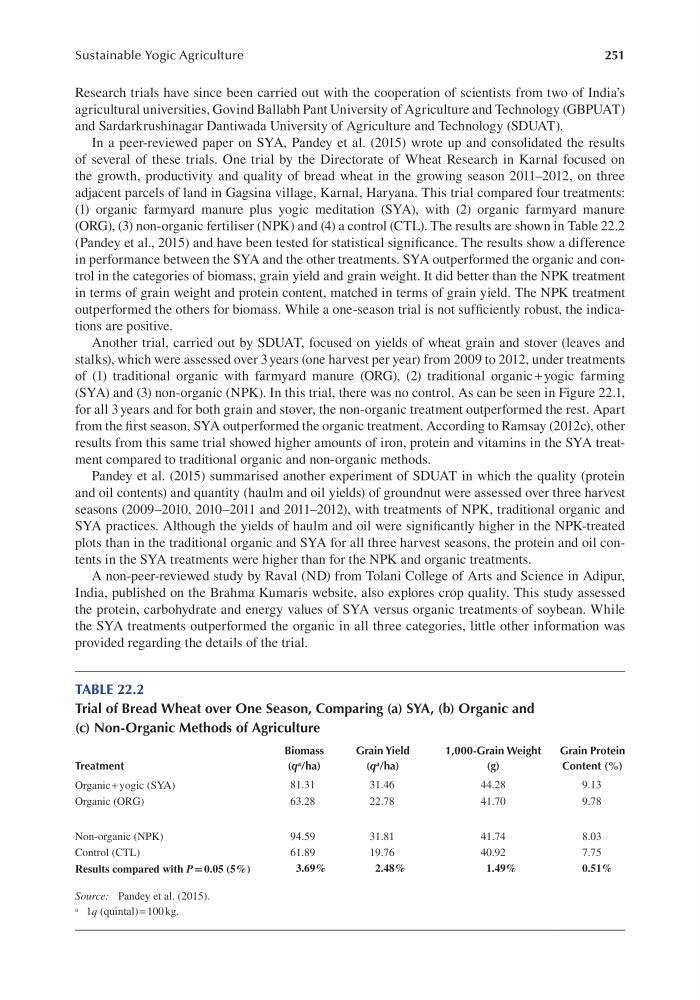
(ORG), (3) non-organic fertiliser (NPK) and (4) a control (CTL). The results are shown in Table 22.2
(Pandey et al., 2015) and have been tested for statistical signifcance. The results show a difference
in performance between the SYA and the other treatments. SYA outperformed the organic and control in the categories of biomass, grain yield and grain weight. It did better than the NPK treatment
in terms of grain weight and protein content, matched in terms of grain yield. The NPK treatment
outperformed the others for biomass. While a one-season trial is not suffciently robust, the indications are positive.
Another trial, carried out by SDUAT, focused on yields of wheat grain and stover (leaves and
stalks), which were assessed over 3 years (one harvest per year) from 2009 to 2012, under treatments
of (1) traditional organic with farmyard manure (ORG), (2) traditional organic + yogic farming
(SYA) and (3) non-organic (NPK). In this trial, there was no control. As can be seen in Figure 22.1,
for all 3 years and for both grain and stover, the non-organic treatment outperformed the rest. Apart
from the frst season, SYA outperformed the organic treatment. According to Ramsay (2012c), other
results from this same trial showed higher amounts of iron, protein and vitamins in the SYA treatment compared to traditional organic and non-organic methods.
Pandey et al. (2015) summarised another experiment of SDUAT in which the quality (protein
and oil contents) and quantity (haulm and oil yields) of groundnut were assessed over three harvest
seasons (2009–2010, 2010–2011 and 2011–2012), with treatments of NPK, traditional organic and
SYA practices. Although the yields of haulm and oil were signifcantly higher in the NPK-treated
plots than in the traditional organic and SYA for all three harvest seasons, the protein and oil contents in the SYA treatments were higher than for the NPK and organic treatments.
A non-peer-reviewed study by Raval (ND) from Tolani College of Arts and Science in Adipur,
India, published on the Brahma Kumaris website, also explores crop quality. This study assessed
the protein, carbohydrate and energy values of SYA versus organic treatments of soybean. While
the SYA treatments outperformed the organic in all three categories, little other information was
provided regarding the details of the trial.
TABLE 22.2
Trial of Bread Wheat over One Season, Comparing (a) SYA, (b) Organic and
(c) Non-Organic Methods of Agriculture
Biomass
Grain Yield
1,000-Grain Weight
Grain Protein
Treatment
(q a /ha)
(q a /ha)
(g)
Content (%)
Organic + yogic (SYA)
81.31
31.46
44.28
9.13
Organic (ORG)
63.28
22.78
41.70
9.78
Non-organic (NPK)
94.59
31.81
41.74
8.03
Control (CTL)
61.89
19.76
40.92
7.75
Results compared with P = 0.05 (5%)
3.69%
2.48%
1.49%
0.51%
Source: Pandey et al. (2015).
a 1q (quintal) = 100 kg.
Sustainable Yogic Agriculture
Research trials have since been carried out with the cooperation of scientists from two of India’s
agricultural universities, Govind Ballabh Pant University of Agriculture and Technology (GBPUAT)
and Sardarkrushinagar Dantiwada University of Agriculture and Technology (SDUAT).
In a peer-reviewed paper on SYA, Pandey et al. (2015) wrote up and consolidated the results
of several of these trials. One trial by the Directorate of Wheat Research in Karnal focused on
the growth, productivity and quality of bread wheat in the growing season 2011–2012, on three
adjacent parcels of land in Gagsina village, Karnal, Haryana. This trial compared four treatments:
(1) organic farmyard manure plus yogic meditation (SYA), with (2) organic farmyard manure
(ORG), (3) non-organic fertiliser (NPK) and (4) a control (CTL). The results are shown in Table 22.2
(Pandey et al., 2015) and have been tested for statistical signifcance. The results show a difference
in performance between the SYA and the other treatments. SYA outperformed the organic and control in the categories of biomass, grain yield and grain weight. It did better than the NPK treatment
in terms of grain weight and protein content, matched in terms of grain yield. The NPK treatment
outperformed the others for biomass. While a one-season trial is not suffciently robust, the indications are positive.
Another trial, carried out by SDUAT, focused on yields of wheat grain and stover (leaves and
stalks), which were assessed over 3 years (one harvest per year) from 2009 to 2012, under treatments
of (1) traditional organic with farmyard manure (ORG), (2) traditional organic + yogic farming
(SYA) and (3) non-organic (NPK). In this trial, there was no control. As can be seen in Figure 22.1,
for all 3 years and for both grain and stover, the non-organic treatment outperformed the rest. Apart
from the frst season, SYA outperformed the organic treatment. According to Ramsay (2012c), other
results from this same trial showed higher amounts of iron, protein and vitamins in the SYA treatment compared to traditional organic and non-organic methods.
Pandey et al. (2015) summarised another experiment of SDUAT in which the quality (protein
and oil contents) and quantity (haulm and oil yields) of groundnut were assessed over three harvest
seasons (2009–2010, 2010–2011 and 2011–2012), with treatments of NPK, traditional organic and
SYA practices. Although the yields of haulm and oil were signifcantly higher in the NPK-treated
plots than in the traditional organic and SYA for all three harvest seasons, the protein and oil contents in the SYA treatments were higher than for the NPK and organic treatments.
A non-peer-reviewed study by Raval (ND) from Tolani College of Arts and Science in Adipur,
India, published on the Brahma Kumaris website, also explores crop quality. This study assessed
the protein, carbohydrate and energy values of SYA versus organic treatments of soybean. While
the SYA treatments outperformed the organic in all three categories, little other information was
provided regarding the details of the trial.
TABLE 22.2
Trial of Bread Wheat over One Season, Comparing (a) SYA, (b) Organic and
(c) Non-Organic Methods of Agriculture
Biomass
Grain Yield
1,000-Grain Weight
Grain Protein
Treatment
(q a /ha)
(q a /ha)
(g)
Content (%)
Organic + yogic (SYA)
81.31
31.46
44.28
9.13
Organic (ORG)
63.28
22.78
41.70
9.78
Non-organic (NPK)
94.59
31.81
41.74
8.03
Control (CTL)
61.89
19.76
40.92
7.75
Results compared with P = 0.05 (5%)
3.69%
2.48%
1.49%
0.51%
Source: Pandey et al. (2015).
a 1q (quintal) = 100 kg.