

173
FES to Evaluate Food Quality
kernels, its emissions were similar to those of a vegetative in-growth state, while the emissions of
other samples were more dormant and seed-like. This indicates that the excitation spectroscopy
can detect whether growing and ripening were performed and fnished by the plant’s own characteristic physiology under natural conditions, or whether it was infuenced by fertilisers or other
physiology-infuencing factors.
On the basis of these results, it can be concluded that the biophoton emission after colour excitation can indicate whether the sample is in a more or less characteristic state,
• being more leaf-like, representing vegetative growth-processes,
• being more seed-like, representing generative, mature, dormant situations, where physiological processes are reduced, resulting in conservation and storage of growth-relevant
substances,
• or being more like a pure chemical substance, representing minerals which are not actually
integrated in life processes.
4) COCOA BEANS GROWN IN MONOCULTURES OR IN AGROFORESTRY SYSTEMS
A scientifcally controlled feld trial with cocoa plants was installed in 2009 in Bolivia (Sara Ana,
near La Paz), to compare the effects of the farming system on ecological aspects (biodiversity), soil
parameters, plant health and product quality. The experimental factors were as follows: (1) monoculture (Mono) vs. agroforestry (AF) farming and (2) conventional (Conv) vs. organic (Org) farming; additionally, a successional agroforestry system (SAFS) was investigated. FES measurements
were performed on fermented cocoa beans which were harvested in 2012.
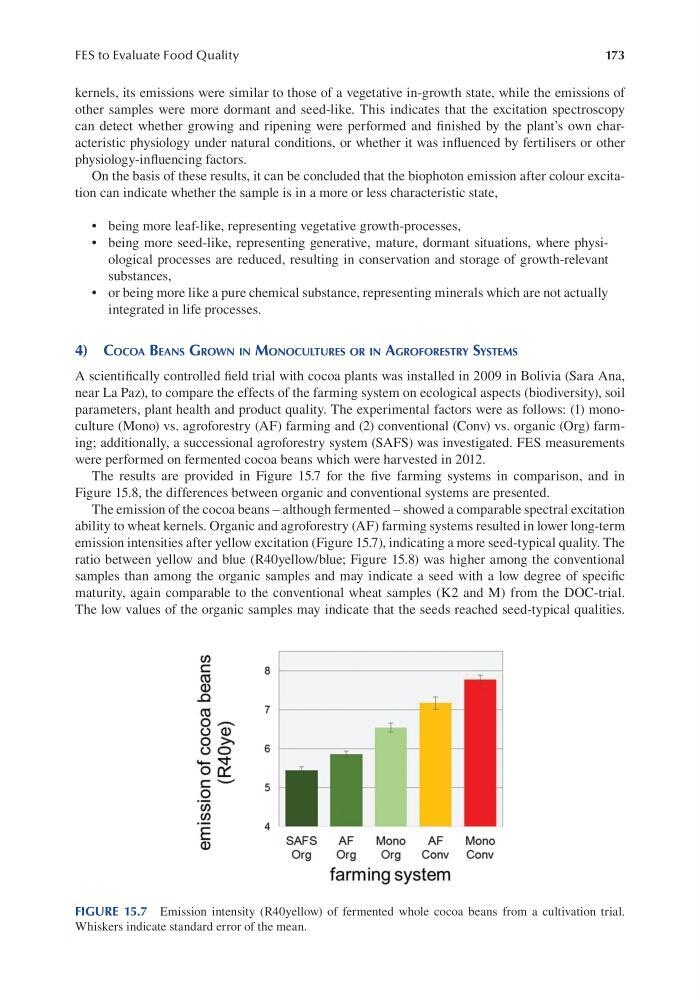
The results are provided in Figure 15.7 for the fve farming systems in comparison, and in
Figure 15.8, the differences between organic and conventional systems are presented.
The emission of the cocoa beans – although fermented – showed a comparable spectral excitation
ability to wheat kernels. Organic and agroforestry (AF) farming systems resulted in lower long-term
emission intensities after yellow excitation (Figure 15.7), indicating a more seed-typical quality. The
ratio between yellow and blue (R40yellow/blue; Figure 15.8) was higher among the conventional
samples than among the organic samples and may indicate a seed with a low degree of specifc
maturity, again comparable to the conventional wheat samples (K2 and M) from the DOC-trial.
The low values of the organic samples may indicate that the seeds reached seed-typical qualities.
FIGURE 15.7 Emission intensity (R40yellow) of fermented whole cocoa beans from a cultivation trial.
Whiskers indicate standard error of the mean.