

170
Subtle Agroecologies
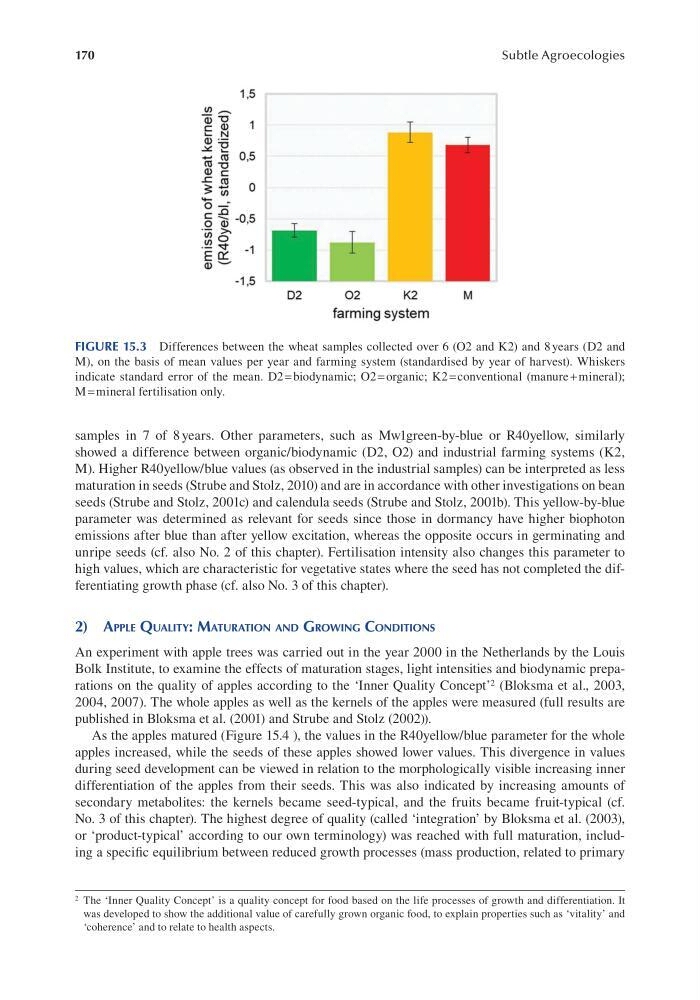
FIGURE 15.3 Differences between the wheat samples collected over 6 (O2 and K2) and 8 years (D2 and
M), on the basis of mean values per year and farming system (standardised by year of harvest). Whiskers
indicate standard error of the mean. D2 = biodynamic; O2 = organic; K2 = conventional (manure + mineral);
M = mineral fertilisation only.
samples in 7 of 8 years. Other parameters, such as Mw1green-by-blue or R40yellow, similarly
showed a difference between organic/biodynamic (D2, O2) and industrial farming systems (K2,
M). Higher R40yellow/blue values (as observed in the industrial samples) can be interpreted as less
maturation in seeds (Strube and Stolz, 2010) and are in accordance with other investigations on bean
seeds (Strube and Stolz, 2001c) and calendula seeds (Strube and Stolz, 2001b). This yellow-by-blue
parameter was determined as relevant for seeds since those in dormancy have higher biophoton
emissions after blue than after yellow excitation, whereas the opposite occurs in germinating and
unripe seeds (cf. also No. 2 of this chapter). Fertilisation intensity also changes this parameter to
high values, which are characteristic for vegetative states where the seed has not completed the differentiating growth phase (cf. also No. 3 of this chapter).
2) APPLE QUALITY: MATURATION AND GROWING CONDITIONS
An experiment with apple trees was carried out in the year 2000 in the Netherlands by the Louis
Bolk Institute, to examine the effects of maturation stages, light intensities and biodynamic preparations on the quality of apples according to the ‘Inner Quality Concept’ 2 (Bloksma et al., 2003,
2004, 2007). The whole apples as well as the kernels of the apples were measured (full results are
published in Bloksma et al. (2001) and Strube and Stolz (2002)).
As the apples matured (Figure 15.4 ), the values in the R40yellow/blue parameter for the whole
apples increased, while the seeds of these apples showed lower values. This divergence in values
during seed development can be viewed in relation to the morphologically visible increasing inner
differentiation of the apples from their seeds. This was also indicated by increasing amounts of
secondary metabolites: the kernels became seed-typical, and the fruits became fruit-typical (cf.
No. 3 of this chapter). The highest degree of quality (called ‘integration’ by Bloksma et al. (2003),
or ‘product-typical’ according to our own terminology) was reached with full maturation, including a specifc equilibrium between reduced growth processes (mass production, related to primary
2 The ‘Inner Quality Concept’ is a quality concept for food based on the life processes of growth and differentiation. It
was developed to show the additional value of carefully grown organic food, to explain properties such as ‘vitality’ and
‘coherence’ and to relate to health aspects.