

159
Low-Power Laser Biotechnology Pretreatment
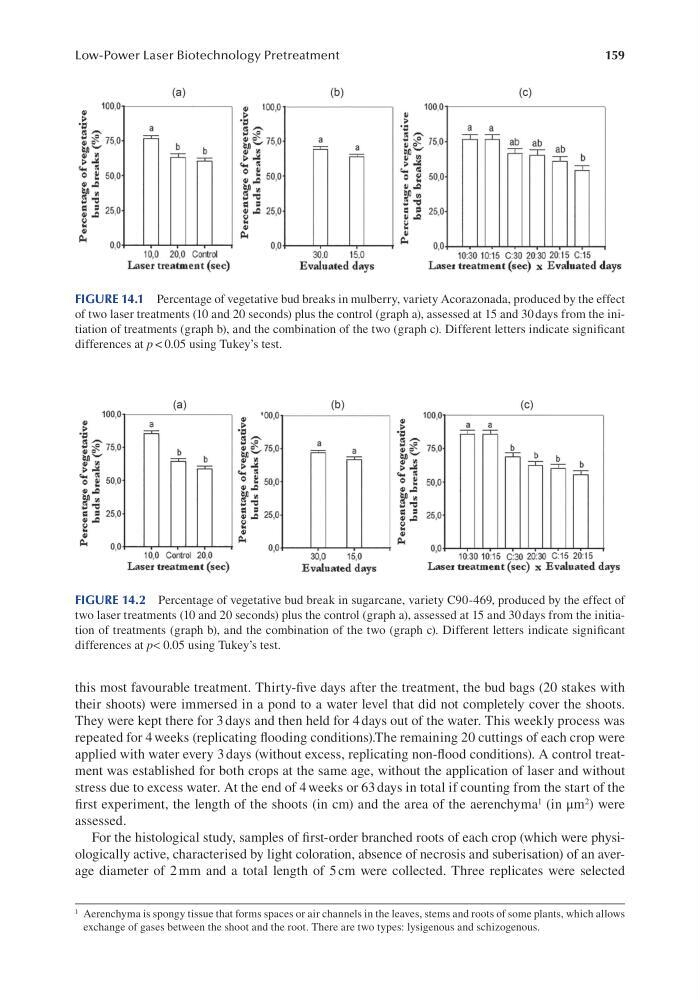
FIGURE 14.1 Percentage of vegetative bud breaks in mulberry, variety Acorazonada, produced by the effect
of two laser treatments (10 and 20 seconds) plus the control (graph a), assessed at 15 and 30 days from the initiation of treatments (graph b), and the combination of the two (graph c). Different letters indicate signifcant
differences at p < 0.05 using Tukey’s test.
FIGURE 14.2 Percentage of vegetative bud break in sugarcane, variety C90-469, produced by the effect of
two laser treatments (10 and 20 seconds) plus the control (graph a), assessed at 15 and 30 days from the initiation of treatments (graph b), and the combination of the two (graph c). Different letters indicate signifcant
differences at p< 0.05 using Tukey’s test.
this most favourable treatment. Thirty-fve days after the treatment, the bud bags (20 stakes with
their shoots) were immersed in a pond to a water level that did not completely cover the shoots.
They were kept there for 3 days and then held for 4 days out of the water. This weekly process was
repeated for 4 weeks (replicating fooding conditions).The remaining 20 cuttings of each crop were
applied with water every 3 days (without excess, replicating non-food conditions). A control treatment was established for both crops at the same age, without the application of laser and without
stress due to excess water. At the end of 4 weeks or 63 days in total if counting from the start of the
frst experiment, the length of the shoots (in cm) and the area of the aerenchyma 1 (in μm 2 ) were
assessed.
For the histological study, samples of frst-order branched roots of each crop (which were physiologically active, characterised by light coloration, absence of necrosis and suberisation) of an average diameter of 2 mm and a total length of 5 cm were collected. Three replicates were selected
1 Aerenchyma is spongy tissue that forms spaces or air channels in the leaves, stems and roots of some plants, which allows
exchange of gases between the shoot and the root. There are two types: lysigenous and schizogenous.