

150
Subtle Agroecologies
own diagnoses and prepare remedies using local materials, whilst others use preformulated remedies
but focus on advising and training the farmers to be actively engaged in the healing process and to
understand the medicines as part of this process. For example, the University of Viçosa, Minas Gerais
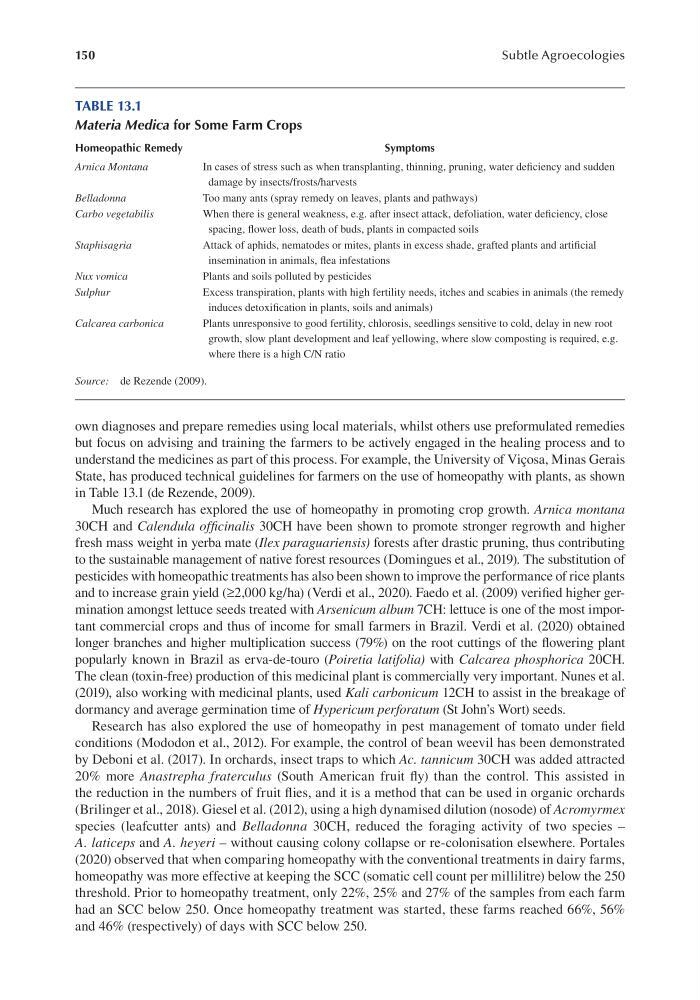
State, has produced technical guidelines for farmers on the use of homeopathy with plants, as shown
in Table 13.1 ( de Rezende, 2009).
Much research has explored the use of homeopathy in promoting crop growth. Arnica montana
30CH and Calendula officinalis 30CH have been shown to promote stronger regrowth and higher
fresh mass weight in yerba mate ( Ilex paraguariensis) forests after drastic pruning, thus contributing
to the sustainable management of native forest resources ( Domingues et al., 2019). The substitution of
pesticides with homeopathic treatments has also been shown to improve the performance of rice plants
and to increase grain yield (≥2,000 kg/ ha) ( Verdi et al., 2020). Faedo et al. ( 2009) verified higher germination amongst lettuce seeds treated with Arsenicum album 7CH: lettuce is one of the most important commercial crops and thus of income for small farmers in Brazil. Verdi et al. ( 2020) obtained
longer branches and higher multiplication success ( 79%) on the root cuttings of the flowering plant
popularly known in Brazil as erva- de-touro ( Poiretia latifolia) with Calcarea phosphorica 20CH.
The clean ( toxin-free) production of this medicinal plant is commercially very important. Nunes et al.
( 2019), also working with medicinal plants, used Kali carbonicum 12CH to assist in the breakage of
dormancy and average germination time of Hypericum perforatum ( St John’s Wort) seeds.
Research has also explored the use of homeopathy in pest management of tomato under field
conditions (Mododon et al., 2012). For example, the control of bean weevil has been demonstrated
by Deboni et al. ( 2017). In orchards, insect traps to which Ac. tannicum 30CH was added attracted
20% more Anastrepha fraterculus ( South American fruit fly) than the control. This assisted in
the reduction in the numbers of fruit flies, and it is a method that can be used in organic orchards
( Brilinger et al., 2018). Giesel et al. ( 2012), using a high dynamised dilution ( nosode) of Acromyrmex
species ( leafcutter ants) and Belladonna 30CH, reduced the foraging activity of two species –
A. laticeps and A. heyeri – without causing colony collapse or re-colonisation elsewhere. Portales
( 2020) observed that when comparing homeopathy with the conventional treatments in dairy farms,
homeopathy was more effective at keeping the SCC ( somatic cell count per millilitre) below the 250
threshold. Prior to homeopathy treatment, only 22%, 25% and 27% of the samples from each farm
had an SCC below 250. Once homeopathy treatment was started, these farms reached 66%, 56%
and 46% ( respectively) of days with SCC below 250.
TABLE 13.1
Materia Medica for Some Farm Crops
Homeopathic Remedy
Symptoms
Arnica Montana
In cases of stress such as when transplanting, thinning, pruning, water deficiency and sudden
damage by insects/ frosts/ harvests
Belladonna
Too many ants ( spray remedy on leaves, plants and pathways)
Carbo vegetabilis
When there is general weakness, e.g. after insect attack, defoliation, water deficiency, close
spacing, flower loss, death of buds, plants in compacted soils
Staphisagria
Attack of aphids, nematodes or mites, plants in excess shade, grafted plants and artificial
insemination in animals, flea infestations
Nux vomica
Plants and soils polluted by pesticides
Sulphur
Excess transpiration, plants with high fertility needs, itches and scabies in animals ( the remedy
induces detoxification in plants, soils and animals)
Calcarea carbonica
Plants unresponsive to good fertility, chlorosis, seedlings sensitive to cold, delay in new root
growth, slow plant development and leaf yellowing, where slow composting is required, e.g.
where there is a high C/ N ratio
Source: de Rezende ( 2009).
Subtle Agroecologies
own diagnoses and prepare remedies using local materials, whilst others use preformulated remedies
but focus on advising and training the farmers to be actively engaged in the healing process and to
understand the medicines as part of this process. For example, the University of Viçosa, Minas Gerais
State, has produced technical guidelines for farmers on the use of homeopathy with plants, as shown
in Table 13.1 ( de Rezende, 2009).
Much research has explored the use of homeopathy in promoting crop growth. Arnica montana
30CH and Calendula officinalis 30CH have been shown to promote stronger regrowth and higher
fresh mass weight in yerba mate ( Ilex paraguariensis) forests after drastic pruning, thus contributing
to the sustainable management of native forest resources ( Domingues et al., 2019). The substitution of
pesticides with homeopathic treatments has also been shown to improve the performance of rice plants
and to increase grain yield (≥2,000 kg/ ha) ( Verdi et al., 2020). Faedo et al. ( 2009) verified higher germination amongst lettuce seeds treated with Arsenicum album 7CH: lettuce is one of the most important commercial crops and thus of income for small farmers in Brazil. Verdi et al. ( 2020) obtained
longer branches and higher multiplication success ( 79%) on the root cuttings of the flowering plant
popularly known in Brazil as erva- de-touro ( Poiretia latifolia) with Calcarea phosphorica 20CH.
The clean ( toxin-free) production of this medicinal plant is commercially very important. Nunes et al.
( 2019), also working with medicinal plants, used Kali carbonicum 12CH to assist in the breakage of
dormancy and average germination time of Hypericum perforatum ( St John’s Wort) seeds.
Research has also explored the use of homeopathy in pest management of tomato under field
conditions (Mododon et al., 2012). For example, the control of bean weevil has been demonstrated
by Deboni et al. ( 2017). In orchards, insect traps to which Ac. tannicum 30CH was added attracted
20% more Anastrepha fraterculus ( South American fruit fly) than the control. This assisted in
the reduction in the numbers of fruit flies, and it is a method that can be used in organic orchards
( Brilinger et al., 2018). Giesel et al. ( 2012), using a high dynamised dilution ( nosode) of Acromyrmex
species ( leafcutter ants) and Belladonna 30CH, reduced the foraging activity of two species –
A. laticeps and A. heyeri – without causing colony collapse or re-colonisation elsewhere. Portales
( 2020) observed that when comparing homeopathy with the conventional treatments in dairy farms,
homeopathy was more effective at keeping the SCC ( somatic cell count per millilitre) below the 250
threshold. Prior to homeopathy treatment, only 22%, 25% and 27% of the samples from each farm
had an SCC below 250. Once homeopathy treatment was started, these farms reached 66%, 56%
and 46% ( respectively) of days with SCC below 250.
TABLE 13.1
Materia Medica for Some Farm Crops
Homeopathic Remedy
Symptoms
Arnica Montana
In cases of stress such as when transplanting, thinning, pruning, water deficiency and sudden
damage by insects/ frosts/ harvests
Belladonna
Too many ants ( spray remedy on leaves, plants and pathways)
Carbo vegetabilis
When there is general weakness, e.g. after insect attack, defoliation, water deficiency, close
spacing, flower loss, death of buds, plants in compacted soils
Staphisagria
Attack of aphids, nematodes or mites, plants in excess shade, grafted plants and artificial
insemination in animals, flea infestations
Nux vomica
Plants and soils polluted by pesticides
Sulphur
Excess transpiration, plants with high fertility needs, itches and scabies in animals ( the remedy
induces detoxification in plants, soils and animals)
Calcarea carbonica
Plants unresponsive to good fertility, chlorosis, seedlings sensitive to cold, delay in new root
growth, slow plant development and leaf yellowing, where slow composting is required, e.g.
where there is a high C/ N ratio
Source: de Rezende ( 2009).