

103
EMFs and Environmental Stresses in Plants
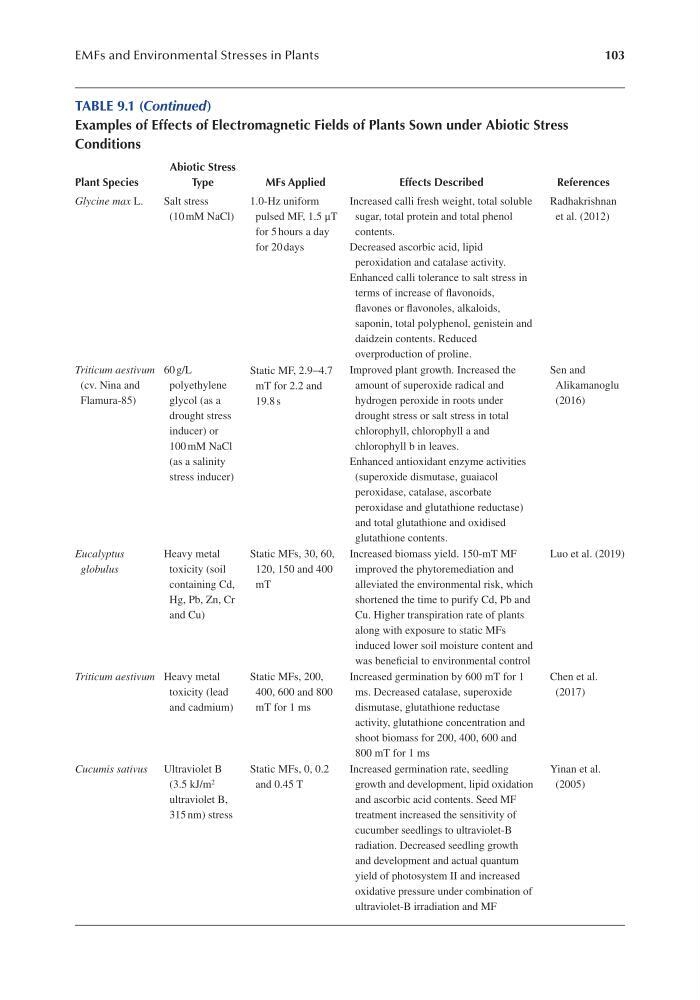
TABLE 9.1 (Continued)
Examples of Effects of Electromagnetic Fields of Plants Sown under Abiotic Stress
Conditions
Plant Species
Glycine max L.
Abiotic Stress
Type
Salt stress
(10 mM NaCl)
MFs Applied
1.0-Hz uniform
pulsed MF, 1.5 μT
for 5 hours a day
for 20 days
Triticum aestivum
(cv. Nina and
Flamura-85)
60 g/L
polyethylene
glycol (as a
drought stress
inducer) or
100 mM NaCl
(as a salinity
stress inducer)
Static MF, 2.9−4.7
mT for 2.2 and
19.8 s
Eucalyptus
globulus
Heavy metal
toxicity (soil
containing Cd,
Hg, Pb, Zn, Cr
and Cu)
Static MFs, 30, 60,
120, 150 and 400
mT
Triticum aestivum Heavy metal
toxicity (lead
and cadmium)
Static MFs, 200,
400, 600 and 800
mT for 1 ms
Cucumis sativus Ultraviolet B
(3.5 kJ/m 2
ultraviolet B,
315 nm) stress
Static MFs, 0, 0.2
and 0.45 T
Effects Described
References
Increased calli fresh weight, total soluble
Radhakrishnan
sugar, total protein and total phenol
et al. (2012)
contents.
Decreased ascorbic acid, lipid
peroxidation and catalase activity.
Enhanced calli tolerance to salt stress in
terms of increase of favonoids,
favones or favonoles, alkaloids,
saponin, total polyphenol, genistein and
daidzein contents. Reduced
overproduction of proline.
Improved plant growth. Increased the
Sen and
amount of superoxide radical and
Alikamanoglu
hydrogen peroxide in roots under
(2016)
drought stress or salt stress in total
chlorophyll, chlorophyll a and
chlorophyll b in leaves.
Enhanced antioxidant enzyme activities
(superoxide dismutase, guaiacol
peroxidase, catalase, ascorbate
peroxidase and glutathione reductase)
and total glutathione and oxidised
glutathione contents.
Increased biomass yield. 150-mT MF
Luo et al. (2019)
improved the phytoremediation and
alleviated the environmental risk, which
shortened the time to purify Cd, Pb and
Cu. Higher transpiration rate of plants
along with exposure to static MFs
induced lower soil moisture content and
was benefcial to environmental control
Increased germination by 600 mT for 1
Chen et al.
ms. Decreased catalase, superoxide
(2017)
dismutase, glutathione reductase
activity, glutathione concentration and
shoot biomass for 200, 400, 600 and
800 mT for 1 ms
Increased germination rate, seedling
Yinan et al.
growth and development, lipid oxidation
(2005)
and ascorbic acid contents. Seed MF
treatment increased the sensitivity of
cucumber seedlings to ultraviolet-B
radiation. Decreased seedling growth
and development and actual quantum
yield of photosystem II and increased
oxidative pressure under combination of
ultraviolet-B irradiation and MF
EMFs and Environmental Stresses in Plants
TABLE 9.1 (Continued)
Examples of Effects of Electromagnetic Fields of Plants Sown under Abiotic Stress
Conditions
Plant Species
Glycine max L.
Abiotic Stress
Type
Salt stress
(10 mM NaCl)
MFs Applied
1.0-Hz uniform
pulsed MF, 1.5 μT
for 5 hours a day
for 20 days
Triticum aestivum
(cv. Nina and
Flamura-85)
60 g/L
polyethylene
glycol (as a
drought stress
inducer) or
100 mM NaCl
(as a salinity
stress inducer)
Static MF, 2.9−4.7
mT for 2.2 and
19.8 s
Eucalyptus
globulus
Heavy metal
toxicity (soil
containing Cd,
Hg, Pb, Zn, Cr
and Cu)
Static MFs, 30, 60,
120, 150 and 400
mT
Triticum aestivum Heavy metal
toxicity (lead
and cadmium)
Static MFs, 200,
400, 600 and 800
mT for 1 ms
Cucumis sativus Ultraviolet B
(3.5 kJ/m 2
ultraviolet B,
315 nm) stress
Static MFs, 0, 0.2
and 0.45 T
Effects Described
References
Increased calli fresh weight, total soluble
Radhakrishnan
sugar, total protein and total phenol
et al. (2012)
contents.
Decreased ascorbic acid, lipid
peroxidation and catalase activity.
Enhanced calli tolerance to salt stress in
terms of increase of favonoids,
favones or favonoles, alkaloids,
saponin, total polyphenol, genistein and
daidzein contents. Reduced
overproduction of proline.
Improved plant growth. Increased the
Sen and
amount of superoxide radical and
Alikamanoglu
hydrogen peroxide in roots under
(2016)
drought stress or salt stress in total
chlorophyll, chlorophyll a and
chlorophyll b in leaves.
Enhanced antioxidant enzyme activities
(superoxide dismutase, guaiacol
peroxidase, catalase, ascorbate
peroxidase and glutathione reductase)
and total glutathione and oxidised
glutathione contents.
Increased biomass yield. 150-mT MF
Luo et al. (2019)
improved the phytoremediation and
alleviated the environmental risk, which
shortened the time to purify Cd, Pb and
Cu. Higher transpiration rate of plants
along with exposure to static MFs
induced lower soil moisture content and
was benefcial to environmental control
Increased germination by 600 mT for 1
Chen et al.
ms. Decreased catalase, superoxide
(2017)
dismutase, glutathione reductase
activity, glutathione concentration and
shoot biomass for 200, 400, 600 and
800 mT for 1 ms
Increased germination rate, seedling
Yinan et al.
growth and development, lipid oxidation
(2005)
and ascorbic acid contents. Seed MF
treatment increased the sensitivity of
cucumber seedlings to ultraviolet-B
radiation. Decreased seedling growth
and development and actual quantum
yield of photosystem II and increased
oxidative pressure under combination of
ultraviolet-B irradiation and MF