

102
Subtle Agroecologies
It is predicted that, with climate change and especially global warming, environmental stresses
will become more intense and frequent in the future. Therefore, maintaining crop yields under
adverse environmental stresses is one of the major challenges facing modern agriculture, and plants
might react to environmental stress on several levels: on the biochemical, cellular or morphological
scale, and at species or population level. However, different studies suggest that static and alternating MFs and PEMFs prevent the huge injuries of abiotic and biotic stresses on agricultural crops
and other economically important plants and play a role in triggering plant defence responses and
antioxidant defence systems by reducing the oxidative damage in plants caused by stress situations
(Anand et al., 2012; Baby et al., 2011; Baghel et al., 2018; Chen et al., 2017; Javed et al., 2011; Karimi
et al., 2017; Ruzic and Jerman, 2002; Radhakrishnan et al., 2012; Sen and Alikamanoglu, 2016;
Trebbi et al., 2007; Shine and Guruprasad, 2012; Shine et al., 2012).
EFFECTS OF MFS ON ABIOTIC STRESS
Abiotic stress exerts a negative impact on the growth rate and reproduction of a plant (Gull et al.,
2019). Drought, salinity, heavy metal toxicity, ultraviolet light and low and high temperatures are
examples of abiotic stress factors. It has been claimed that abiotic stress causes the most crop loss
of any other factor, causing most major crops to have over 50% lower yields than their potential
(Fahad et al., 2017).
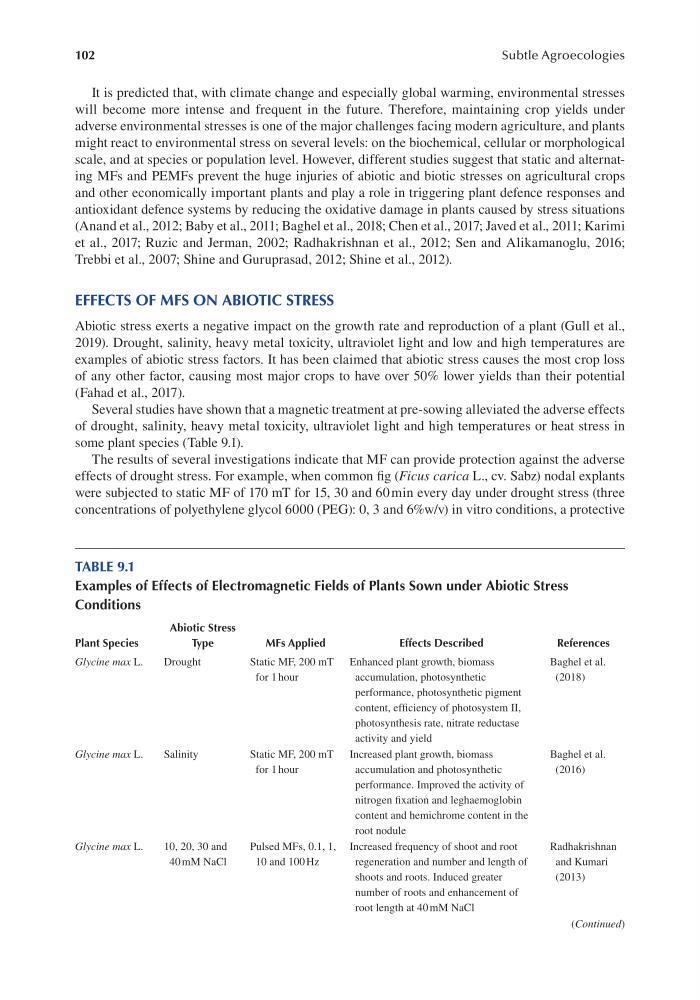
Several studies have shown that a magnetic treatment at pre-sowing alleviated the adverse effects
of drought, salinity, heavy metal toxicity, ultraviolet light and high temperatures or heat stress in
some plant species (Table 9.1).
The results of several investigations indicate that MF can provide protection against the adverse
effects of drought stress. For example, when common fg (Ficus carica L., cv. Sabz) nodal explants
were subjected to static MF of 170 mT for 15, 30 and 60 min every day under drought stress (three
concentrations of polyethylene glycol 6000 (PEG): 0, 3 and 6%w/v) in vitro conditions, a protective
TABLE 9.1
Examples of Effects of Electromagnetic Fields of Plants Sown under Abiotic Stress
Conditions
Abiotic Stress
Plant Species
Type
MFs Applied
Effects Described
References
Glycine max L.
Drought
Static MF, 200 mT Enhanced plant growth, biomass
Baghel et al.
for 1 hour
accumulation, photosynthetic
(2018)
performance, photosynthetic pigment
content, effciency of photosystem II,
photosynthesis rate, nitrate reductase
activity and yield
Glycine max L.
Salinity
Static MF, 200 mT Increased plant growth, biomass
Baghel et al.
for 1 hour
accumulation and photosynthetic
(2016)
performance. Improved the activity of
nitrogen fxation and leghaemoglobin
content and hemichrome content in the
root nodule
Glycine max L.
10, 20, 30 and
Pulsed MFs, 0.1, 1, Increased frequency of shoot and root
Radhakrishnan
40 mM NaCl
10 and 100 Hz
regeneration and number and length of
and Kumari
shoots and roots. Induced greater
(2013)
number of roots and enhancement of
root length at 40 mM NaCl
(Continued)
Subtle Agroecologies
It is predicted that, with climate change and especially global warming, environmental stresses
will become more intense and frequent in the future. Therefore, maintaining crop yields under
adverse environmental stresses is one of the major challenges facing modern agriculture, and plants
might react to environmental stress on several levels: on the biochemical, cellular or morphological
scale, and at species or population level. However, different studies suggest that static and alternating MFs and PEMFs prevent the huge injuries of abiotic and biotic stresses on agricultural crops
and other economically important plants and play a role in triggering plant defence responses and
antioxidant defence systems by reducing the oxidative damage in plants caused by stress situations
(Anand et al., 2012; Baby et al., 2011; Baghel et al., 2018; Chen et al., 2017; Javed et al., 2011; Karimi
et al., 2017; Ruzic and Jerman, 2002; Radhakrishnan et al., 2012; Sen and Alikamanoglu, 2016;
Trebbi et al., 2007; Shine and Guruprasad, 2012; Shine et al., 2012).
EFFECTS OF MFS ON ABIOTIC STRESS
Abiotic stress exerts a negative impact on the growth rate and reproduction of a plant (Gull et al.,
2019). Drought, salinity, heavy metal toxicity, ultraviolet light and low and high temperatures are
examples of abiotic stress factors. It has been claimed that abiotic stress causes the most crop loss
of any other factor, causing most major crops to have over 50% lower yields than their potential
(Fahad et al., 2017).
Several studies have shown that a magnetic treatment at pre-sowing alleviated the adverse effects
of drought, salinity, heavy metal toxicity, ultraviolet light and high temperatures or heat stress in
some plant species (Table 9.1).
The results of several investigations indicate that MF can provide protection against the adverse
effects of drought stress. For example, when common fg (Ficus carica L., cv. Sabz) nodal explants
were subjected to static MF of 170 mT for 15, 30 and 60 min every day under drought stress (three
concentrations of polyethylene glycol 6000 (PEG): 0, 3 and 6%w/v) in vitro conditions, a protective
TABLE 9.1
Examples of Effects of Electromagnetic Fields of Plants Sown under Abiotic Stress
Conditions
Abiotic Stress
Plant Species
Type
MFs Applied
Effects Described
References
Glycine max L.
Drought
Static MF, 200 mT Enhanced plant growth, biomass
Baghel et al.
for 1 hour
accumulation, photosynthetic
(2018)
performance, photosynthetic pigment
content, effciency of photosystem II,
photosynthesis rate, nitrate reductase
activity and yield
Glycine max L.
Salinity
Static MF, 200 mT Increased plant growth, biomass
Baghel et al.
for 1 hour
accumulation and photosynthetic
(2016)
performance. Improved the activity of
nitrogen fxation and leghaemoglobin
content and hemichrome content in the
root nodule
Glycine max L.
10, 20, 30 and
Pulsed MFs, 0.1, 1, Increased frequency of shoot and root
Radhakrishnan
40 mM NaCl
10 and 100 Hz
regeneration and number and length of
and Kumari
shoots and roots. Induced greater
(2013)
number of roots and enhancement of
root length at 40 mM NaCl
(Continued)