

296
C. Pandey et al.
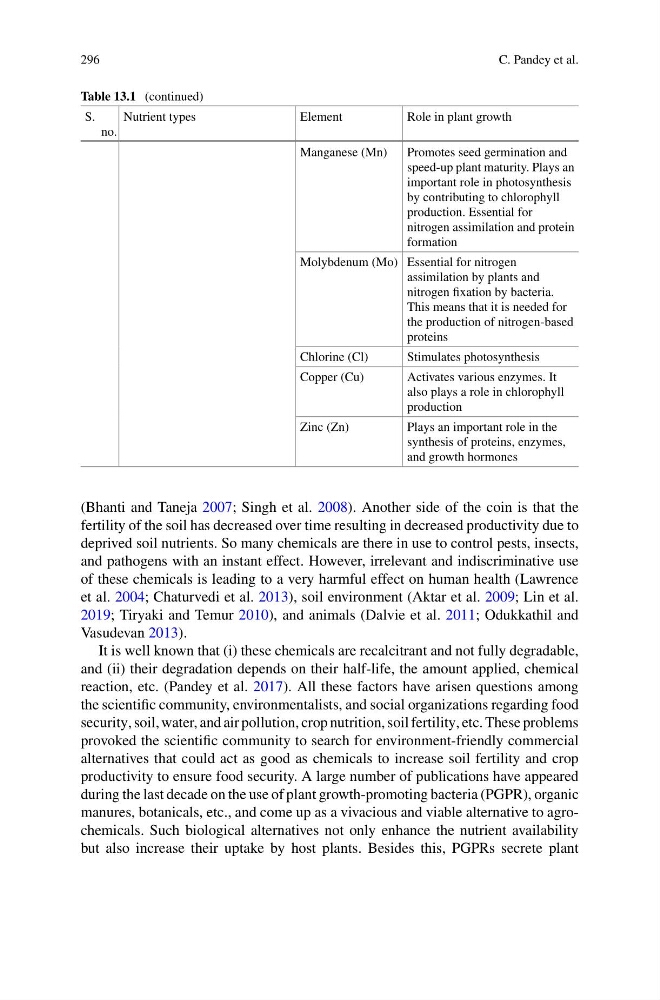
Table 13.1 (continued)
S.
no.
Nutrient types
Element
Role in plant growth
Manganese (Mn)
Promotes seed germination and
speed-up plant maturity. Plays an
important role in photosynthesis
by contributing to chlorophyll
production. Essential for
nitrogen assimilation and protein
formation
Molybdenum (Mo) Essential for nitrogen
assimilation by plants and
nitrogen fixation by bacteria.
This means that it is needed for
the production of nitrogen-based
proteins
Chlorine (Cl)
Stimulates photosynthesis
Copper (Cu)
Activates various enzymes. It
also plays a role in chlorophyll
production
Zinc (Zn)
Plays an important role in the
synthesis of proteins, enzymes,
and growth hormones
(Bhanti and Taneja 2007; Singh et al. 2008). Another side of the coin is that the
fertility of the soil has decreased over time resulting in decreased productivity due to
deprived soil nutrients. So many chemicals are there in use to control pests, insects,
and pathogens with an instant effect. However, irrelevant and indiscriminative use
of these chemicals is leading to a very harmful effect on human health (Lawrence
et al. 2004; Chaturvedi et al. 2013), soil environment (Aktar et al. 2009; Lin et al.
2019; Tiryaki and Temur 2010), and animals (Dalvie et al. 2011; Odukkathil and
Vasudevan 2013).
It is well known that (i) these chemicals are recalcitrant and not fully degradable,
and (ii) their degradation depends on their half-life, the amount applied, chemical
reaction, etc. (Pandey et al. 2017). All these factors have arisen questions among
the scientific community, environmentalists, and social organizations regarding food
security, soil, water, and air pollution, crop nutrition, soil fertility, etc. These problems
provoked the scientific community to search for environment-friendly commercial
alternatives that could act as good as chemicals to increase soil fertility and crop
productivity to ensure food security. A large number of publications have appeared
during the last decade on the use of plant growth-promoting bacteria (PGPR), organic
manures, botanicals, etc., and come up as a vivacious and viable alternative to agrochemicals. Such biological alternatives not only enhance the nutrient availability
but also increase their uptake by host plants. Besides this, PGPRs secrete plant
C. Pandey et al.
Table 13.1 (continued)
S.
no.
Nutrient types
Element
Role in plant growth
Manganese (Mn)
Promotes seed germination and
speed-up plant maturity. Plays an
important role in photosynthesis
by contributing to chlorophyll
production. Essential for
nitrogen assimilation and protein
formation
Molybdenum (Mo) Essential for nitrogen
assimilation by plants and
nitrogen fixation by bacteria.
This means that it is needed for
the production of nitrogen-based
proteins
Chlorine (Cl)
Stimulates photosynthesis
Copper (Cu)
Activates various enzymes. It
also plays a role in chlorophyll
production
Zinc (Zn)
Plays an important role in the
synthesis of proteins, enzymes,
and growth hormones
(Bhanti and Taneja 2007; Singh et al. 2008). Another side of the coin is that the
fertility of the soil has decreased over time resulting in decreased productivity due to
deprived soil nutrients. So many chemicals are there in use to control pests, insects,
and pathogens with an instant effect. However, irrelevant and indiscriminative use
of these chemicals is leading to a very harmful effect on human health (Lawrence
et al. 2004; Chaturvedi et al. 2013), soil environment (Aktar et al. 2009; Lin et al.
2019; Tiryaki and Temur 2010), and animals (Dalvie et al. 2011; Odukkathil and
Vasudevan 2013).
It is well known that (i) these chemicals are recalcitrant and not fully degradable,
and (ii) their degradation depends on their half-life, the amount applied, chemical
reaction, etc. (Pandey et al. 2017). All these factors have arisen questions among
the scientific community, environmentalists, and social organizations regarding food
security, soil, water, and air pollution, crop nutrition, soil fertility, etc. These problems
provoked the scientific community to search for environment-friendly commercial
alternatives that could act as good as chemicals to increase soil fertility and crop
productivity to ensure food security. A large number of publications have appeared
during the last decade on the use of plant growth-promoting bacteria (PGPR), organic
manures, botanicals, etc., and come up as a vivacious and viable alternative to agrochemicals. Such biological alternatives not only enhance the nutrient availability
but also increase their uptake by host plants. Besides this, PGPRs secrete plant