

9 Phosphate Solubilization by Endophytes from the Tropical Plants
213
hormones and other growth factors. Additionally, bio-priming and seed coating
appeared as an efficient method in growth-promotion because endophytes as organisms can be adhered onto the seed surface (Rosenblueth and Martínez-Romero 2006;
Ryan et al. 2008). The endophytic microbiota plays a role not only in supplying
plants with the basic nutrients that are indispensable for their growth but also in
the mechanisms of adaptation to various environmental stresses, important in terms
of crop yields (Ku´ zniar et al. 2019). The rational method of plant growth promotion by endophytes is the improvement of plant nutrient acquisition. However, the
mechanisms for direct nutrient transfer from endophytic bacteria to plants have been
elusive (Pandey et al. 2018; Roley et al. 2018). In some cases, endophytes have been
shown to increase the solubilization of bound phosphates in the rhizosphere and thus
have been hypothesized to function by increasing the plant phosphate supply in the
rhizosphere for its uptake by plants(Shehata et al. 2017).
In a recent publication, White et al. (2018) proposed that many host plants acquire
some nutrients directly from symbiotic microbes by a process called the ‘rhizophagy
cycle’. In this cycle, symbiotic microbes alternate between an endophytic phase
and a free-living soil phase. The authors hypothesize that microbes acquire soil
nutrients in the free-living soil phase and that those nutrients are extracted from
microbes oxidatively in the intracellular/endophytic phase. In this review, White
et al. (2018) discuss the proposed mechanisms that plants employ to manipulate
symbiotic microbes to transport nutrients from the soil into root cell periplasmic
spaces.
Oliveira et al (2013) investigated endophytic diversity in Coffea arabica L. cherries from southeastern Brazil by using culture-independent approaches to identify the
associated microorganisms with the goal of better understanding their ecology and
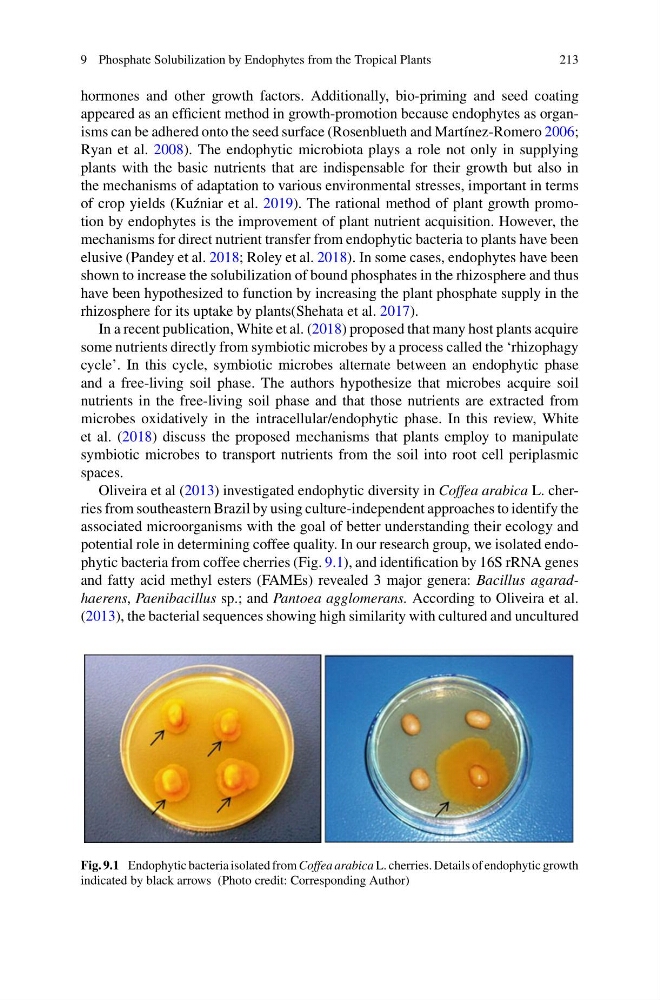
potential role in determining coffee quality. In our research group, we isolated endophytic bacteria from coffee cherries (Fig. 9.1), and identification by 16S rRNA genes
and fatty acid methyl esters (FAMEs) revealed 3 major genera: Bacillus agaradhaerens, Paenibacillus sp.; and Pantoea agglomerans. According to Oliveira et al.
(2013), the bacterial sequences showing high similarity with cultured and uncultured
Fig. 9.1 Endophytic bacteria isolated from Coffea arabica L. cherries. Details of endophytic growth
indicated by black arrows (Photo credit: Corresponding Author)
213
hormones and other growth factors. Additionally, bio-priming and seed coating
appeared as an efficient method in growth-promotion because endophytes as organisms can be adhered onto the seed surface (Rosenblueth and Martínez-Romero 2006;
Ryan et al. 2008). The endophytic microbiota plays a role not only in supplying
plants with the basic nutrients that are indispensable for their growth but also in
the mechanisms of adaptation to various environmental stresses, important in terms
of crop yields (Ku´ zniar et al. 2019). The rational method of plant growth promotion by endophytes is the improvement of plant nutrient acquisition. However, the
mechanisms for direct nutrient transfer from endophytic bacteria to plants have been
elusive (Pandey et al. 2018; Roley et al. 2018). In some cases, endophytes have been
shown to increase the solubilization of bound phosphates in the rhizosphere and thus
have been hypothesized to function by increasing the plant phosphate supply in the
rhizosphere for its uptake by plants(Shehata et al. 2017).
In a recent publication, White et al. (2018) proposed that many host plants acquire
some nutrients directly from symbiotic microbes by a process called the ‘rhizophagy
cycle’. In this cycle, symbiotic microbes alternate between an endophytic phase
and a free-living soil phase. The authors hypothesize that microbes acquire soil
nutrients in the free-living soil phase and that those nutrients are extracted from
microbes oxidatively in the intracellular/endophytic phase. In this review, White
et al. (2018) discuss the proposed mechanisms that plants employ to manipulate
symbiotic microbes to transport nutrients from the soil into root cell periplasmic
spaces.
Oliveira et al (2013) investigated endophytic diversity in Coffea arabica L. cherries from southeastern Brazil by using culture-independent approaches to identify the
associated microorganisms with the goal of better understanding their ecology and
potential role in determining coffee quality. In our research group, we isolated endophytic bacteria from coffee cherries (Fig. 9.1), and identification by 16S rRNA genes
and fatty acid methyl esters (FAMEs) revealed 3 major genera: Bacillus agaradhaerens, Paenibacillus sp.; and Pantoea agglomerans. According to Oliveira et al.
(2013), the bacterial sequences showing high similarity with cultured and uncultured
Fig. 9.1 Endophytic bacteria isolated from Coffea arabica L. cherries. Details of endophytic growth
indicated by black arrows (Photo credit: Corresponding Author)