

114
C. Dileep et al.
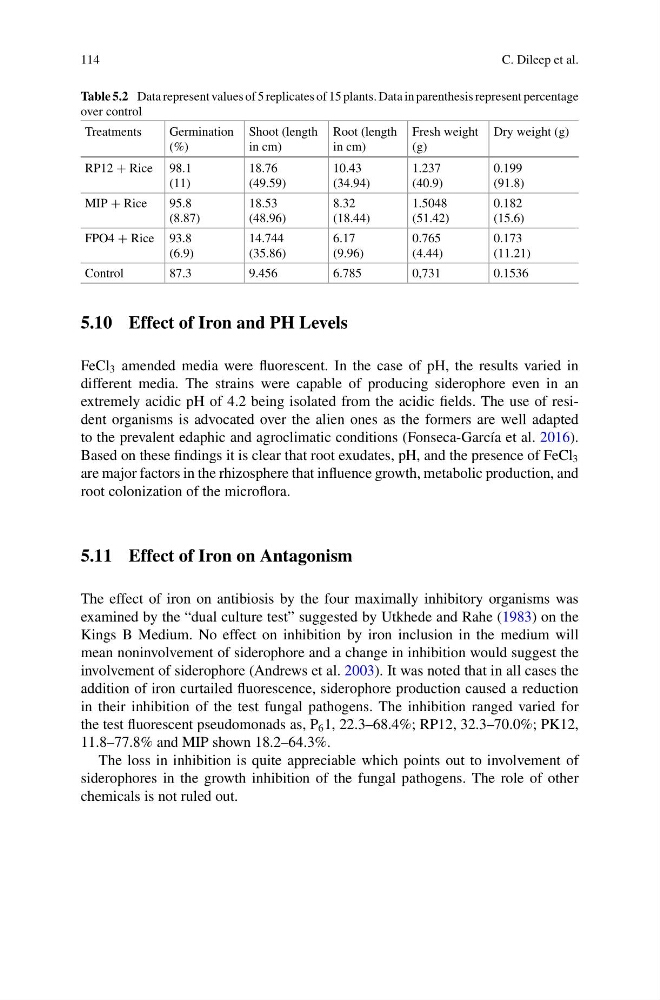
Table 5.2 Data represent values of 5 replicates of 15 plants. Data in parenthesis represent percentage
over control
Treatments
Germination
(%)
Shoot (length
in cm)
Root (length
in cm)
Fresh weight
(g)
Dry weight (g)
RP12 + Rice 98.1
(11)
18.76
(49.59)
10.43
(34.94)
1.237
(40.9)
0.199
(91.8)
MIP + Rice
95.8
(8.87)
18.53
(48.96)
8.32
(18.44)
1.5048
(51.42)
0.182
(15.6)
FPO4 + Rice 93.8
(6.9)
14.744
(35.86)
6.17
(9.96)
0.765
(4.44)
0.173
(11.21)
Control
87.3
9.456
6.785
0,731
0.1536
5.10 Effect of Iron and PH Levels
FeCl 3 amended media were fluorescent. In the case of pH, the results varied in
different media. The strains were capable of producing siderophore even in an
extremely acidic pH of 4.2 being isolated from the acidic fields. The use of resident organisms is advocated over the alien ones as the formers are well adapted
to the prevalent edaphic and agroclimatic conditions (Fonseca-García et al. 2016).
Based on these findings it is clear that root exudates, pH, and the presence of FeCl 3
are major factors in the rhizosphere that influence growth, metabolic production, and
root colonization of the microflora.
5.11 Effect of Iron on Antagonism
The effect of iron on antibiosis by the four maximally inhibitory organisms was
examined by the “dual culture test” suggested by Utkhede and Rahe (1983) on the
Kings B Medium. No effect on inhibition by iron inclusion in the medium will
mean noninvolvement of siderophore and a change in inhibition would suggest the
involvement of siderophore (Andrews et al. 2003). It was noted that in all cases the
addition of iron curtailed fluorescence, siderophore production caused a reduction
in their inhibition of the test fungal pathogens. The inhibition ranged varied for
the test fluorescent pseudomonads as, P 6 1, 22.3–68.4%; RP12, 32.3–70.0%; PK12,
11.8–77.8% and MIP shown 18.2–64.3%.
The loss in inhibition is quite appreciable which points out to involvement of
siderophores in the growth inhibition of the fungal pathogens. The role of other
chemicals is not ruled out.
C. Dileep et al.
Table 5.2 Data represent values of 5 replicates of 15 plants. Data in parenthesis represent percentage
over control
Treatments
Germination
(%)
Shoot (length
in cm)
Root (length
in cm)
Fresh weight
(g)
Dry weight (g)
RP12 + Rice 98.1
(11)
18.76
(49.59)
10.43
(34.94)
1.237
(40.9)
0.199
(91.8)
MIP + Rice
95.8
(8.87)
18.53
(48.96)
8.32
(18.44)
1.5048
(51.42)
0.182
(15.6)
FPO4 + Rice 93.8
(6.9)
14.744
(35.86)
6.17
(9.96)
0.765
(4.44)
0.173
(11.21)
Control
87.3
9.456
6.785
0,731
0.1536
5.10 Effect of Iron and PH Levels
FeCl 3 amended media were fluorescent. In the case of pH, the results varied in
different media. The strains were capable of producing siderophore even in an
extremely acidic pH of 4.2 being isolated from the acidic fields. The use of resident organisms is advocated over the alien ones as the formers are well adapted
to the prevalent edaphic and agroclimatic conditions (Fonseca-García et al. 2016).
Based on these findings it is clear that root exudates, pH, and the presence of FeCl 3
are major factors in the rhizosphere that influence growth, metabolic production, and
root colonization of the microflora.
5.11 Effect of Iron on Antagonism
The effect of iron on antibiosis by the four maximally inhibitory organisms was
examined by the “dual culture test” suggested by Utkhede and Rahe (1983) on the
Kings B Medium. No effect on inhibition by iron inclusion in the medium will
mean noninvolvement of siderophore and a change in inhibition would suggest the
involvement of siderophore (Andrews et al. 2003). It was noted that in all cases the
addition of iron curtailed fluorescence, siderophore production caused a reduction
in their inhibition of the test fungal pathogens. The inhibition ranged varied for
the test fluorescent pseudomonads as, P 6 1, 22.3–68.4%; RP12, 32.3–70.0%; PK12,
11.8–77.8% and MIP shown 18.2–64.3%.
The loss in inhibition is quite appreciable which points out to involvement of
siderophores in the growth inhibition of the fungal pathogens. The role of other
chemicals is not ruled out.