

112
C. Dileep et al.
Table 5.1 Siderophore
production in Pseudomonas
isolates
Bacterial strains Incubation period (h) Peak Absorbance
P 6 1
48
404
0.788
PK7
48
403
2.137
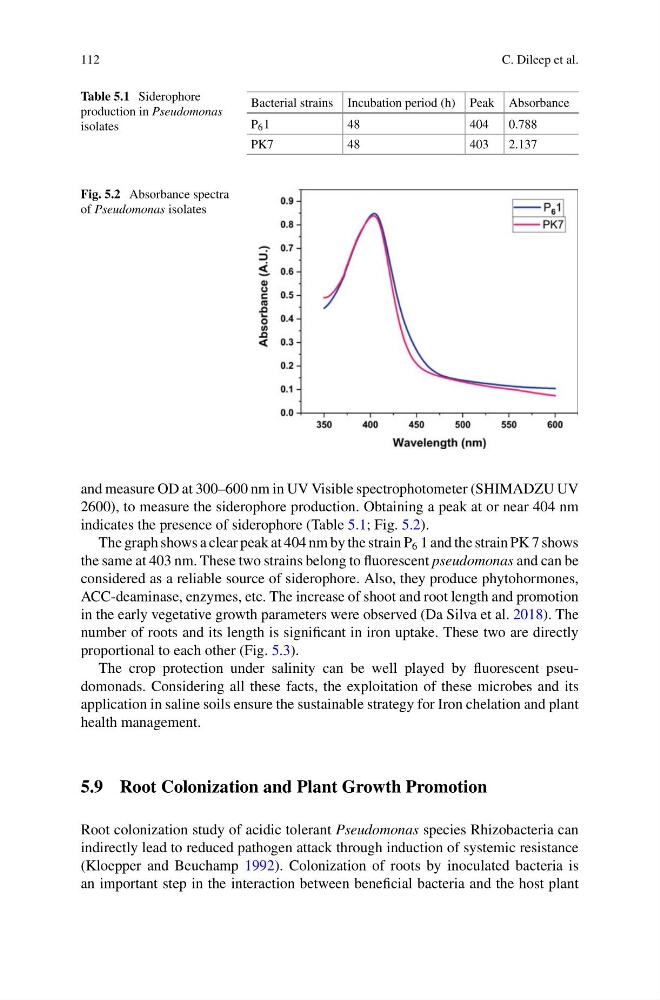
Fig. 5.2 Absorbance spectra
of Pseudomonas isolates
and measure OD at 300–600 nm in UV Visible spectrophotometer (SHIMADZU UV
2600), to measure the siderophore production. Obtaining a peak at or near 404 nm
indicates the presence of siderophore (Table 5.1; Fig. 5.2).
The graph shows a clear peak at 404 nm by the strain P 6 1 and the strain PK 7 shows
the same at 403 nm. These two strains belong to fluorescent pseudomonas and can be
considered as a reliable source of siderophore. Also, they produce phytohormones,
ACC-deaminase, enzymes, etc. The increase of shoot and root length and promotion
in the early vegetative growth parameters were observed (Da Silva et al. 2018). The
number of roots and its length is significant in iron uptake. These two are directly
proportional to each other (Fig. 5.3).
The crop protection under salinity can be well played by fluorescent pseudomonads. Considering all these facts, the exploitation of these microbes and its
application in saline soils ensure the sustainable strategy for Iron chelation and plant
health management.
5.9 Root Colonization and Plant Growth Promotion
Root colonization study of acidic tolerant Pseudomonas species Rhizobacteria can
indirectly lead to reduced pathogen attack through induction of systemic resistance
(Kloepper and Beuchamp 1992). Colonization of roots by inoculated bacteria is
an important step in the interaction between beneficial bacteria and the host plant
C. Dileep et al.
Table 5.1 Siderophore
production in Pseudomonas
isolates
Bacterial strains Incubation period (h) Peak Absorbance
P 6 1
48
404
0.788
PK7
48
403
2.137
Fig. 5.2 Absorbance spectra
of Pseudomonas isolates
and measure OD at 300–600 nm in UV Visible spectrophotometer (SHIMADZU UV
2600), to measure the siderophore production. Obtaining a peak at or near 404 nm
indicates the presence of siderophore (Table 5.1; Fig. 5.2).
The graph shows a clear peak at 404 nm by the strain P 6 1 and the strain PK 7 shows
the same at 403 nm. These two strains belong to fluorescent pseudomonas and can be
considered as a reliable source of siderophore. Also, they produce phytohormones,
ACC-deaminase, enzymes, etc. The increase of shoot and root length and promotion
in the early vegetative growth parameters were observed (Da Silva et al. 2018). The
number of roots and its length is significant in iron uptake. These two are directly
proportional to each other (Fig. 5.3).
The crop protection under salinity can be well played by fluorescent pseudomonads. Considering all these facts, the exploitation of these microbes and its
application in saline soils ensure the sustainable strategy for Iron chelation and plant
health management.
5.9 Root Colonization and Plant Growth Promotion
Root colonization study of acidic tolerant Pseudomonas species Rhizobacteria can
indirectly lead to reduced pathogen attack through induction of systemic resistance
(Kloepper and Beuchamp 1992). Colonization of roots by inoculated bacteria is
an important step in the interaction between beneficial bacteria and the host plant