

given PBM are measured by fluorescence polarization assay and
subsequently used to estimate the concentration of that
PBM [8].
Acknowledgments
This work received institutional support from Centre National de la
Recherche Scientifique (CNRS), Universite ´ de Strasbourg, Institut
National de la Sante ´ et de la Recherche Me ´dicale (INSERM) and
Re ´gion Alsace. The work was supported by funding from the
European Union’s Horizon 2020 research and innovation program
under the Marie Sklodowska-Curie grant agreement No 675341,
by the Ligue contre le Cancer (e ´quipe labellise ´e 2015), by the
National Institutes of Health (Grant R01CA134737), and by the
French Infrastructure for Integrated Structural Biology (FRISBI).
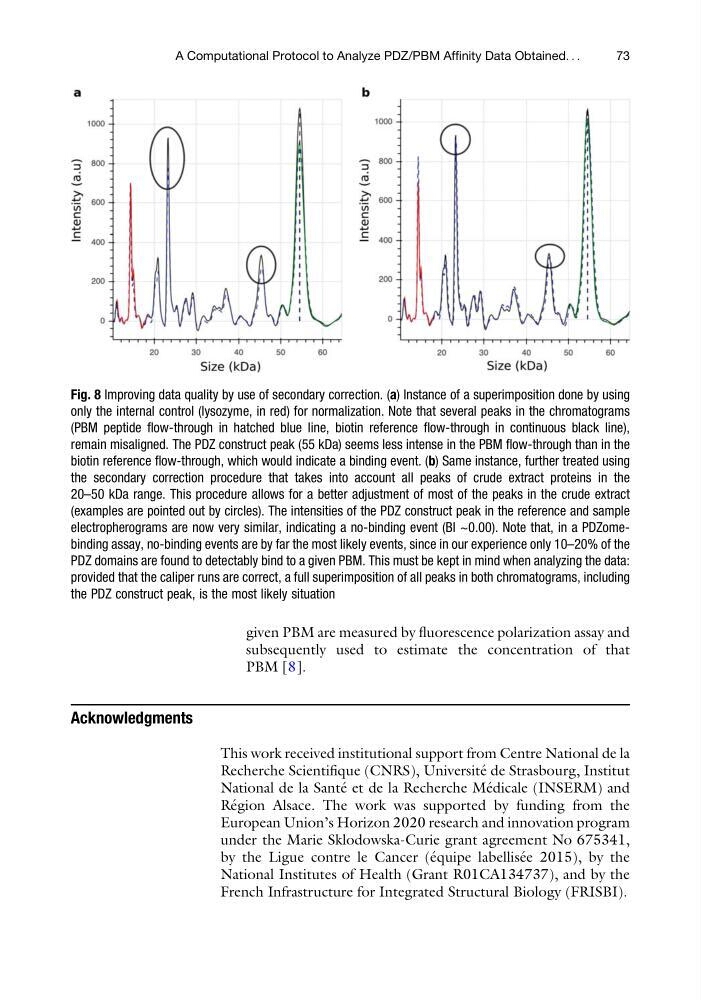
Fig. 8 Improving data quality by use of secondary correction. (a) Instance of a superimposition done by using
only the internal control (lysozyme, in red) for normalization. Note that several peaks in the chromatograms
(PBM peptide flow-through in hatched blue line, biotin reference flow-through in continuous black line),
remain misaligned. The PDZ construct peak (55 kDa) seems less intense in the PBM flow-through than in the
biotin reference flow-through, which would indicate a binding event. (b) Same instance, further treated using
the secondary correction procedure that takes into account all peaks of crude extract proteins in the
20–50 kDa range. This procedure allows for a better adjustment of most of the peaks in the crude extract
(examples are pointed out by circles). The intensities of the PDZ construct peak in the reference and sample
electropherograms are now very similar, indicating a no-binding event (BI ~0.00). Note that, in a PDZomebinding assay, no-binding events are by far the most likely events, since in our experience only 10–20% of the
PDZ domains are found to detectably bind to a given PBM. This must be kept in mind when analyzing the data:
provided that the caliper runs are correct, a full superimposition of all peaks in both chromatograms, including
the PDZ construct peak, is the most likely situation
A Computational Protocol to Analyze PDZ/PBM Affinity Data Obtained. . .
73
subsequently used to estimate the concentration of that
PBM [8].
Acknowledgments
This work received institutional support from Centre National de la
Recherche Scientifique (CNRS), Universite ´ de Strasbourg, Institut
National de la Sante ´ et de la Recherche Me ´dicale (INSERM) and
Re ´gion Alsace. The work was supported by funding from the
European Union’s Horizon 2020 research and innovation program
under the Marie Sklodowska-Curie grant agreement No 675341,
by the Ligue contre le Cancer (e ´quipe labellise ´e 2015), by the
National Institutes of Health (Grant R01CA134737), and by the
French Infrastructure for Integrated Structural Biology (FRISBI).
Fig. 8 Improving data quality by use of secondary correction. (a) Instance of a superimposition done by using
only the internal control (lysozyme, in red) for normalization. Note that several peaks in the chromatograms
(PBM peptide flow-through in hatched blue line, biotin reference flow-through in continuous black line),
remain misaligned. The PDZ construct peak (55 kDa) seems less intense in the PBM flow-through than in the
biotin reference flow-through, which would indicate a binding event. (b) Same instance, further treated using
the secondary correction procedure that takes into account all peaks of crude extract proteins in the
20–50 kDa range. This procedure allows for a better adjustment of most of the peaks in the crude extract
(examples are pointed out by circles). The intensities of the PDZ construct peak in the reference and sample
electropherograms are now very similar, indicating a no-binding event (BI ~0.00). Note that, in a PDZomebinding assay, no-binding events are by far the most likely events, since in our experience only 10–20% of the
PDZ domains are found to detectably bind to a given PBM. This must be kept in mind when analyzing the data:
provided that the caliper runs are correct, a full superimposition of all peaks in both chromatograms, including
the PDZ construct peak, is the most likely situation
A Computational Protocol to Analyze PDZ/PBM Affinity Data Obtained. . .
73