

At all inactive positions, rotamers from a library are positioned. We
use the Tuffery rotamer library, slightly extended [34, 35]. It has
about ten rotamers per amino acid type. At the active positions, we
position all the rotamers for all the allowed amino acid types,
around 200 if all types are allowed. In fact, we do not mutate into
Gly or Pro, so there are 18 possible types. With four active positions, there are 104,976 possible sequences. At this point, each
residue in the system has around 10 rotamer conformations in
place, or 200 if it is active. All these are recapitulated in a single
PDB file. The protein and peptide backbone conformations will be
held fixed. Backbone flexibility will be modeled implicitly, through
the protein dielectric constant. One can also perform several design
calculations, each with a slightly different backbone conformation,
or a single, multibackbone calculation. This last protocol is significantly more complicated and expensive [36], and is not
described here.
2.1.3 Unfolded
Protein State
If we allow mutations (active positions) in the protein, we will need
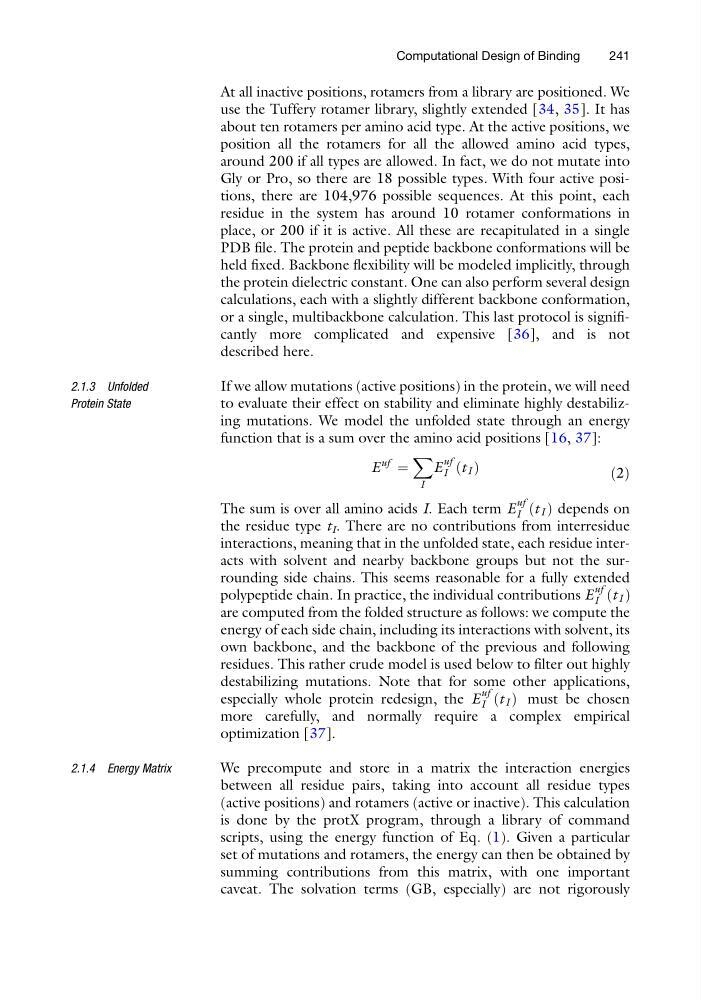
to evaluate their effect on stability and eliminate highly destabilizing mutations. We model the unfolded state through an energy
function that is a sum over the amino acid positions [16, 37]:
E
uf
¼
X
I
E
uf
I t I
ð Þ
ð2Þ
The sum is over all amino acids I. Each term E
uf
I t I
ð Þ depends on
the residue type t I . There are no contributions from interresidue
interactions, meaning that in the unfolded state, each residue interacts with solvent and nearby backbone groups but not the surrounding side chains. This seems reasonable for a fully extended
polypeptide chain. In practice, the individual contributions E
uf
I t I
ð Þ
are computed from the folded structure as follows: we compute the
energy of each side chain, including its interactions with solvent, its
own backbone, and the backbone of the previous and following
residues. This rather crude model is used below to filter out highly
destabilizing mutations. Note that for some other applications,
especially whole protein redesign, the E
uf
I t I
ð Þ must be chosen
more carefully, and normally require a complex empirical
optimization [37].
2.1.4 Energy Matrix
We precompute and store in a matrix the interaction energies
between all residue pairs, taking into account all residue types
(active positions) and rotamers (active or inactive). This calculation
is done by the protX program, through a library of command
scripts, using the energy function of Eq. (1). Given a particular
set of mutations and rotamers, the energy can then be obtained by
summing contributions from this matrix, with one important
caveat. The solvation terms (GB, especially) are not rigorously
Computational Design of Binding
241
use the Tuffery rotamer library, slightly extended [34, 35]. It has
about ten rotamers per amino acid type. At the active positions, we
position all the rotamers for all the allowed amino acid types,
around 200 if all types are allowed. In fact, we do not mutate into
Gly or Pro, so there are 18 possible types. With four active positions, there are 104,976 possible sequences. At this point, each
residue in the system has around 10 rotamer conformations in
place, or 200 if it is active. All these are recapitulated in a single
PDB file. The protein and peptide backbone conformations will be
held fixed. Backbone flexibility will be modeled implicitly, through
the protein dielectric constant. One can also perform several design
calculations, each with a slightly different backbone conformation,
or a single, multibackbone calculation. This last protocol is significantly more complicated and expensive [36], and is not
described here.
2.1.3 Unfolded
Protein State
If we allow mutations (active positions) in the protein, we will need
to evaluate their effect on stability and eliminate highly destabilizing mutations. We model the unfolded state through an energy
function that is a sum over the amino acid positions [16, 37]:
E
uf
¼
X
I
E
uf
I t I
ð Þ
ð2Þ
The sum is over all amino acids I. Each term E
uf
I t I
ð Þ depends on
the residue type t I . There are no contributions from interresidue
interactions, meaning that in the unfolded state, each residue interacts with solvent and nearby backbone groups but not the surrounding side chains. This seems reasonable for a fully extended
polypeptide chain. In practice, the individual contributions E
uf
I t I
ð Þ
are computed from the folded structure as follows: we compute the
energy of each side chain, including its interactions with solvent, its
own backbone, and the backbone of the previous and following
residues. This rather crude model is used below to filter out highly
destabilizing mutations. Note that for some other applications,
especially whole protein redesign, the E
uf
I t I
ð Þ must be chosen
more carefully, and normally require a complex empirical
optimization [37].
2.1.4 Energy Matrix
We precompute and store in a matrix the interaction energies
between all residue pairs, taking into account all residue types
(active positions) and rotamers (active or inactive). This calculation
is done by the protX program, through a library of command
scripts, using the energy function of Eq. (1). Given a particular
set of mutations and rotamers, the energy can then be obtained by
summing contributions from this matrix, with one important
caveat. The solvation terms (GB, especially) are not rigorously
Computational Design of Binding
241