

based” CPD. One of its characteristics is the energy function drawn
from molecular mechanics. The other is its sampling approach,
which uses adaptive Monte Carlo to target the binding free energy,
as opposed to simpler properties like the bound-state energy. The
CPD methods described below are available (and further documented) in the recently released Proteus 3.0 package (https://proteus.
polytechnique.fr) [17].
2.1 Model
Ingredients
and System Setup
2.1.1 Energy Model
We use a molecular mechanics energy function along with an
implicit solvent model that contains a Generalized Born
(GB) term and a nonpolar term:
E ¼ E bond þ E angle þ E dihedral þ E improper þ E vdW þ E Coulomb
þ E GB þ E NP
ð1Þ
The first six terms describe the internal and nonbonded contributions to the potential energy of the protein or peptide, and are
borrowed from the Amber ff99SB molecular mechanics energy
function [31]. The next two terms capture solvent effects via a
GB approximation for electrostatic effects and a nonpolar term.
This can be either an accessible surface area (SA) term or a Lazaridis–Karplus (LK) term [32].
2.1.2 Structures
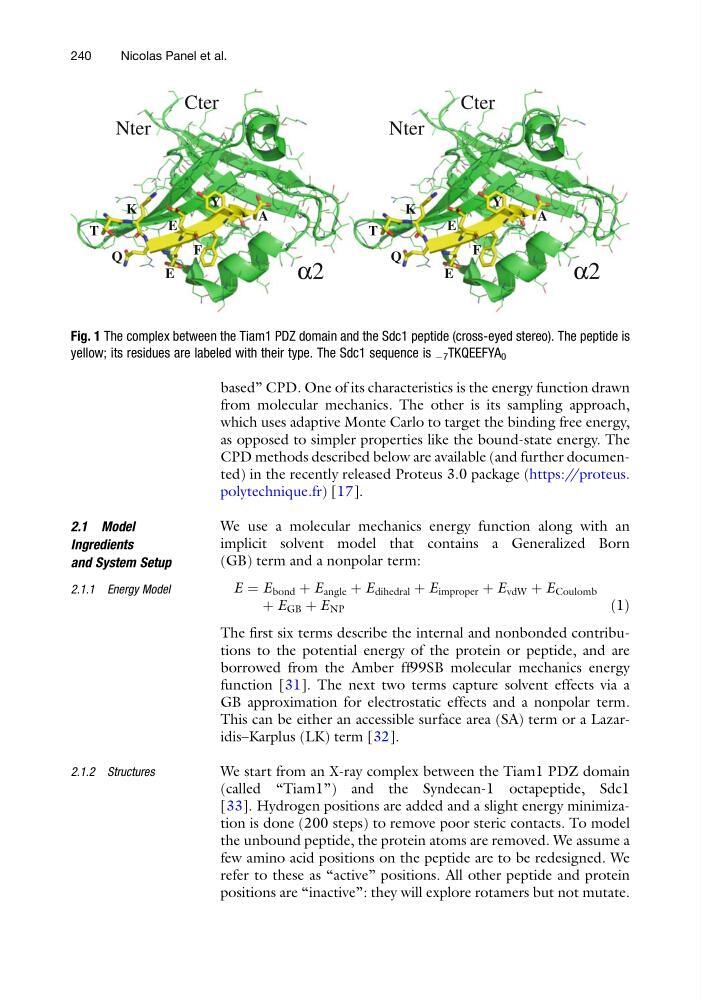
We start from an X-ray complex between the Tiam1 PDZ domain
(called “Tiam1”) and the Syndecan-1 octapeptide, Sdc1
[33]. Hydrogen positions are added and a slight energy minimization is done (200 steps) to remove poor steric contacts. To model
the unbound peptide, the protein atoms are removed. We assume a
few amino acid positions on the peptide are to be redesigned. We
refer to these as “active” positions. All other peptide and protein
positions are “inactive”: they will explore rotamers but not mutate.
Fig. 1 The complex between the Tiam1 PDZ domain and the Sdc1 peptide (cross-eyed stereo). The peptide is
yellow; its residues are labeled with their type. The Sdc1 sequence is À7 TKQEEFYA 0
240
Nicolas Panel et al.
from molecular mechanics. The other is its sampling approach,
which uses adaptive Monte Carlo to target the binding free energy,
as opposed to simpler properties like the bound-state energy. The
CPD methods described below are available (and further documented) in the recently released Proteus 3.0 package (https://proteus.
polytechnique.fr) [17].
2.1 Model
Ingredients
and System Setup
2.1.1 Energy Model
We use a molecular mechanics energy function along with an
implicit solvent model that contains a Generalized Born
(GB) term and a nonpolar term:
E ¼ E bond þ E angle þ E dihedral þ E improper þ E vdW þ E Coulomb
þ E GB þ E NP
ð1Þ
The first six terms describe the internal and nonbonded contributions to the potential energy of the protein or peptide, and are
borrowed from the Amber ff99SB molecular mechanics energy
function [31]. The next two terms capture solvent effects via a
GB approximation for electrostatic effects and a nonpolar term.
This can be either an accessible surface area (SA) term or a Lazaridis–Karplus (LK) term [32].
2.1.2 Structures
We start from an X-ray complex between the Tiam1 PDZ domain
(called “Tiam1”) and the Syndecan-1 octapeptide, Sdc1
[33]. Hydrogen positions are added and a slight energy minimization is done (200 steps) to remove poor steric contacts. To model
the unbound peptide, the protein atoms are removed. We assume a
few amino acid positions on the peptide are to be redesigned. We
refer to these as “active” positions. All other peptide and protein
positions are “inactive”: they will explore rotamers but not mutate.
Fig. 1 The complex between the Tiam1 PDZ domain and the Sdc1 peptide (cross-eyed stereo). The peptide is
yellow; its residues are labeled with their type. The Sdc1 sequence is À7 TKQEEFYA 0
240
Nicolas Panel et al.