

remove all Fmoc-groups. Filter the solution with a 0.2 μm
syringe filter and dilute the filtered liquid 1/50 and 1/100 in
methanol to a total volume of 1 mL. Additionally, prepare
blanks for each dilution with 20% (v/v) piperidine. Measure
the absorbance at 298.8 nm in a silica cuvette and calculate the
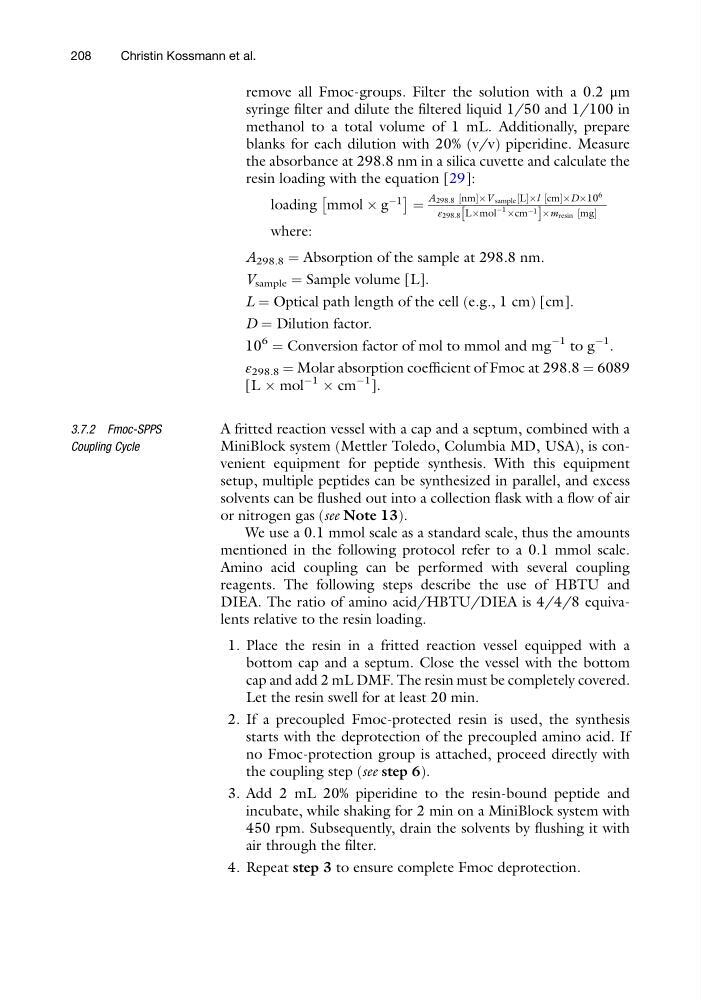
resin loading with the equation [29]:
loading mmol  g
À1
Â
à ¼
A 298:8 nm
½ ÂV sample L
½ Âl cm
½ ÂDÂ10
6
ε 298:8 LÂmol
À1 Âcm À1
½
Âm resin mg
½
where:
A 298.8 ¼ Absorption of the sample at 298.8 nm.
V sample ¼ Sample volume [L].
L ¼ Optical path length of the cell (e.g., 1 cm) [cm].
D ¼ Dilution factor.
10
6
¼ Conversion factor of mol to mmol and mg
À1 to g
À1 .
ε 298.8 ¼ Molar absorption coefficient of Fmoc at 298.8 ¼ 6089
[L Â mol
À1
 cm
À1 ].
3.7.2 Fmoc-SPPS
Coupling Cycle
A fritted reaction vessel with a cap and a septum, combined with a
MiniBlock system (Mettler Toledo, Columbia MD, USA), is convenient equipment for peptide synthesis. With this equipment
setup, multiple peptides can be synthesized in parallel, and excess
solvents can be flushed out into a collection flask with a flow of air
or nitrogen gas (see Note 13).
We use a 0.1 mmol scale as a standard scale, thus the amounts
mentioned in the following protocol refer to a 0.1 mmol scale.
Amino acid coupling can be performed with several coupling
reagents. The following steps describe the use of HBTU and
DIEA. The ratio of amino acid/HBTU/DIEA is 4/4/8 equivalents relative to the resin loading.
1. Place the resin in a fritted reaction vessel equipped with a
bottom cap and a septum. Close the vessel with the bottom
cap and add 2 mL DMF. The resin must be completely covered.
Let the resin swell for at least 20 min.
2. If a precoupled Fmoc-protected resin is used, the synthesis
starts with the deprotection of the precoupled amino acid. If
no Fmoc-protection group is attached, proceed directly with
the coupling step (see step 6).
3. Add 2 mL 20% piperidine to the resin-bound peptide and
incubate, while shaking for 2 min on a MiniBlock system with
450 rpm. Subsequently, drain the solvents by flushing it with
air through the filter.
4. Repeat step 3 to ensure complete Fmoc deprotection.
208
Christin Kossmann et al.
syringe filter and dilute the filtered liquid 1/50 and 1/100 in
methanol to a total volume of 1 mL. Additionally, prepare
blanks for each dilution with 20% (v/v) piperidine. Measure
the absorbance at 298.8 nm in a silica cuvette and calculate the
resin loading with the equation [29]:
loading mmol  g
À1
Â
à ¼
A 298:8 nm
½ ÂV sample L
½ Âl cm
½ ÂDÂ10
6
ε 298:8 LÂmol
À1 Âcm À1
½
Âm resin mg
½
where:
A 298.8 ¼ Absorption of the sample at 298.8 nm.
V sample ¼ Sample volume [L].
L ¼ Optical path length of the cell (e.g., 1 cm) [cm].
D ¼ Dilution factor.
10
6
¼ Conversion factor of mol to mmol and mg
À1 to g
À1 .
ε 298.8 ¼ Molar absorption coefficient of Fmoc at 298.8 ¼ 6089
[L Â mol
À1
 cm
À1 ].
3.7.2 Fmoc-SPPS
Coupling Cycle
A fritted reaction vessel with a cap and a septum, combined with a
MiniBlock system (Mettler Toledo, Columbia MD, USA), is convenient equipment for peptide synthesis. With this equipment
setup, multiple peptides can be synthesized in parallel, and excess
solvents can be flushed out into a collection flask with a flow of air
or nitrogen gas (see Note 13).
We use a 0.1 mmol scale as a standard scale, thus the amounts
mentioned in the following protocol refer to a 0.1 mmol scale.
Amino acid coupling can be performed with several coupling
reagents. The following steps describe the use of HBTU and
DIEA. The ratio of amino acid/HBTU/DIEA is 4/4/8 equivalents relative to the resin loading.
1. Place the resin in a fritted reaction vessel equipped with a
bottom cap and a septum. Close the vessel with the bottom
cap and add 2 mL DMF. The resin must be completely covered.
Let the resin swell for at least 20 min.
2. If a precoupled Fmoc-protected resin is used, the synthesis
starts with the deprotection of the precoupled amino acid. If
no Fmoc-protection group is attached, proceed directly with
the coupling step (see step 6).
3. Add 2 mL 20% piperidine to the resin-bound peptide and
incubate, while shaking for 2 min on a MiniBlock system with
450 rpm. Subsequently, drain the solvents by flushing it with
air through the filter.
4. Repeat step 3 to ensure complete Fmoc deprotection.
208
Christin Kossmann et al.