

3.7.1 Resin Loading
For synthetic N-terminal peptide fragments, a functional hydrazine
linker is essential for the ligation reaction. Fmoc-hydrazono-pyruvyl-aminomethyl polystyrene resins are commercially available, with
the first amino acid precoupled for all standard L-amino acids. If a
noncanonical first amino acid is needed, manual preloading of
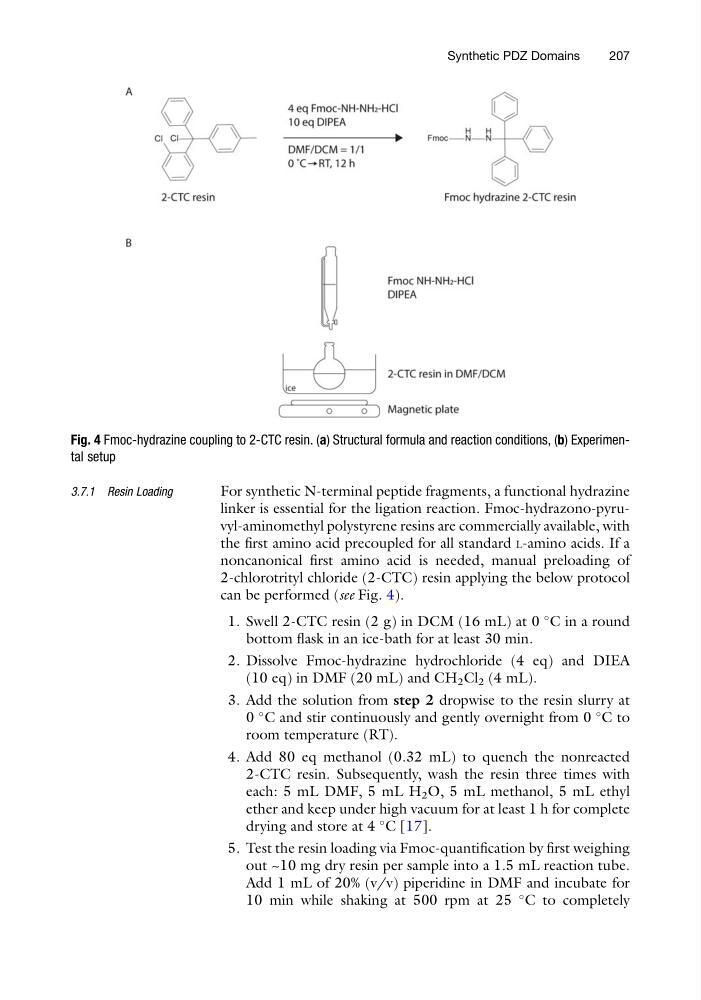
2-chlorotrityl chloride (2-CTC) resin applying the below protocol
can be performed (see Fig. 4).
1. Swell 2-CTC resin (2 g) in DCM (16 mL) at 0
C in a round
bottom flask in an ice-bath for at least 30 min.
2. Dissolve Fmoc-hydrazine hydrochloride (4 eq) and DIEA
(10 eq) in DMF (20 mL) and CH 2 Cl 2 (4 mL).
3. Add the solution from step 2 dropwise to the resin slurry at
0
C and stir continuously and gently overnight from 0
C to
room temperature (RT).
4. Add 80 eq methanol (0.32 mL) to quench the nonreacted
2-CTC resin. Subsequently, wash the resin three times with
each: 5 mL DMF, 5 mL H 2 O, 5 mL methanol, 5 mL ethyl
ether and keep under high vacuum for at least 1 h for complete
drying and store at 4
C [17].
5. Test the resin loading via Fmoc-quantification by first weighing
out ~10 mg dry resin per sample into a 1.5 mL reaction tube.
Add 1 mL of 20% (v/v) piperidine in DMF and incubate for
10 min while shaking at 500 rpm at 25
C to completely
Fig. 4 Fmoc-hydrazine coupling to 2-CTC resin. (a) Structural formula and reaction conditions, (b) Experimental setup
Synthetic PDZ Domains
207
For synthetic N-terminal peptide fragments, a functional hydrazine
linker is essential for the ligation reaction. Fmoc-hydrazono-pyruvyl-aminomethyl polystyrene resins are commercially available, with
the first amino acid precoupled for all standard L-amino acids. If a
noncanonical first amino acid is needed, manual preloading of
2-chlorotrityl chloride (2-CTC) resin applying the below protocol
can be performed (see Fig. 4).
1. Swell 2-CTC resin (2 g) in DCM (16 mL) at 0
C in a round
bottom flask in an ice-bath for at least 30 min.
2. Dissolve Fmoc-hydrazine hydrochloride (4 eq) and DIEA
(10 eq) in DMF (20 mL) and CH 2 Cl 2 (4 mL).
3. Add the solution from step 2 dropwise to the resin slurry at
0
C and stir continuously and gently overnight from 0
C to
room temperature (RT).
4. Add 80 eq methanol (0.32 mL) to quench the nonreacted
2-CTC resin. Subsequently, wash the resin three times with
each: 5 mL DMF, 5 mL H 2 O, 5 mL methanol, 5 mL ethyl
ether and keep under high vacuum for at least 1 h for complete
drying and store at 4
C [17].
5. Test the resin loading via Fmoc-quantification by first weighing
out ~10 mg dry resin per sample into a 1.5 mL reaction tube.
Add 1 mL of 20% (v/v) piperidine in DMF and incubate for
10 min while shaking at 500 rpm at 25
C to completely
Fig. 4 Fmoc-hydrazine coupling to 2-CTC resin. (a) Structural formula and reaction conditions, (b) Experimental setup
Synthetic PDZ Domains
207