

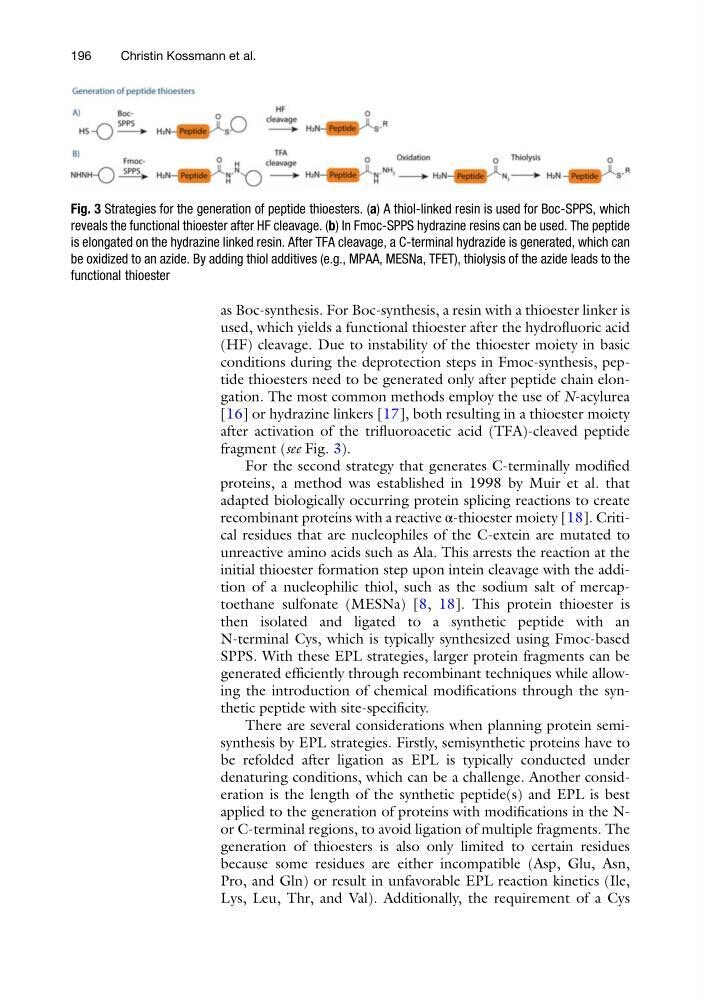
as Boc-synthesis. For Boc-synthesis, a resin with a thioester linker is
used, which yields a functional thioester after the hydrofluoric acid
(HF) cleavage. Due to instability of the thioester moiety in basic
conditions during the deprotection steps in Fmoc-synthesis, peptide thioesters need to be generated only after peptide chain elongation. The most common methods employ the use of N-acylurea
[16] or hydrazine linkers [17], both resulting in a thioester moiety
after activation of the trifluoroacetic acid (TFA)-cleaved peptide
fragment (see Fig. 3).
For the second strategy that generates C-terminally modified
proteins, a method was established in 1998 by Muir et al. that
adapted biologically occurring protein splicing reactions to create
recombinant proteins with a reactive α-thioester moiety [18]. Critical residues that are nucleophiles of the C-extein are mutated to
unreactive amino acids such as Ala. This arrests the reaction at the
initial thioester formation step upon intein cleavage with the addition of a nucleophilic thiol, such as the sodium salt of mercaptoethane sulfonate (MESNa) [8, 18]. This protein thioester is
then isolated and ligated to a synthetic peptide with an
N-terminal Cys, which is typically synthesized using Fmoc-based
SPPS. With these EPL strategies, larger protein fragments can be
generated efficiently through recombinant techniques while allowing the introduction of chemical modifications through the synthetic peptide with site-specificity.
There are several considerations when planning protein semisynthesis by EPL strategies. Firstly, semisynthetic proteins have to
be refolded after ligation as EPL is typically conducted under
denaturing conditions, which can be a challenge. Another consideration is the length of the synthetic peptide(s) and EPL is best
applied to the generation of proteins with modifications in the Nor C-terminal regions, to avoid ligation of multiple fragments. The
generation of thioesters is also only limited to certain residues
because some residues are either incompatible (Asp, Glu, Asn,
Pro, and Gln) or result in unfavorable EPL reaction kinetics (Ile,
Lys, Leu, Thr, and Val). Additionally, the requirement of a Cys
Fig. 3 Strategies for the generation of peptide thioesters. (a) A thiol-linked resin is used for Boc-SPPS, which
reveals the functional thioester after HF cleavage. (b) In Fmoc-SPPS hydrazine resins can be used. The peptide
is elongated on the hydrazine linked resin. After TFA cleavage, a C-terminal hydrazide is generated, which can
be oxidized to an azide. By adding thiol additives (e.g., MPAA, MESNa, TFET), thiolysis of the azide leads to the
functional thioester
196
Christin Kossmann et al.
used, which yields a functional thioester after the hydrofluoric acid
(HF) cleavage. Due to instability of the thioester moiety in basic
conditions during the deprotection steps in Fmoc-synthesis, peptide thioesters need to be generated only after peptide chain elongation. The most common methods employ the use of N-acylurea
[16] or hydrazine linkers [17], both resulting in a thioester moiety
after activation of the trifluoroacetic acid (TFA)-cleaved peptide
fragment (see Fig. 3).
For the second strategy that generates C-terminally modified
proteins, a method was established in 1998 by Muir et al. that
adapted biologically occurring protein splicing reactions to create
recombinant proteins with a reactive α-thioester moiety [18]. Critical residues that are nucleophiles of the C-extein are mutated to
unreactive amino acids such as Ala. This arrests the reaction at the
initial thioester formation step upon intein cleavage with the addition of a nucleophilic thiol, such as the sodium salt of mercaptoethane sulfonate (MESNa) [8, 18]. This protein thioester is
then isolated and ligated to a synthetic peptide with an
N-terminal Cys, which is typically synthesized using Fmoc-based
SPPS. With these EPL strategies, larger protein fragments can be
generated efficiently through recombinant techniques while allowing the introduction of chemical modifications through the synthetic peptide with site-specificity.
There are several considerations when planning protein semisynthesis by EPL strategies. Firstly, semisynthetic proteins have to
be refolded after ligation as EPL is typically conducted under
denaturing conditions, which can be a challenge. Another consideration is the length of the synthetic peptide(s) and EPL is best
applied to the generation of proteins with modifications in the Nor C-terminal regions, to avoid ligation of multiple fragments. The
generation of thioesters is also only limited to certain residues
because some residues are either incompatible (Asp, Glu, Asn,
Pro, and Gln) or result in unfavorable EPL reaction kinetics (Ile,
Lys, Leu, Thr, and Val). Additionally, the requirement of a Cys
Fig. 3 Strategies for the generation of peptide thioesters. (a) A thiol-linked resin is used for Boc-SPPS, which
reveals the functional thioester after HF cleavage. (b) In Fmoc-SPPS hydrazine resins can be used. The peptide
is elongated on the hydrazine linked resin. After TFA cleavage, a C-terminal hydrazide is generated, which can
be oxidized to an azide. By adding thiol additives (e.g., MPAA, MESNa, TFET), thiolysis of the azide leads to the
functional thioester
196
Christin Kossmann et al.