

2.2 Sample
Preparation
for Isothermal Titration
Calorimetry (ITC)
1. Recombinant PDZ domain protein purified to homogeneity in
storage buffer at a concentration of 75 μM.
2. Synthetic C-terminal PBM peptide of eight residues in length
(see Note 2) such as the Superpeptide (RSWFETWV) dissolved
in storage buffer at a final concentration of 900 μM.
3. MicroCalTM iTC200 System (GE Healthcare) or equivalent.
4. Washing solution: 10% SDS in dH 2 O.
5. MicroCal Origin
® version 7.0 (or newer) software (OriginLab™ Corporation).
2.3 Sample
Preparation for X-Ray
Crystallography
1. Recombinant cell polarity protein (e.g., Scribble PDZ and Dlg
PDZ domains) purified to homogeneity in PDZ storage buffer.
2. Synthetic peptide encoding a C-terminal PDZ binding motif
(PBM) dissolved in dH 2 O (e.g., MCC, β-PIX, APC) (see Note
3).
3. 1 mL centrifugal concentrator (MWCO 3 kDa, Millipore).
3 Methods
3.1 Sample
Preparation for CD
Spectroscopy
When preparing samples for CD, an important factor to be considered is the choice of the buffer which the protein is prepared
in. Most buffers absorb light in the far UV (below 250 nm)
range, thereby reducing the amount of light available for the actual
chromophore (protein) to absorb. Many recombinantly expressed
cell polarity proteins are stored in the HEPES buffer (25 mM
HEPES pH 7.2, 150 mM NaCl) or Tris buffer (25 mM Tris
pH 8, 150 mM NaCl) for their long-term storage. Unfortunately,
these buffers absorb in the far UV range (see Table 2) [22]. Therefore, to minimise the buffer effects as much as possible, it is important to use low concentrations of salts and buffers that are not
strong UV absorbers (see Table 2) [22]. Since chloride ions strongly
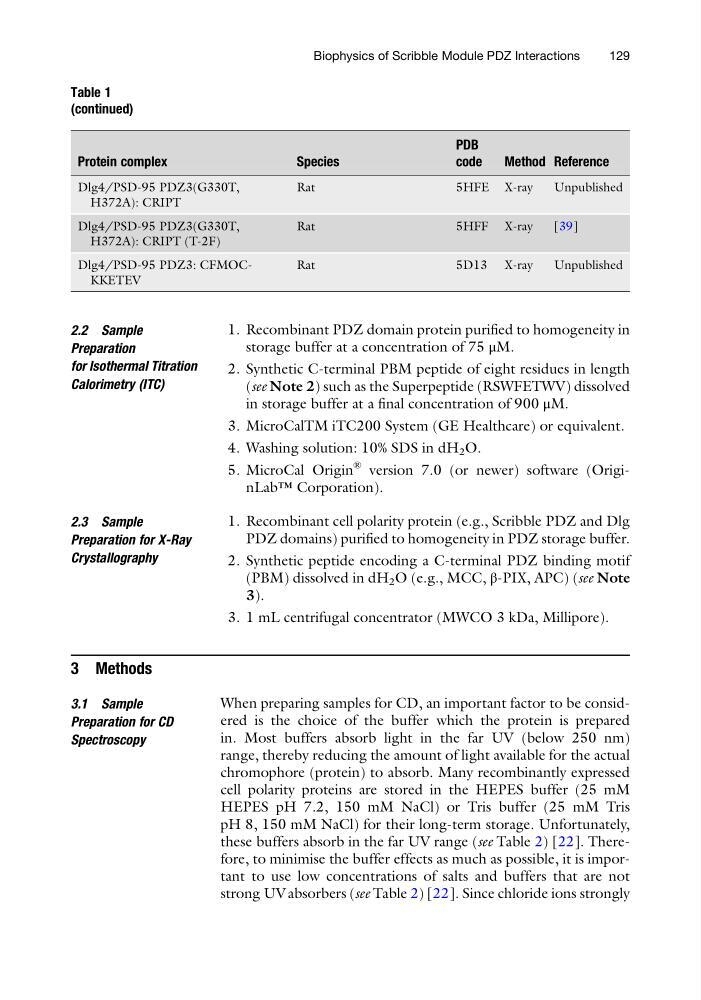
Table 1
(continued)
Protein complex
Species
PDB
code
Method Reference
Dlg4/PSD-95 PDZ3(G330T,
H372A): CRIPT
Rat
5HFE X-ray
Unpublished
Dlg4/PSD-95 PDZ3(G330T,
H372A): CRIPT (T-2F)
Rat
5HFF X-ray
[39]
Dlg4/PSD-95 PDZ3: CFMOCKKETEV
Rat
5D13 X-ray
Unpublished
Biophysics of Scribble Module PDZ Interactions
129
Preparation
for Isothermal Titration
Calorimetry (ITC)
1. Recombinant PDZ domain protein purified to homogeneity in
storage buffer at a concentration of 75 μM.
2. Synthetic C-terminal PBM peptide of eight residues in length
(see Note 2) such as the Superpeptide (RSWFETWV) dissolved
in storage buffer at a final concentration of 900 μM.
3. MicroCalTM iTC200 System (GE Healthcare) or equivalent.
4. Washing solution: 10% SDS in dH 2 O.
5. MicroCal Origin
® version 7.0 (or newer) software (OriginLab™ Corporation).
2.3 Sample
Preparation for X-Ray
Crystallography
1. Recombinant cell polarity protein (e.g., Scribble PDZ and Dlg
PDZ domains) purified to homogeneity in PDZ storage buffer.
2. Synthetic peptide encoding a C-terminal PDZ binding motif
(PBM) dissolved in dH 2 O (e.g., MCC, β-PIX, APC) (see Note
3).
3. 1 mL centrifugal concentrator (MWCO 3 kDa, Millipore).
3 Methods
3.1 Sample
Preparation for CD
Spectroscopy
When preparing samples for CD, an important factor to be considered is the choice of the buffer which the protein is prepared
in. Most buffers absorb light in the far UV (below 250 nm)
range, thereby reducing the amount of light available for the actual
chromophore (protein) to absorb. Many recombinantly expressed
cell polarity proteins are stored in the HEPES buffer (25 mM
HEPES pH 7.2, 150 mM NaCl) or Tris buffer (25 mM Tris
pH 8, 150 mM NaCl) for their long-term storage. Unfortunately,
these buffers absorb in the far UV range (see Table 2) [22]. Therefore, to minimise the buffer effects as much as possible, it is important to use low concentrations of salts and buffers that are not
strong UV absorbers (see Table 2) [22]. Since chloride ions strongly
Table 1
(continued)
Protein complex
Species
PDB
code
Method Reference
Dlg4/PSD-95 PDZ3(G330T,
H372A): CRIPT
Rat
5HFE X-ray
Unpublished
Dlg4/PSD-95 PDZ3(G330T,
H372A): CRIPT (T-2F)
Rat
5HFF X-ray
[39]
Dlg4/PSD-95 PDZ3: CFMOCKKETEV
Rat
5D13 X-ray
Unpublished
Biophysics of Scribble Module PDZ Interactions
129