

and laser power are critical issues as the sensitivity is low. Save
the data and annotate manually the ions. A search using Mascott software is also possible.
3.3 Homogeneity
The objective is to assess if the sample has a tendency to form
aggregates and to consider the potential for oligomerization of
the protein sample.
3.3.1 Dynamic Light
Scattering (DLS)
DLS experiments can be performed using nearly any buffer (see
Note 15). Special care should be taken during measurement if the
buffer contains large scattering particles such as crowding agents,
etc. The required protein concentration depends on the molecular
mass of the protein and can be estimated by the rule of thumb given
in Eq. 1.
c
mg
ml
¼
15
MW
ð1Þ
where MW is the molecular mass of the target protein in kDa.
For most PDZ domains, a concentration around 1 mg/ml is
well adapted to the measurement. In terms of volume, users should
refer to the manufacturer’s specification/manual as it varies from
instrument to instrument, ranging from only a few μl to a couple
of ml.
A simple protocol for a DLS measurement is given below:
1. Switch on the instrument and select the experimental
temperature.
2. Wait for temperature stabilization.
3. If needed, clean the reusable cuvettes or plates with detergent
(e.g., 2%(v/v) Hellmanex) and water, and dry it with ethanol.
4. Filter buffers.
5. Load buffer and samples into the wells or the cuvettes (see Note
16). Avoid the formation of bubbles.
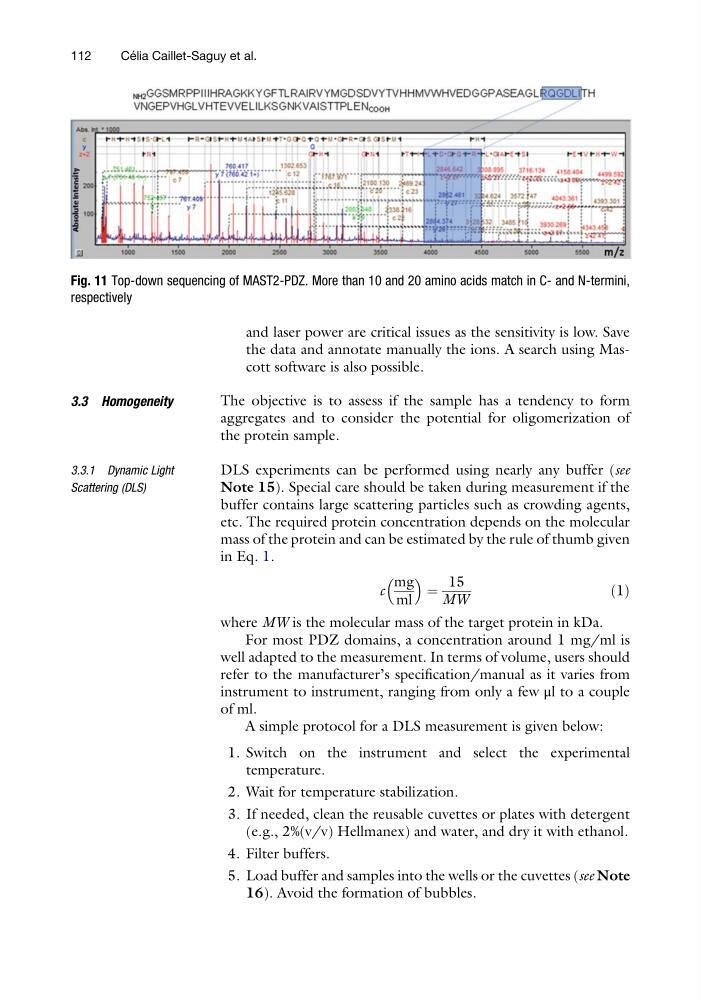
Fig. 11 Top-down sequencing of MAST2-PDZ. More than 10 and 20 amino acids match in C- and N-termini,
respectively
112
Ce ´ lia Caillet-Saguy et al.
the data and annotate manually the ions. A search using Mascott software is also possible.
3.3 Homogeneity
The objective is to assess if the sample has a tendency to form
aggregates and to consider the potential for oligomerization of
the protein sample.
3.3.1 Dynamic Light
Scattering (DLS)
DLS experiments can be performed using nearly any buffer (see
Note 15). Special care should be taken during measurement if the
buffer contains large scattering particles such as crowding agents,
etc. The required protein concentration depends on the molecular
mass of the protein and can be estimated by the rule of thumb given
in Eq. 1.
c
mg
ml
¼
15
MW
ð1Þ
where MW is the molecular mass of the target protein in kDa.
For most PDZ domains, a concentration around 1 mg/ml is
well adapted to the measurement. In terms of volume, users should
refer to the manufacturer’s specification/manual as it varies from
instrument to instrument, ranging from only a few μl to a couple
of ml.
A simple protocol for a DLS measurement is given below:
1. Switch on the instrument and select the experimental
temperature.
2. Wait for temperature stabilization.
3. If needed, clean the reusable cuvettes or plates with detergent
(e.g., 2%(v/v) Hellmanex) and water, and dry it with ethanol.
4. Filter buffers.
5. Load buffer and samples into the wells or the cuvettes (see Note
16). Avoid the formation of bubbles.
Fig. 11 Top-down sequencing of MAST2-PDZ. More than 10 and 20 amino acids match in C- and N-termini,
respectively
112
Ce ´ lia Caillet-Saguy et al.