

3.2.2 ISD and T3
Sequencing
The protocol to perform ISD acquisition is:
1. Use the dried droplet method: Apply 1 μl of PDZ sample on
the plate and overlay with 1 μl of super-DHB matrix. Do a
second spot with the DAN matrix (see Note 14).
2. Select an ISD method usually between 1 and 10 kDa in reflectron and positive mode. In that range of m/z, avoid any contaminations such as detergents or PEG.
3. Increase by 10% the laser power required compare to the intact
mass of the PDZ of interest.
4. Acquire at least 10,000 shoots.
5. Save your spectrum and calibrate it with BSA ions generated in
that range.
6. Open the spectrum in Biotools or another software and assign
it as an ISD-type.
Load the amino-acid sequence and analyze the data as
illustrated in (Fig. 11)
7. If the first amino acid needs to be determined, proceed with a
T3 sequencing procedure that uses a LIFT method as
described in the following steps. Define an ISD fragment ion
around 1000 m/z as parent. Copy the value of the parent ion.
8. Open the LIFT method. Paste the peak around 1000 m/z in
the LIFT method. Acquire the signal of the parent ion. Acquire
signals of the fragment ions on the parent ion spectrum. Gain
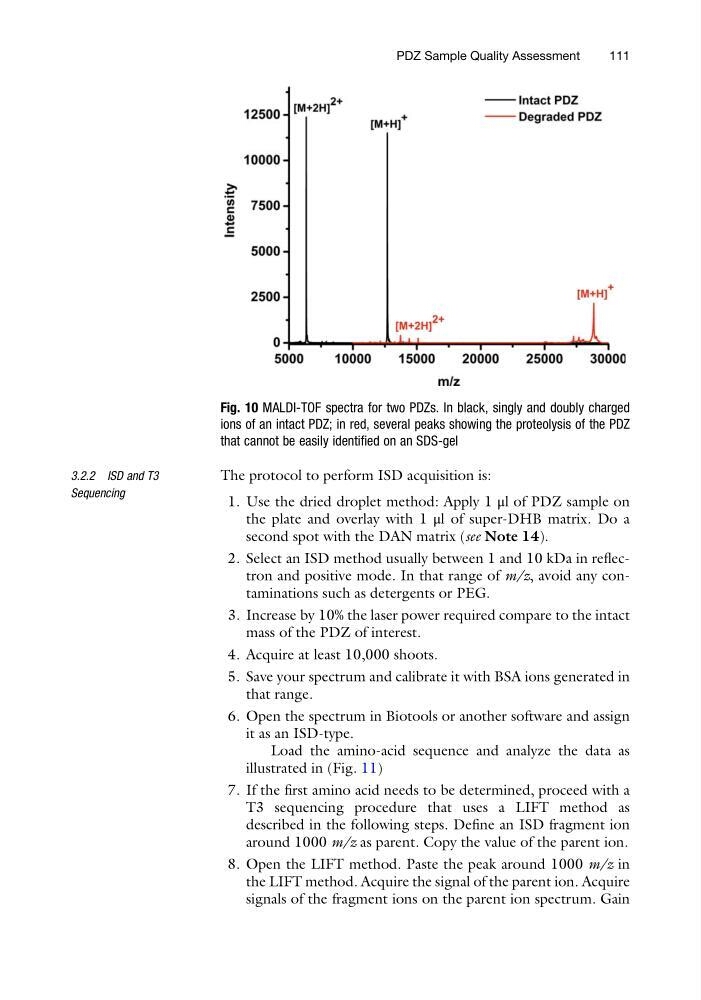
Fig. 10 MALDI-TOF spectra for two PDZs. In black, singly and doubly charged
ions of an intact PDZ; in red, several peaks showing the proteolysis of the PDZ
that cannot be easily identified on an SDS-gel
PDZ Sample Quality Assessment
111
Sequencing
The protocol to perform ISD acquisition is:
1. Use the dried droplet method: Apply 1 μl of PDZ sample on
the plate and overlay with 1 μl of super-DHB matrix. Do a
second spot with the DAN matrix (see Note 14).
2. Select an ISD method usually between 1 and 10 kDa in reflectron and positive mode. In that range of m/z, avoid any contaminations such as detergents or PEG.
3. Increase by 10% the laser power required compare to the intact
mass of the PDZ of interest.
4. Acquire at least 10,000 shoots.
5. Save your spectrum and calibrate it with BSA ions generated in
that range.
6. Open the spectrum in Biotools or another software and assign
it as an ISD-type.
Load the amino-acid sequence and analyze the data as
illustrated in (Fig. 11)
7. If the first amino acid needs to be determined, proceed with a
T3 sequencing procedure that uses a LIFT method as
described in the following steps. Define an ISD fragment ion
around 1000 m/z as parent. Copy the value of the parent ion.
8. Open the LIFT method. Paste the peak around 1000 m/z in
the LIFT method. Acquire the signal of the parent ion. Acquire
signals of the fragment ions on the parent ion spectrum. Gain
Fig. 10 MALDI-TOF spectra for two PDZs. In black, singly and doubly charged
ions of an intact PDZ; in red, several peaks showing the proteolysis of the PDZ
that cannot be easily identified on an SDS-gel
PDZ Sample Quality Assessment
111