

considered as an excellent assay [10]. Reads of blank (or medium-only wells) can be used to quantify the OD of the
medium itself to identify experimental complications (possible
contamination and precipitation of one component).
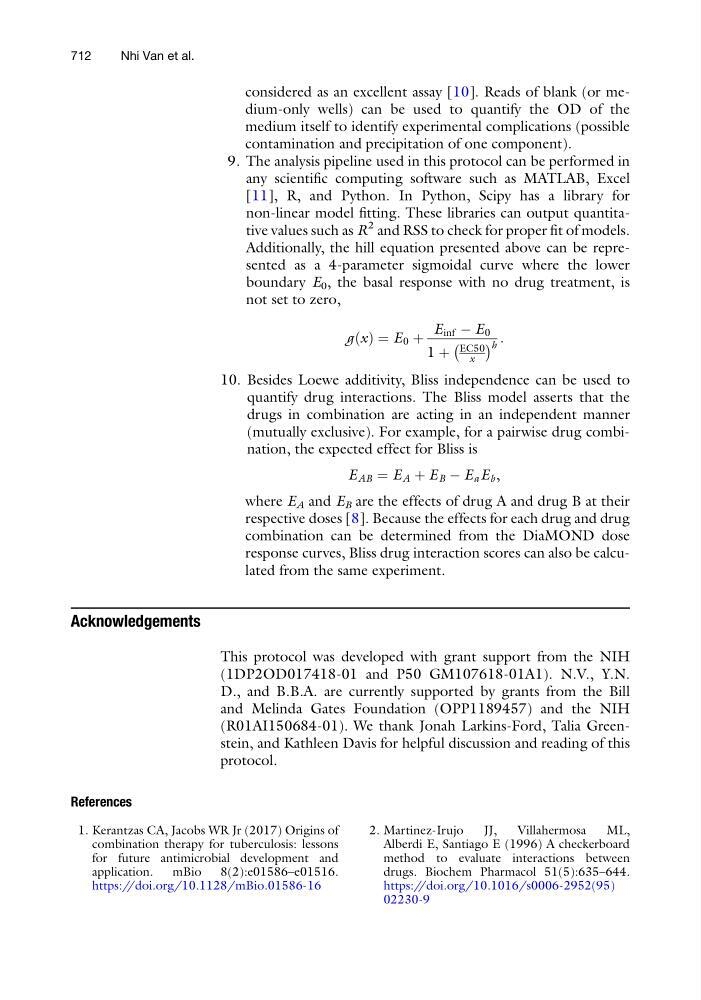
9. The analysis pipeline used in this protocol can be performed in
any scientific computing software such as MATLAB, Excel
[11], R, and Python. In Python, Scipy has a library for
non-linear model fitting. These libraries can output quantitative values such as R
2 and RSS to check for proper fit of models.
Additionally, the hill equation presented above can be represented as a 4-parameter sigmoidal curve where the lower
boundary E 0 , the basal response with no drug treatment, is
not set to zero,
g x
ð Þ ¼ E 0 þ
E inf À E 0
1 þ
EC50
x
À
Á h :
10. Besides Loewe additivity, Bliss independence can be used to
quantify drug interactions. The Bliss model asserts that the
drugs in combination are acting in an independent manner
(mutually exclusive). For example, for a pairwise drug combination, the expected effect for Bliss is
E AB ¼ E A þ E B À E a E b ,
where E A and E B are the effects of drug A and drug B at their
respective doses [8]. Because the effects for each drug and drug
combination can be determined from the DiaMOND dose
response curves, Bliss drug interaction scores can also be calculated from the same experiment.
Acknowledgements
This protocol was developed with grant support from the NIH
(1DP2OD017418-01 and P50 GM107618-01A1). N.V., Y.N.
D., and B.B.A. are currently supported by grants from the Bill
and Melinda Gates Foundation (OPP1189457) and the NIH
(R01AI150684-01). We thank Jonah Larkins-Ford, Talia Greenstein, and Kathleen Davis for helpful discussion and reading of this
protocol.
References
1. Kerantzas CA, Jacobs WR Jr (2017) Origins of
combination therapy for tuberculosis: lessons
for future antimicrobial development and
application.
mBio
8(2):e01586–e01516.
https://doi.org/10.1128/mBio.01586-16
2. Martinez-Irujo
JJ,
Villahermosa
ML,
Alberdi E, Santiago E (1996) A checkerboard
method to evaluate interactions between
drugs. Biochem Pharmacol 51(5):635–644.
https://doi.org/10.1016/s0006-2952(95)
02230-9
712
Nhi Van et al.