

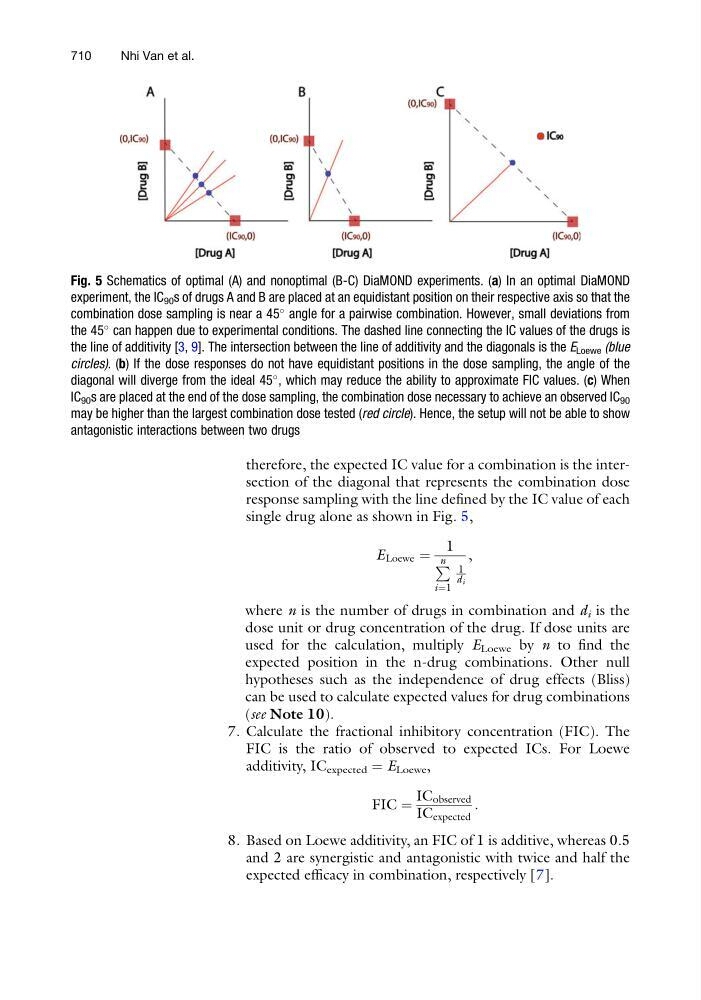
therefore, the expected IC value for a combination is the intersection of the diagonal that represents the combination dose
response sampling with the line defined by the IC value of each
single drug alone as shown in Fig. 5,
E Loewe ¼
1
P n
i¼1
1
d i
,
where n is the number of drugs in combination and d i is the
dose unit or drug concentration of the drug. If dose units are
used for the calculation, multiply E Loewe by n to find the
expected position in the n-drug combinations. Other null
hypotheses such as the independence of drug effects (Bliss)
can be used to calculate expected values for drug combinations
(see Note 10).
7. Calculate the fractional inhibitory concentration (FIC). The
FIC is the ratio of observed to expected ICs. For Loewe
additivity, IC expected ¼ E Loewe ,
FIC ¼
IC observed
IC expected
:
8. Based on Loewe additivity, an FIC of 1 is additive, whereas 0.5
and 2 are synergistic and antagonistic with twice and half the
expected efficacy in combination, respectively [7].
Fig. 5 Schematics of optimal (A) and nonoptimal (B-C) DiaMOND experiments. (a) In an optimal DiaMOND
experiment, the IC 90 s of drugs A and B are placed at an equidistant position on their respective axis so that the
combination dose sampling is near a 45
angle for a pairwise combination. However, small deviations from
the 45
can happen due to experimental conditions. The dashed line connecting the IC values of the drugs is
the line of additivity [3, 9]. The intersection between the line of additivity and the diagonals is the E Loewe (blue
circles). (b) If the dose responses do not have equidistant positions in the dose sampling, the angle of the
diagonal will diverge from the ideal 45
, which may reduce the ability to approximate FIC values. (c) When
IC 90 s are placed at the end of the dose sampling, the combination dose necessary to achieve an observed IC 90
may be higher than the largest combination dose tested (red circle). Hence, the setup will not be able to show
antagonistic interactions between two drugs
710
Nhi Van et al.