

1.1 Platform
and Multiplexing
Selection
The output of RNAseq is dependent on several key parameters.
One of the most important considerations in designing the RNAseq preparation pipeline is deciding the necessary sequencing depth
(i.e., the number of sequenced fragments per sample generated in a
sequencing run), which depends on the desired application, as well
as the genome size and genome complexity of the organism
[4]. For the purposes of quantifying DGE in bacteria, a recent
study in E. coli found that achieving sequencing depth of 5–10
million reads mapped to the organism of interest was sufficient to
quantify the expression levels of both highly and lowly expressed
transcripts [5]. This finding aligns with our experience with RNAseq profiling in M. tuberculosis.
There are two technical parameters that can be adjusted to
achieve the desired sequencing depth: the sequencing platform
and kit used to generate the sequencing data and the extent of
sample multiplexing implemented per sequencing run. There are
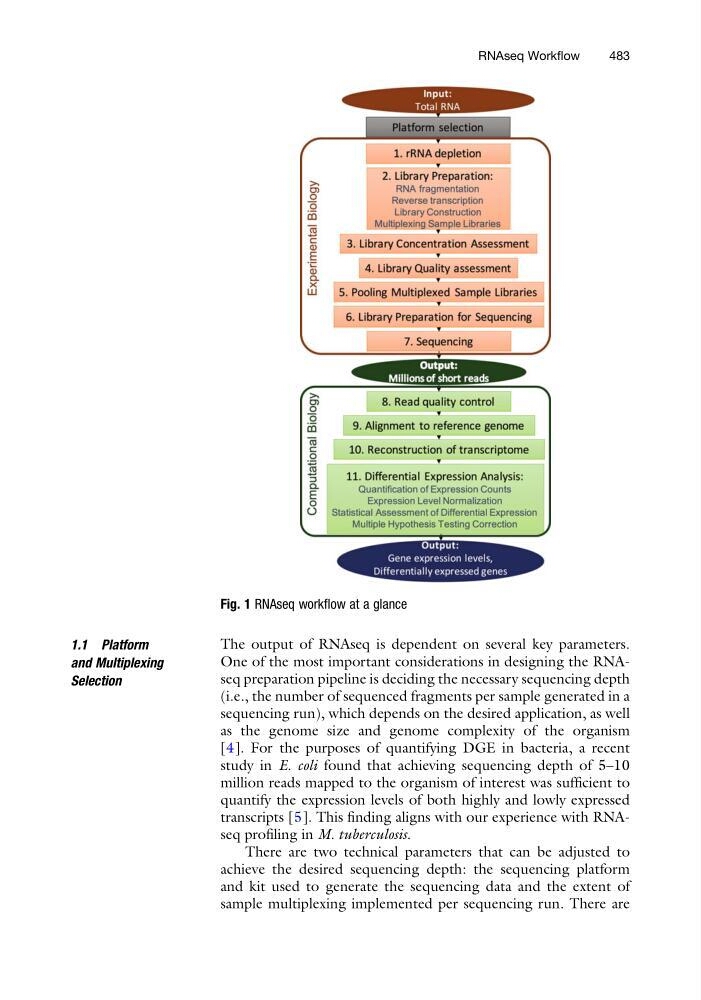
Fig. 1 RNAseq workflow at a glance
RNAseq Workflow
483
and Multiplexing
Selection
The output of RNAseq is dependent on several key parameters.
One of the most important considerations in designing the RNAseq preparation pipeline is deciding the necessary sequencing depth
(i.e., the number of sequenced fragments per sample generated in a
sequencing run), which depends on the desired application, as well
as the genome size and genome complexity of the organism
[4]. For the purposes of quantifying DGE in bacteria, a recent
study in E. coli found that achieving sequencing depth of 5–10
million reads mapped to the organism of interest was sufficient to
quantify the expression levels of both highly and lowly expressed
transcripts [5]. This finding aligns with our experience with RNAseq profiling in M. tuberculosis.
There are two technical parameters that can be adjusted to
achieve the desired sequencing depth: the sequencing platform
and kit used to generate the sequencing data and the extent of
sample multiplexing implemented per sequencing run. There are
Fig. 1 RNAseq workflow at a glance
RNAseq Workflow
483