

that sequencing will be performed on an Illumina sequencing
machine, and that the input sample will be total RNA (for a workflow to isolate and extract total RNA from M. tuberculosis cultures,
please see [3]). The major steps in the RNAseq workflow are summarized in Fig. 1 and include (1) selecting the sequencing platform
and sample multiplexing conditions, (2) rRNA depletion, (3) fragmentation of transcripts, (4) generation of cDNA, (5) generation of
sample “libraries” compatible with Illumina sequencing by ligating
Illumina-compatible adaptor oligonucleotides, (6) multiplexing of
sample libraries, (7) assessment of multiplexed sample library quality, (8) sequencing, (9) computational quality control of the raw
sequence data, (10) computational alignment of sequenced reads
to a reference genome, (11) computational reconstruction of the
transcriptome, (12) computational quantification of gene expression count levels, (13) expression count normalization, and
(14) calculation of differential expression. There are multiple analogous commercially available kits for each of the experimental steps
of this workflow, as well as multiple free and commercially available
computational tools to perform the computational steps of this
workflow. We will describe the considerations of selecting the
sequencing platform and multiplexing conditions, as well as the
considerations that factor into subsequent steps in the Introduction
below. We will then enumerate a protocol using one specific set of
experimental kits and computational tools in Subheadings 3 and 4.
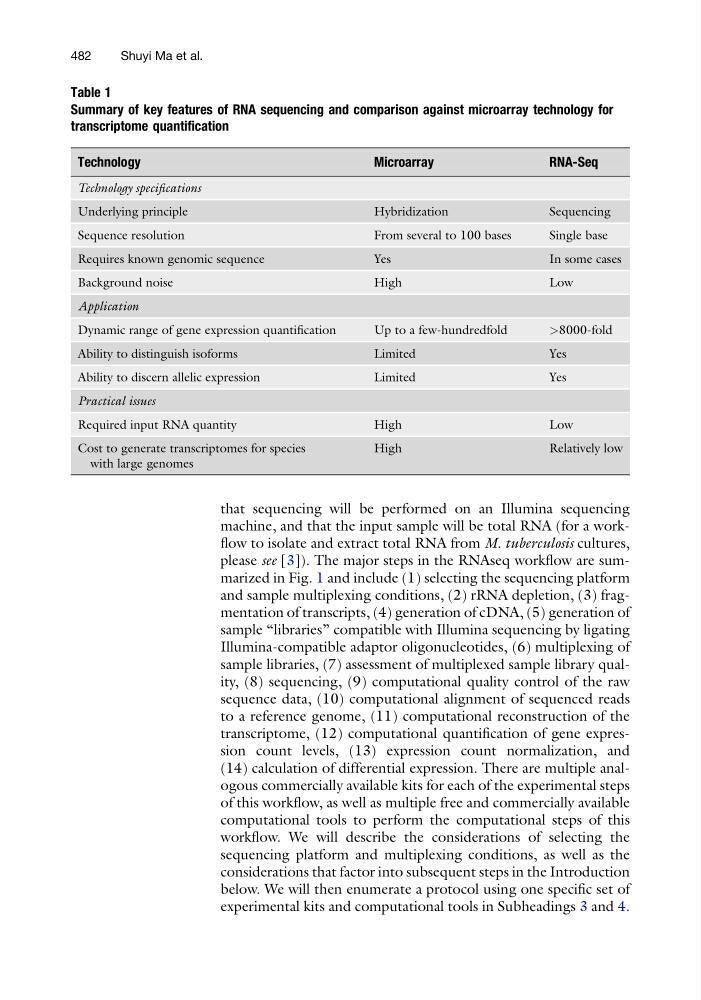
Table 1
Summary of key features of RNA sequencing and comparison against microarray technology for
transcriptome quantification
Technology
Microarray
RNA-Seq
Technology specifications
Underlying principle
Hybridization
Sequencing
Sequence resolution
From several to 100 bases
Single base
Requires known genomic sequence
Yes
In some cases
Background noise
High
Low
Application
Dynamic range of gene expression quantification
Up to a few-hundredfold
>8000-fold
Ability to distinguish isoforms
Limited
Yes
Ability to discern allelic expression
Limited
Yes
Practical issues
Required input RNA quantity
High
Low
Cost to generate transcriptomes for species
with large genomes
High
Relatively low
482
Shuyi Ma et al.
machine, and that the input sample will be total RNA (for a workflow to isolate and extract total RNA from M. tuberculosis cultures,
please see [3]). The major steps in the RNAseq workflow are summarized in Fig. 1 and include (1) selecting the sequencing platform
and sample multiplexing conditions, (2) rRNA depletion, (3) fragmentation of transcripts, (4) generation of cDNA, (5) generation of
sample “libraries” compatible with Illumina sequencing by ligating
Illumina-compatible adaptor oligonucleotides, (6) multiplexing of
sample libraries, (7) assessment of multiplexed sample library quality, (8) sequencing, (9) computational quality control of the raw
sequence data, (10) computational alignment of sequenced reads
to a reference genome, (11) computational reconstruction of the
transcriptome, (12) computational quantification of gene expression count levels, (13) expression count normalization, and
(14) calculation of differential expression. There are multiple analogous commercially available kits for each of the experimental steps
of this workflow, as well as multiple free and commercially available
computational tools to perform the computational steps of this
workflow. We will describe the considerations of selecting the
sequencing platform and multiplexing conditions, as well as the
considerations that factor into subsequent steps in the Introduction
below. We will then enumerate a protocol using one specific set of
experimental kits and computational tools in Subheadings 3 and 4.
Table 1
Summary of key features of RNA sequencing and comparison against microarray technology for
transcriptome quantification
Technology
Microarray
RNA-Seq
Technology specifications
Underlying principle
Hybridization
Sequencing
Sequence resolution
From several to 100 bases
Single base
Requires known genomic sequence
Yes
In some cases
Background noise
High
Low
Application
Dynamic range of gene expression quantification
Up to a few-hundredfold
>8000-fold
Ability to distinguish isoforms
Limited
Yes
Ability to discern allelic expression
Limited
Yes
Practical issues
Required input RNA quantity
High
Low
Cost to generate transcriptomes for species
with large genomes
High
Relatively low
482
Shuyi Ma et al.