

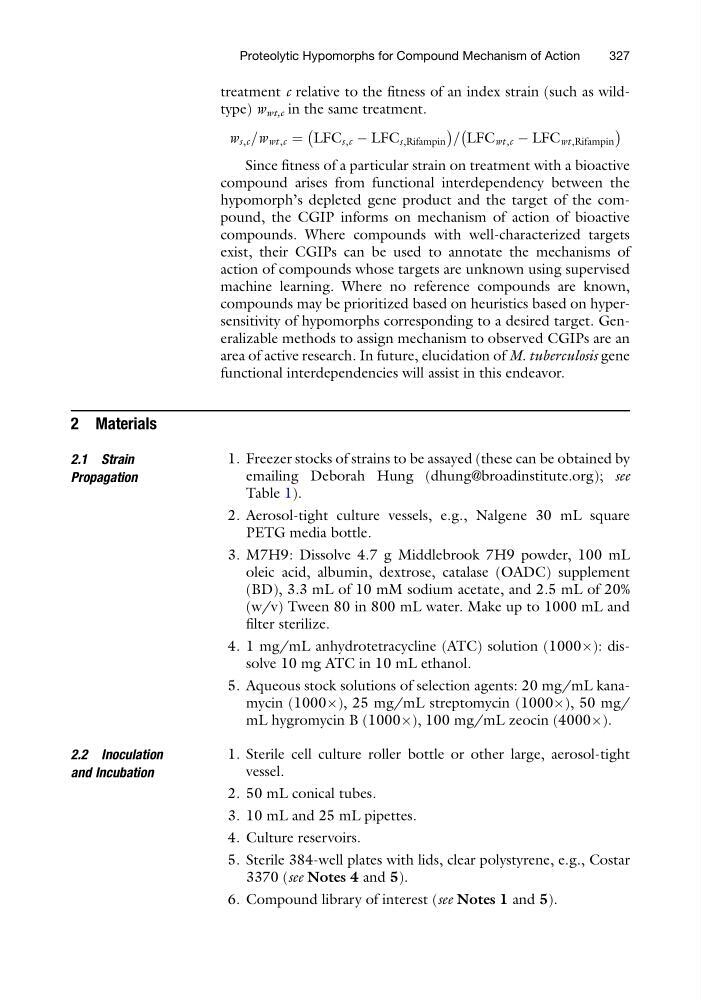
treatment c relative to the fitness of an index strain (such as wildtype) w wt,c in the same treatment.
w s,c =w wt,c ¼ LFC s,c À LFC s,Rifampin
À
Á = LFC wt,c À LFC wt,Rifampin
À
Á
Since fitness of a particular strain on treatment with a bioactive
compound arises from functional interdependency between the
hypomorph’s depleted gene product and the target of the compound, the CGIP informs on mechanism of action of bioactive
compounds. Where compounds with well-characterized targets
exist, their CGIPs can be used to annotate the mechanisms of
action of compounds whose targets are unknown using supervised
machine learning. Where no reference compounds are known,
compounds may be prioritized based on heuristics based on hypersensitivity of hypomorphs corresponding to a desired target. Generalizable methods to assign mechanism to observed CGIPs are an
area of active research. In future, elucidation of M. tuberculosis gene
functional interdependencies will assist in this endeavor.
2 Materials
2.1 Strain
Propagation
1. Freezer stocks of strains to be assayed (these can be obtained by
emailing Deborah Hung (dhung@broadinstitute.org); see
Table 1).
2. Aerosol-tight culture vessels, e.g., Nalgene 30 mL square
PETG media bottle.
3. M7H9: Dissolve 4.7 g Middlebrook 7H9 powder, 100 mL
oleic acid, albumin, dextrose, catalase (OADC) supplement
(BD), 3.3 mL of 10 mM sodium acetate, and 2.5 mL of 20%
(w/v) Tween 80 in 800 mL water. Make up to 1000 mL and
filter sterilize.
4. 1 mg/mL anhydrotetracycline (ATC) solution (1000Â): dissolve 10 mg ATC in 10 mL ethanol.
5. Aqueous stock solutions of selection agents: 20 mg/mL kanamycin (1000Â), 25 mg/mL streptomycin (1000Â), 50 mg/
mL hygromycin B (1000Â), 100 mg/mL zeocin (4000Â).
2.2 Inoculation
and Incubation
1. Sterile cell culture roller bottle or other large, aerosol-tight
vessel.
2. 50 mL conical tubes.
3. 10 mL and 25 mL pipettes.
4. Culture reservoirs.
5. Sterile 384-well plates with lids, clear polystyrene, e.g., Costar
3370 (see Notes 4 and 5).
6. Compound library of interest (see Notes 1 and 5).
Proteolytic Hypomorphs for Compound Mechanism of Action
327
w s,c =w wt,c ¼ LFC s,c À LFC s,Rifampin
À
Á = LFC wt,c À LFC wt,Rifampin
À
Á
Since fitness of a particular strain on treatment with a bioactive
compound arises from functional interdependency between the
hypomorph’s depleted gene product and the target of the compound, the CGIP informs on mechanism of action of bioactive
compounds. Where compounds with well-characterized targets
exist, their CGIPs can be used to annotate the mechanisms of
action of compounds whose targets are unknown using supervised
machine learning. Where no reference compounds are known,
compounds may be prioritized based on heuristics based on hypersensitivity of hypomorphs corresponding to a desired target. Generalizable methods to assign mechanism to observed CGIPs are an
area of active research. In future, elucidation of M. tuberculosis gene
functional interdependencies will assist in this endeavor.
2 Materials
2.1 Strain
Propagation
1. Freezer stocks of strains to be assayed (these can be obtained by
emailing Deborah Hung (dhung@broadinstitute.org); see
Table 1).
2. Aerosol-tight culture vessels, e.g., Nalgene 30 mL square
PETG media bottle.
3. M7H9: Dissolve 4.7 g Middlebrook 7H9 powder, 100 mL
oleic acid, albumin, dextrose, catalase (OADC) supplement
(BD), 3.3 mL of 10 mM sodium acetate, and 2.5 mL of 20%
(w/v) Tween 80 in 800 mL water. Make up to 1000 mL and
filter sterilize.
4. 1 mg/mL anhydrotetracycline (ATC) solution (1000Â): dissolve 10 mg ATC in 10 mL ethanol.
5. Aqueous stock solutions of selection agents: 20 mg/mL kanamycin (1000Â), 25 mg/mL streptomycin (1000Â), 50 mg/
mL hygromycin B (1000Â), 100 mg/mL zeocin (4000Â).
2.2 Inoculation
and Incubation
1. Sterile cell culture roller bottle or other large, aerosol-tight
vessel.
2. 50 mL conical tubes.
3. 10 mL and 25 mL pipettes.
4. Culture reservoirs.
5. Sterile 384-well plates with lids, clear polystyrene, e.g., Costar
3370 (see Notes 4 and 5).
6. Compound library of interest (see Notes 1 and 5).
Proteolytic Hypomorphs for Compound Mechanism of Action
327