

nontuberculous mycobacteria. In this context, obviously
M. tuberculosis does not belong to the slowly growing NTM and
M. leprae and M. ulcerans are often listed separately and not part of
the SGM/NTM. On the disease side, it is even clearer, as these are
referred as tuberculosis, leprosy, Buruli ulcer, and diseases caused
by NTM.
1.2 Solid Media
Egg-based media, the most common being Lo ¨wenstein–Jensen
(L-J), will support growth of most mycobacteria. In addition to
egg, L-J also contains potato starch and glycerol. The concentration of malachite green will inhibit the growth of many other
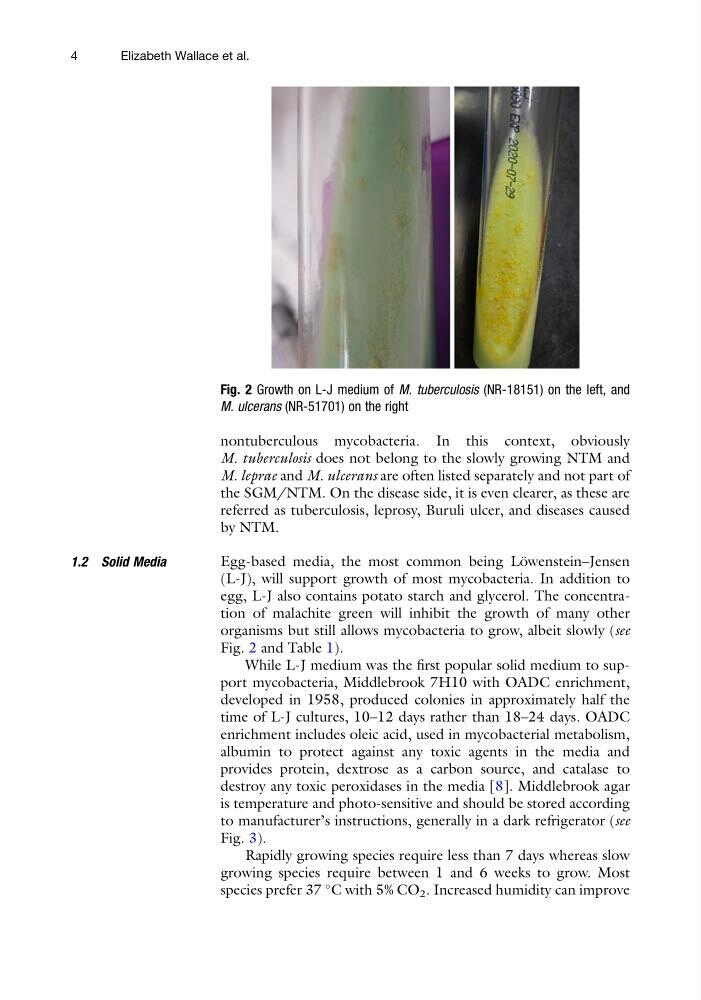
organisms but still allows mycobacteria to grow, albeit slowly (see
Fig. 2 and Table 1).
While L-J medium was the first popular solid medium to support mycobacteria, Middlebrook 7H10 with OADC enrichment,
developed in 1958, produced colonies in approximately half the
time of L-J cultures, 10–12 days rather than 18–24 days. OADC
enrichment includes oleic acid, used in mycobacterial metabolism,
albumin to protect against any toxic agents in the media and
provides protein, dextrose as a carbon source, and catalase to
destroy any toxic peroxidases in the media [8]. Middlebrook agar
is temperature and photo-sensitive and should be stored according
to manufacturer’s instructions, generally in a dark refrigerator (see
Fig. 3).
Rapidly growing species require less than 7 days whereas slow
growing species require between 1 and 6 weeks to grow. Most
species prefer 37
C with 5% CO 2 . Increased humidity can improve
Fig. 2 Growth on L-J medium of M. tuberculosis (NR-18151) on the left, and
M. ulcerans (NR-51701) on the right
4
Elizabeth Wallace et al.
M. tuberculosis does not belong to the slowly growing NTM and
M. leprae and M. ulcerans are often listed separately and not part of
the SGM/NTM. On the disease side, it is even clearer, as these are
referred as tuberculosis, leprosy, Buruli ulcer, and diseases caused
by NTM.
1.2 Solid Media
Egg-based media, the most common being Lo ¨wenstein–Jensen
(L-J), will support growth of most mycobacteria. In addition to
egg, L-J also contains potato starch and glycerol. The concentration of malachite green will inhibit the growth of many other
organisms but still allows mycobacteria to grow, albeit slowly (see
Fig. 2 and Table 1).
While L-J medium was the first popular solid medium to support mycobacteria, Middlebrook 7H10 with OADC enrichment,
developed in 1958, produced colonies in approximately half the
time of L-J cultures, 10–12 days rather than 18–24 days. OADC
enrichment includes oleic acid, used in mycobacterial metabolism,
albumin to protect against any toxic agents in the media and
provides protein, dextrose as a carbon source, and catalase to
destroy any toxic peroxidases in the media [8]. Middlebrook agar
is temperature and photo-sensitive and should be stored according
to manufacturer’s instructions, generally in a dark refrigerator (see
Fig. 3).
Rapidly growing species require less than 7 days whereas slow
growing species require between 1 and 6 weeks to grow. Most
species prefer 37
C with 5% CO 2 . Increased humidity can improve
Fig. 2 Growth on L-J medium of M. tuberculosis (NR-18151) on the left, and
M. ulcerans (NR-51701) on the right
4
Elizabeth Wallace et al.