

technical support are available through the Colorado CF Research
and Development Program, located at National Jewish Health in
Denver and funded by the CF Foundation (https://www.
nationaljewish.org/cocfrdp).
1.1 Mycobacterium
Growth
The Mycobacterium genus was initially composed of more than
190 closely related species [3]. This genus was recently reclassified
into five different genera: Mycobacterium, Mycobacteroides, Mycolicibacterium, Mycolycibacterium, and Mycolicibacillus [4]. However,
this new taxonomy is generating controversy and has not been
accepted by all stakeholders [5]. Because the new taxonomic classification bears no relevance on the way, these organisms are grown,
for the sake of simplicity, in this chapter we use the general term
mycobacteria to refer to species in the Mycobacterium genus as well
as the four new genera derived from it.
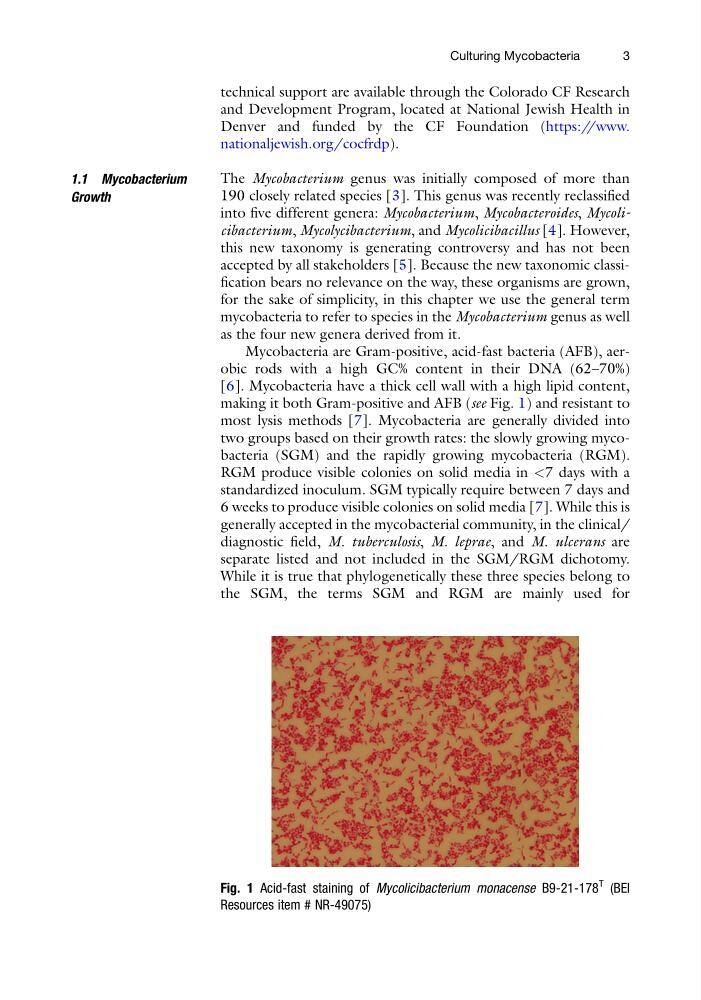
Mycobacteria are Gram-positive, acid-fast bacteria (AFB), aerobic rods with a high GC% content in their DNA (62–70%)
[6]. Mycobacteria have a thick cell wall with a high lipid content,
making it both Gram-positive and AFB (see Fig. 1) and resistant to
most lysis methods [7]. Mycobacteria are generally divided into
two groups based on their growth rates: the slowly growing mycobacteria (SGM) and the rapidly growing mycobacteria (RGM).
RGM produce visible colonies on solid media in <7 days with a
standardized inoculum. SGM typically require between 7 days and
6 weeks to produce visible colonies on solid media [7]. While this is
generally accepted in the mycobacterial community, in the clinical/
diagnostic field, M. tuberculosis, M. leprae, and M. ulcerans are
separate listed and not included in the SGM/RGM dichotomy.
While it is true that phylogenetically these three species belong to
the SGM, the terms SGM and RGM are mainly used for
Fig. 1 Acid-fast staining of Mycolicibacterium monacense B9-21-178
T
(BEI
Resources item # NR-49075)
Culturing Mycobacteria
3
and Development Program, located at National Jewish Health in
Denver and funded by the CF Foundation (https://www.
nationaljewish.org/cocfrdp).
1.1 Mycobacterium
Growth
The Mycobacterium genus was initially composed of more than
190 closely related species [3]. This genus was recently reclassified
into five different genera: Mycobacterium, Mycobacteroides, Mycolicibacterium, Mycolycibacterium, and Mycolicibacillus [4]. However,
this new taxonomy is generating controversy and has not been
accepted by all stakeholders [5]. Because the new taxonomic classification bears no relevance on the way, these organisms are grown,
for the sake of simplicity, in this chapter we use the general term
mycobacteria to refer to species in the Mycobacterium genus as well
as the four new genera derived from it.
Mycobacteria are Gram-positive, acid-fast bacteria (AFB), aerobic rods with a high GC% content in their DNA (62–70%)
[6]. Mycobacteria have a thick cell wall with a high lipid content,
making it both Gram-positive and AFB (see Fig. 1) and resistant to
most lysis methods [7]. Mycobacteria are generally divided into
two groups based on their growth rates: the slowly growing mycobacteria (SGM) and the rapidly growing mycobacteria (RGM).
RGM produce visible colonies on solid media in <7 days with a
standardized inoculum. SGM typically require between 7 days and
6 weeks to produce visible colonies on solid media [7]. While this is
generally accepted in the mycobacterial community, in the clinical/
diagnostic field, M. tuberculosis, M. leprae, and M. ulcerans are
separate listed and not included in the SGM/RGM dichotomy.
While it is true that phylogenetically these three species belong to
the SGM, the terms SGM and RGM are mainly used for
Fig. 1 Acid-fast staining of Mycolicibacterium monacense B9-21-178
T
(BEI
Resources item # NR-49075)
Culturing Mycobacteria
3