

4 Notes
1. D-Pantothenic acid hemicalcium salt is used as a supplement to
allow growth of panCD mutants of M. tuberculosis, including
mc
2 7000. These severely attenuated mutants have been proven
to be safe for use in a BSL-2 laboratory [23, 24] and are very
useful in molecular studies of M. tuberculosis in a host-free
environment.
2. Repeated washing of cells is necessary to minimize contaminating levels of zinc in the inoculum that can introduce significant
level of irreproducibility in the timings of ribosome remodeling
and hibernation.
3. Consistency in inoculum size is important for obtaining a
reproducible pattern of separation between the timings of C+
to CÀ remodeling and hibernation of CÀ ribosomes. Moreover, a 2-L flask should be used for 500 mL culture to provide
sufficient aeration necessary for cellular growth.
4. Remodeling of ribosome is transcriptionally regulated by the
zinc-responsive transcriptional repressor, Zur [12, 20], which
under zinc limitation derepresses the promoters of genes
encoding the CÀ ribosomal proteins. Thus, the induction of
genes encoding CÀ ribosomal proteins is a valid indicator of
ribosome remodeling. Measurement of CÀ transcripts by
RT-PCR from an aliquot, prior to freezing the culture, is
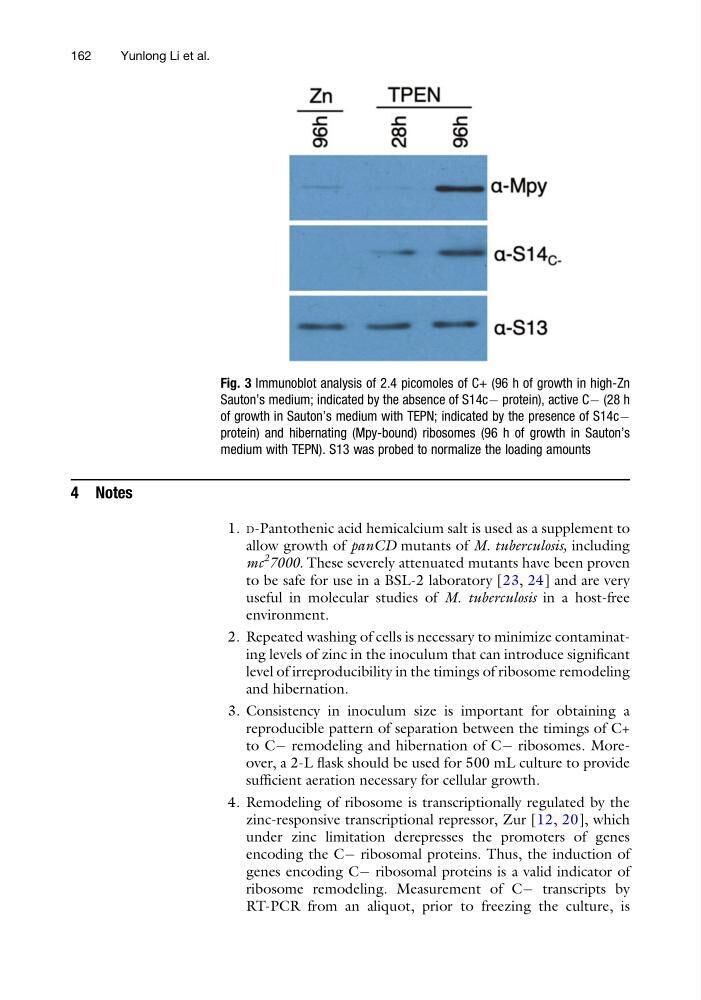
Fig. 3 Immunoblot analysis of 2.4 picomoles of C+ (96 h of growth in high-Zn
Sauton’s medium; indicated by the absence of S14cÀ protein), active CÀ (28 h
of growth in Sauton’s medium with TEPN; indicated by the presence of S14cÀ
protein) and hibernating (Mpy-bound) ribosomes (96 h of growth in Sauton’s
medium with TEPN). S13 was probed to normalize the loading amounts
162
Yunlong Li et al.
1. D-Pantothenic acid hemicalcium salt is used as a supplement to
allow growth of panCD mutants of M. tuberculosis, including
mc
2 7000. These severely attenuated mutants have been proven
to be safe for use in a BSL-2 laboratory [23, 24] and are very
useful in molecular studies of M. tuberculosis in a host-free
environment.
2. Repeated washing of cells is necessary to minimize contaminating levels of zinc in the inoculum that can introduce significant
level of irreproducibility in the timings of ribosome remodeling
and hibernation.
3. Consistency in inoculum size is important for obtaining a
reproducible pattern of separation between the timings of C+
to CÀ remodeling and hibernation of CÀ ribosomes. Moreover, a 2-L flask should be used for 500 mL culture to provide
sufficient aeration necessary for cellular growth.
4. Remodeling of ribosome is transcriptionally regulated by the
zinc-responsive transcriptional repressor, Zur [12, 20], which
under zinc limitation derepresses the promoters of genes
encoding the CÀ ribosomal proteins. Thus, the induction of
genes encoding CÀ ribosomal proteins is a valid indicator of
ribosome remodeling. Measurement of CÀ transcripts by
RT-PCR from an aliquot, prior to freezing the culture, is
Fig. 3 Immunoblot analysis of 2.4 picomoles of C+ (96 h of growth in high-Zn
Sauton’s medium; indicated by the absence of S14cÀ protein), active CÀ (28 h
of growth in Sauton’s medium with TEPN; indicated by the presence of S14cÀ
protein) and hibernating (Mpy-bound) ribosomes (96 h of growth in Sauton’s
medium with TEPN). S13 was probed to normalize the loading amounts
162
Yunlong Li et al.