

Processes 2019, 7,20
ε = 0.5 in combination with G Ca 2+ = 0.032
mS
cm 2 does not yield MMOs, cf. Figure 9. The reason for this
is that the condition 0 < ε ≪ 1 is not suitable satisfied. Notice that there is no explicit condition how
small ε has to be, only it has to be much smaller than 1. Nevertheless, Figure 9 shows the system
(1) exhibits MMOs, but for smaller values of G Ca 2+ . For a more suitable visualisation of Figure 9,
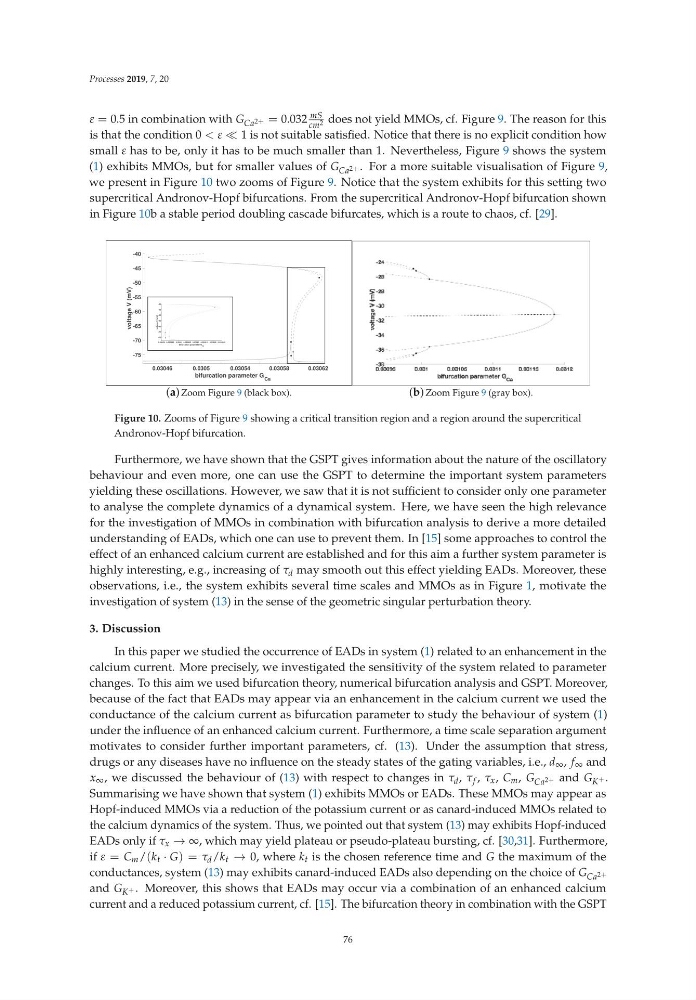
we present in Figure 10 two zooms of Figure 9. Notice that the system exhibits for this setting two
supercritical Andronov-Hopf bifurcations. From the supercritical Andronov-Hopf bifurcation shown
in Figure 10b a stable period doubling cascade bifurcates, which is a route to chaos, cf. [29].
0.03046
0.0305
0.03054
0.03058
0.03062
bifurcation parameter G Ca
-75
-70
-65
-60
-55
-50
-45
-40
voltage V (mV)
0.03059 0.030595 0.0306 0.030605 0.03061 0.030615 0.03062 0.030625
bifurcation parameter GCa
-75
-70
-65
-60
-55
-50
-45
voltage V (mV)
(a) Zoom Figure 9 (black box).
(b) Zoom Figure 9 (gray box).
Figure 10. Zooms of Figure 9 showing a critical transition region and a region around the supercritical
Andronov-Hopf bifurcation.
Furthermore, we have shown that the GSPT gives information about the nature of the oscillatory
behaviour and even more, one can use the GSPT to determine the important system parameters
yielding these oscillations. However, we saw that it is not sufficient to consider only one parameter
to analyse the complete dynamics of a dynamical system. Here, we have seen the high relevance
for the investigation of MMOs in combination with bifurcation analysis to derive a more detailed
understanding of EADs, which one can use to prevent them. In [15] some approaches to control the
effect of an enhanced calcium current are established and for this aim a further system parameter is
highly interesting, e.g., increasing of τ d may smooth out this effect yielding EADs. Moreover, these
observations, i.e., the system exhibits several time scales and MMOs as in Figure 1, motivate the
investigation of system (13) in the sense of the geometric singular perturbation theory.
3. Discussion
In this paper we studied the occurrence of EADs in system (1) related to an enhancement in the
calcium current. More precisely, we investigated the sensitivity of the system related to parameter
changes. To this aim we used bifurcation theory, numerical bifurcation analysis and GSPT. Moreover,
because of the fact that EADs may appear via an enhancement in the calcium current we used the
conductance of the calcium current as bifurcation parameter to study the behaviour of system (1)
under the influence of an enhanced calcium current. Furthermore, a time scale separation argument
motivates to consider further important parameters, cf. (13). Under the assumption that stress,
drugs or any diseases have no influence on the steady states of the gating variables, i.e., d ∞ , f ∞ and
x ∞ , we discussed the behaviour of (13) with respect to changes in τ d , τ f , τ x , C m , G Ca 2+ and G K + .
Summarising we have shown that system (1) exhibits MMOs or EADs. These MMOs may appear as
Hopf-induced MMOs via a reduction of the potassium current or as canard-induced MMOs related to
the calcium dynamics of the system. Thus, we pointed out that system (13) may exhibits Hopf-induced
EADs only if τ x → ∞, which may yield plateau or pseudo-plateau bursting, cf. [30,31]. Furthermore,
if ε = C m /(k t · G)=τ d /k t → 0, where k t is the chosen reference time and G the maximum of the
conductances, system (13) may exhibits canard-induced EADs also depending on the choice of G Ca 2+
and G K + . Moreover, this shows that EADs may occur via a combination of an enhanced calcium
current and a reduced potassium current, cf. [15]. The bifurcation theory in combination with the GSPT
76
ε = 0.5 in combination with G Ca 2+ = 0.032
mS
cm 2 does not yield MMOs, cf. Figure 9. The reason for this
is that the condition 0 < ε ≪ 1 is not suitable satisfied. Notice that there is no explicit condition how
small ε has to be, only it has to be much smaller than 1. Nevertheless, Figure 9 shows the system
(1) exhibits MMOs, but for smaller values of G Ca 2+ . For a more suitable visualisation of Figure 9,
we present in Figure 10 two zooms of Figure 9. Notice that the system exhibits for this setting two
supercritical Andronov-Hopf bifurcations. From the supercritical Andronov-Hopf bifurcation shown
in Figure 10b a stable period doubling cascade bifurcates, which is a route to chaos, cf. [29].
0.03046
0.0305
0.03054
0.03058
0.03062
bifurcation parameter G Ca
-75
-70
-65
-60
-55
-50
-45
-40
voltage V (mV)
0.03059 0.030595 0.0306 0.030605 0.03061 0.030615 0.03062 0.030625
bifurcation parameter GCa
-75
-70
-65
-60
-55
-50
-45
voltage V (mV)
(a) Zoom Figure 9 (black box).
(b) Zoom Figure 9 (gray box).
Figure 10. Zooms of Figure 9 showing a critical transition region and a region around the supercritical
Andronov-Hopf bifurcation.
Furthermore, we have shown that the GSPT gives information about the nature of the oscillatory
behaviour and even more, one can use the GSPT to determine the important system parameters
yielding these oscillations. However, we saw that it is not sufficient to consider only one parameter
to analyse the complete dynamics of a dynamical system. Here, we have seen the high relevance
for the investigation of MMOs in combination with bifurcation analysis to derive a more detailed
understanding of EADs, which one can use to prevent them. In [15] some approaches to control the
effect of an enhanced calcium current are established and for this aim a further system parameter is
highly interesting, e.g., increasing of τ d may smooth out this effect yielding EADs. Moreover, these
observations, i.e., the system exhibits several time scales and MMOs as in Figure 1, motivate the
investigation of system (13) in the sense of the geometric singular perturbation theory.
3. Discussion
In this paper we studied the occurrence of EADs in system (1) related to an enhancement in the
calcium current. More precisely, we investigated the sensitivity of the system related to parameter
changes. To this aim we used bifurcation theory, numerical bifurcation analysis and GSPT. Moreover,
because of the fact that EADs may appear via an enhancement in the calcium current we used the
conductance of the calcium current as bifurcation parameter to study the behaviour of system (1)
under the influence of an enhanced calcium current. Furthermore, a time scale separation argument
motivates to consider further important parameters, cf. (13). Under the assumption that stress,
drugs or any diseases have no influence on the steady states of the gating variables, i.e., d ∞ , f ∞ and
x ∞ , we discussed the behaviour of (13) with respect to changes in τ d , τ f , τ x , C m , G Ca 2+ and G K + .
Summarising we have shown that system (1) exhibits MMOs or EADs. These MMOs may appear as
Hopf-induced MMOs via a reduction of the potassium current or as canard-induced MMOs related to
the calcium dynamics of the system. Thus, we pointed out that system (13) may exhibits Hopf-induced
EADs only if τ x → ∞, which may yield plateau or pseudo-plateau bursting, cf. [30,31]. Furthermore,
if ε = C m /(k t · G)=τ d /k t → 0, where k t is the chosen reference time and G the maximum of the
conductances, system (13) may exhibits canard-induced EADs also depending on the choice of G Ca 2+
and G K + . Moreover, this shows that EADs may occur via a combination of an enhanced calcium
current and a reduced potassium current, cf. [15]. The bifurcation theory in combination with the GSPT
76