

Processes 2019, 7,37
for better understanding of the immune system in cancer. In the following section, we provide an
overview of the current computational modeling approaches for the study of cancer.
3. Overview of Computational Modeling Methodologies including Agent-Based Modeling
Computational modeling has provided great insight into studying intra-tumor heterogeneity [45]
and the interplay between the tumor and the microenvironment [46]. Modeling has the benefit of
providing a quantitative time- and cost-effective means to study the physical and chemical interactions
in tumor initiation and growth. Modeling efforts complement experimental platforms by providing an
understanding of clonal dynamics and microenvironmental cues over time. There are several ways
to classify mathematical/computational models in general, and cancer models in particular. One is
deterministic vs. stochastic; another is continuum vs. discrete models. Deterministic models have an
end state that does not change as long as the initial conditions remain the same, whereas stochastic
models have randomness included, resulting in differences in end states, even with the same initial
conditions. Continuum models treat cells as concentrations of cell types, whereas discrete models (such
as agent-based or particle models) consider discrete cells; the cell behaviors, including interactions
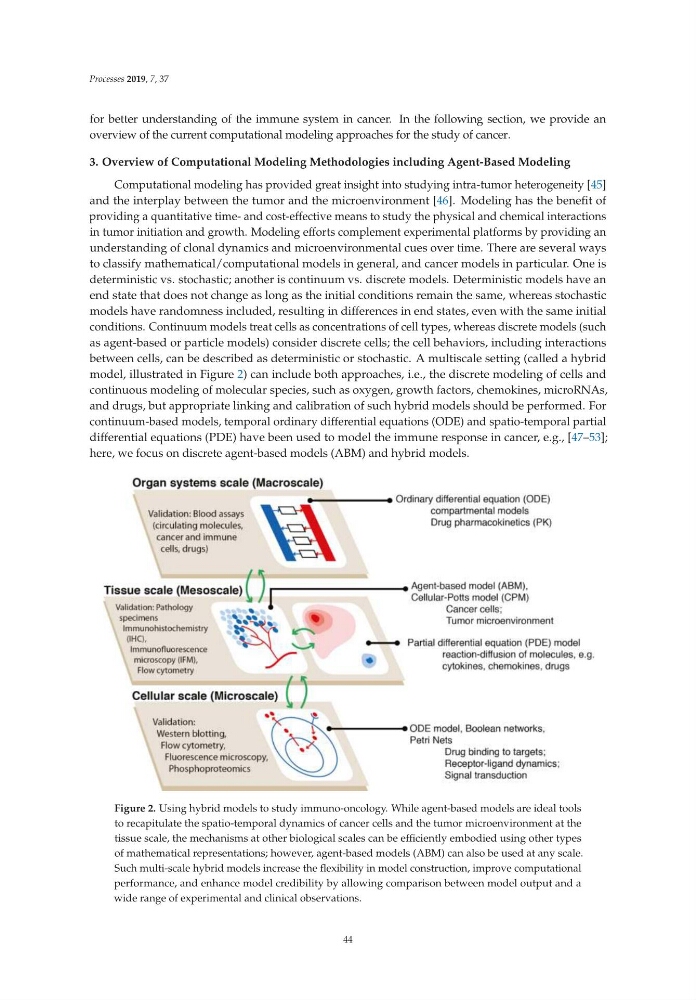
between cells, can be described as deterministic or stochastic. A multiscale setting (called a hybrid
model, illustrated in Figure 2) can include both approaches, i.e., the discrete modeling of cells and
continuous modeling of molecular species, such as oxygen, growth factors, chemokines, microRNAs,
and drugs, but appropriate linking and calibration of such hybrid models should be performed. For
continuum-based models, temporal ordinary differential equations (ODE) and spatio-temporal partial
differential equations (PDE) have been used to model the immune response in cancer, e.g., [47–53];
here, we focus on discrete agent-based models (ABM) and hybrid models.
Figure 2. Using hybrid models to study immuno-oncology. While agent-based models are ideal tools
to recapitulate the spatio-temporal dynamics of cancer cells and the tumor microenvironment at the
tissue scale, the mechanisms at other biological scales can be efficiently embodied using other types
of mathematical representations; however, agent-based models (ABM) can also be used at any scale.
Such multi-scale hybrid models increase the flexibility in model construction, improve computational
performance, and enhance model credibility by allowing comparison between model output and a
wide range of experimental and clinical observations.
44
for better understanding of the immune system in cancer. In the following section, we provide an
overview of the current computational modeling approaches for the study of cancer.
3. Overview of Computational Modeling Methodologies including Agent-Based Modeling
Computational modeling has provided great insight into studying intra-tumor heterogeneity [45]
and the interplay between the tumor and the microenvironment [46]. Modeling has the benefit of
providing a quantitative time- and cost-effective means to study the physical and chemical interactions
in tumor initiation and growth. Modeling efforts complement experimental platforms by providing an
understanding of clonal dynamics and microenvironmental cues over time. There are several ways
to classify mathematical/computational models in general, and cancer models in particular. One is
deterministic vs. stochastic; another is continuum vs. discrete models. Deterministic models have an
end state that does not change as long as the initial conditions remain the same, whereas stochastic
models have randomness included, resulting in differences in end states, even with the same initial
conditions. Continuum models treat cells as concentrations of cell types, whereas discrete models (such
as agent-based or particle models) consider discrete cells; the cell behaviors, including interactions
between cells, can be described as deterministic or stochastic. A multiscale setting (called a hybrid
model, illustrated in Figure 2) can include both approaches, i.e., the discrete modeling of cells and
continuous modeling of molecular species, such as oxygen, growth factors, chemokines, microRNAs,
and drugs, but appropriate linking and calibration of such hybrid models should be performed. For
continuum-based models, temporal ordinary differential equations (ODE) and spatio-temporal partial
differential equations (PDE) have been used to model the immune response in cancer, e.g., [47–53];
here, we focus on discrete agent-based models (ABM) and hybrid models.
Figure 2. Using hybrid models to study immuno-oncology. While agent-based models are ideal tools
to recapitulate the spatio-temporal dynamics of cancer cells and the tumor microenvironment at the
tissue scale, the mechanisms at other biological scales can be efficiently embodied using other types
of mathematical representations; however, agent-based models (ABM) can also be used at any scale.
Such multi-scale hybrid models increase the flexibility in model construction, improve computational
performance, and enhance model credibility by allowing comparison between model output and a
wide range of experimental and clinical observations.
44