

Processes 2019, 7,97
F. prausnitzii (Strain A2-165) [90], and E. coli (Strain K-12 MG1655) [91]. The biofilm was considered to
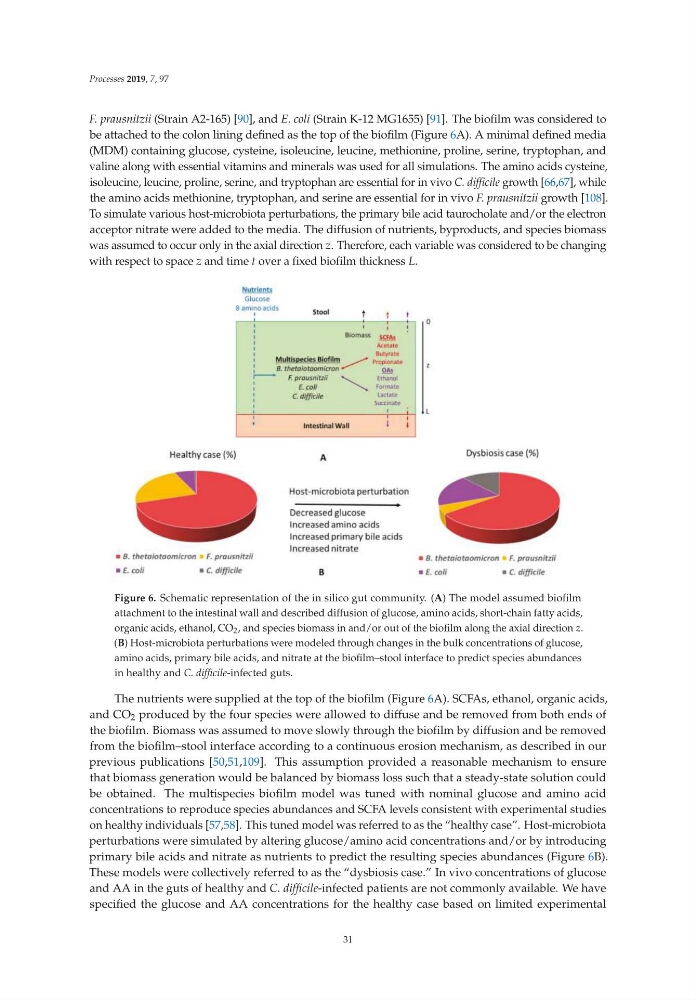
be attached to the colon lining defined as the top of the biofilm (Figure 6A). A minimal defined media
(MDM) containing glucose, cysteine, isoleucine, leucine, methionine, proline, serine, tryptophan, and
valine along with essential vitamins and minerals was used for all simulations. The amino acids cysteine,
isoleucine, leucine, proline, serine, and tryptophan are essential for in vivo C. difficile growth [66,67], while
the amino acids methionine, tryptophan, and serine are essential for in vivo F. prausnitzii growth [108].
To simulate various host-microbiota perturbations, the primary bile acid taurocholate and/or the electron
acceptor nitrate were added to the media. The diffusion of nutrients, byproducts, and species biomass
was assumed to occur only in the axial direction z. Therefore, each variable was considered to be changing
with respect to space z and time t over a fixed biofilm thickness L.
Figure 6. Schematic representation of the in silico gut community. (A) The model assumed biofilm
attachment to the intestinal wall and described diffusion of glucose, amino acids, short-chain fatty acids,
organic acids, ethanol, CO 2 , and species biomass in and/or out of the biofilm along the axial direction z.
(B) Host-microbiota perturbations were modeled through changes in the bulk concentrations of glucose,
amino acids, primary bile acids, and nitrate at the biofilm–stool interface to predict species abundances
in healthy and C. difficile-infected guts.
The nutrients were supplied at the top of the biofilm (Figure 6A). SCFAs, ethanol, organic acids,
and CO 2 produced by the four species were allowed to diffuse and be removed from both ends of
the biofilm. Biomass was assumed to move slowly through the biofilm by diffusion and be removed
from the biofilm–stool interface according to a continuous erosion mechanism, as described in our
previous publications [50,51,109]. This assumption provided a reasonable mechanism to ensure
that biomass generation would be balanced by biomass loss such that a steady-state solution could
be obtained. The multispecies biofilm model was tuned with nominal glucose and amino acid
concentrations to reproduce species abundances and SCFA levels consistent with experimental studies
on healthy individuals [57,58]. This tuned model was referred to as the “healthy case”. Host-microbiota
perturbations were simulated by altering glucose/amino acid concentrations and/or by introducing
primary bile acids and nitrate as nutrients to predict the resulting species abundances (Figure 6B).
These models were collectively referred to as the “dysbiosis case.” In vivo concentrations of glucose
and AA in the guts of healthy and C. difficile-infected patients are not commonly available. We have
specified the glucose and AA concentrations for the healthy case based on limited experimental
31
F. prausnitzii (Strain A2-165) [90], and E. coli (Strain K-12 MG1655) [91]. The biofilm was considered to
be attached to the colon lining defined as the top of the biofilm (Figure 6A). A minimal defined media
(MDM) containing glucose, cysteine, isoleucine, leucine, methionine, proline, serine, tryptophan, and
valine along with essential vitamins and minerals was used for all simulations. The amino acids cysteine,
isoleucine, leucine, proline, serine, and tryptophan are essential for in vivo C. difficile growth [66,67], while
the amino acids methionine, tryptophan, and serine are essential for in vivo F. prausnitzii growth [108].
To simulate various host-microbiota perturbations, the primary bile acid taurocholate and/or the electron
acceptor nitrate were added to the media. The diffusion of nutrients, byproducts, and species biomass
was assumed to occur only in the axial direction z. Therefore, each variable was considered to be changing
with respect to space z and time t over a fixed biofilm thickness L.
Figure 6. Schematic representation of the in silico gut community. (A) The model assumed biofilm
attachment to the intestinal wall and described diffusion of glucose, amino acids, short-chain fatty acids,
organic acids, ethanol, CO 2 , and species biomass in and/or out of the biofilm along the axial direction z.
(B) Host-microbiota perturbations were modeled through changes in the bulk concentrations of glucose,
amino acids, primary bile acids, and nitrate at the biofilm–stool interface to predict species abundances
in healthy and C. difficile-infected guts.
The nutrients were supplied at the top of the biofilm (Figure 6A). SCFAs, ethanol, organic acids,
and CO 2 produced by the four species were allowed to diffuse and be removed from both ends of
the biofilm. Biomass was assumed to move slowly through the biofilm by diffusion and be removed
from the biofilm–stool interface according to a continuous erosion mechanism, as described in our
previous publications [50,51,109]. This assumption provided a reasonable mechanism to ensure
that biomass generation would be balanced by biomass loss such that a steady-state solution could
be obtained. The multispecies biofilm model was tuned with nominal glucose and amino acid
concentrations to reproduce species abundances and SCFA levels consistent with experimental studies
on healthy individuals [57,58]. This tuned model was referred to as the “healthy case”. Host-microbiota
perturbations were simulated by altering glucose/amino acid concentrations and/or by introducing
primary bile acids and nitrate as nutrients to predict the resulting species abundances (Figure 6B).
These models were collectively referred to as the “dysbiosis case.” In vivo concentrations of glucose
and AA in the guts of healthy and C. difficile-infected patients are not commonly available. We have
specified the glucose and AA concentrations for the healthy case based on limited experimental
31