

Processes 2019, 7, 163
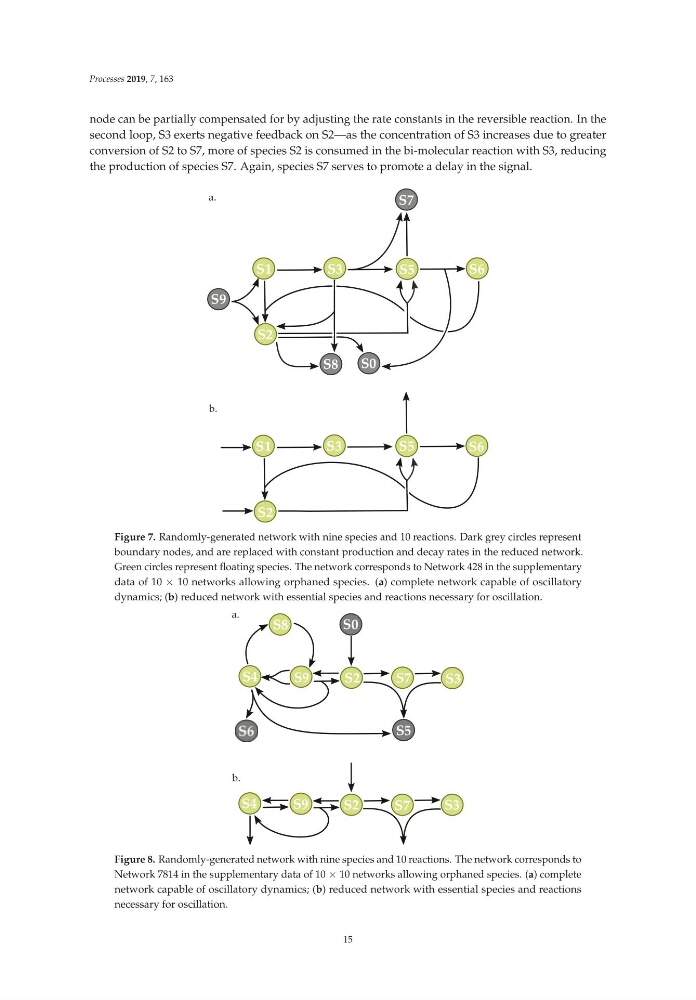
node can be partially compensated for by adjusting the rate constants in the reversible reaction. In the
second loop, S3 exerts negative feedback on S2—as the concentration of S3 increases due to greater
conversion of S2 to S7, more of species S2 is consumed in the bi-molecular reaction with S3, reducing
the production of species S7. Again, species S7 serves to promote a delay in the signal.
Figure 7. Randomly-generated network with nine species and 10 reactions. Dark grey circles represent
boundary nodes, and are replaced with constant production and decay rates in the reduced network.
Green circles represent floating species. The network corresponds to Network 428 in the supplementary
data of 10 × 10 networks allowing orphaned species. (a) complete network capable of oscillatory
dynamics; (b) reduced network with essential species and reactions necessary for oscillation.
Figure 8. Randomly-generated network with nine species and 10 reactions. The network corresponds to
Network 7814 in the supplementary data of 10 × 10 networks allowing orphaned species. (a) complete
network capable of oscillatory dynamics; (b) reduced network with essential species and reactions
necessary for oscillation.
15
node can be partially compensated for by adjusting the rate constants in the reversible reaction. In the
second loop, S3 exerts negative feedback on S2—as the concentration of S3 increases due to greater
conversion of S2 to S7, more of species S2 is consumed in the bi-molecular reaction with S3, reducing
the production of species S7. Again, species S7 serves to promote a delay in the signal.
Figure 7. Randomly-generated network with nine species and 10 reactions. Dark grey circles represent
boundary nodes, and are replaced with constant production and decay rates in the reduced network.
Green circles represent floating species. The network corresponds to Network 428 in the supplementary
data of 10 × 10 networks allowing orphaned species. (a) complete network capable of oscillatory
dynamics; (b) reduced network with essential species and reactions necessary for oscillation.
Figure 8. Randomly-generated network with nine species and 10 reactions. The network corresponds to
Network 7814 in the supplementary data of 10 × 10 networks allowing orphaned species. (a) complete
network capable of oscillatory dynamics; (b) reduced network with essential species and reactions
necessary for oscillation.
15