

Processes 2018, 6,42
2.3. Computational Identification of MiRNAs Biased towards Editing
The list of remaining putative edit sites (plus the sites identified in a previous study [37]) were
used to generate a dataset consisting of two files each containing 201 bp sequences (edit site plus/minus
100 bp flanking sequences from the human reference genome). One file contained an ‘unedited’ version
of the transcript with the edit site corresponding to the reference genome, and the other file contained
an ‘edited’ version where the central site was edited. An in-house program written in Java was used to
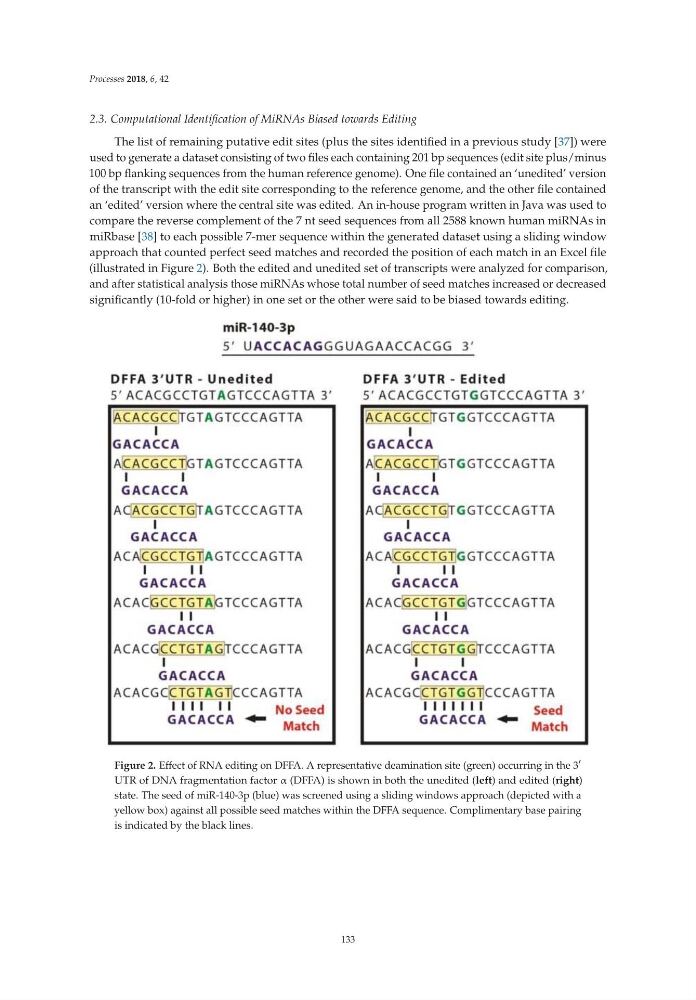
compare the reverse complement of the 7 nt seed sequences from all 2588 known human miRNAs in
miRbase [38] to each possible 7-mer sequence within the generated dataset using a sliding window
approach that counted perfect seed matches and recorded the position of each match in an Excel file
(illustrated in Figure 2). Both the edited and unedited set of transcripts were analyzed for comparison,
and after statistical analysis those miRNAs whose total number of seed matches increased or decreased
significantly (10-fold or higher) in one set or the other were said to be biased towards editing.
Figure 2. Effect of RNA editing on DFFA. A representative deamination site (green) occurring in the 3 ′
UTR of DNA fragmentation factor α (DFFA) is shown in both the unedited (left) and edited (right)
state. The seed of miR-140-3p (blue) was screened using a sliding windows approach (depicted with a
yellow box) against all possible seed matches within the DFFA sequence. Complimentary base pairing
is indicated by the black lines.
133
2.3. Computational Identification of MiRNAs Biased towards Editing
The list of remaining putative edit sites (plus the sites identified in a previous study [37]) were
used to generate a dataset consisting of two files each containing 201 bp sequences (edit site plus/minus
100 bp flanking sequences from the human reference genome). One file contained an ‘unedited’ version
of the transcript with the edit site corresponding to the reference genome, and the other file contained
an ‘edited’ version where the central site was edited. An in-house program written in Java was used to
compare the reverse complement of the 7 nt seed sequences from all 2588 known human miRNAs in
miRbase [38] to each possible 7-mer sequence within the generated dataset using a sliding window
approach that counted perfect seed matches and recorded the position of each match in an Excel file
(illustrated in Figure 2). Both the edited and unedited set of transcripts were analyzed for comparison,
and after statistical analysis those miRNAs whose total number of seed matches increased or decreased
significantly (10-fold or higher) in one set or the other were said to be biased towards editing.
Figure 2. Effect of RNA editing on DFFA. A representative deamination site (green) occurring in the 3 ′
UTR of DNA fragmentation factor α (DFFA) is shown in both the unedited (left) and edited (right)
state. The seed of miR-140-3p (blue) was screened using a sliding windows approach (depicted with a
yellow box) against all possible seed matches within the DFFA sequence. Complimentary base pairing
is indicated by the black lines.
133