

Processes 2018, 6,82
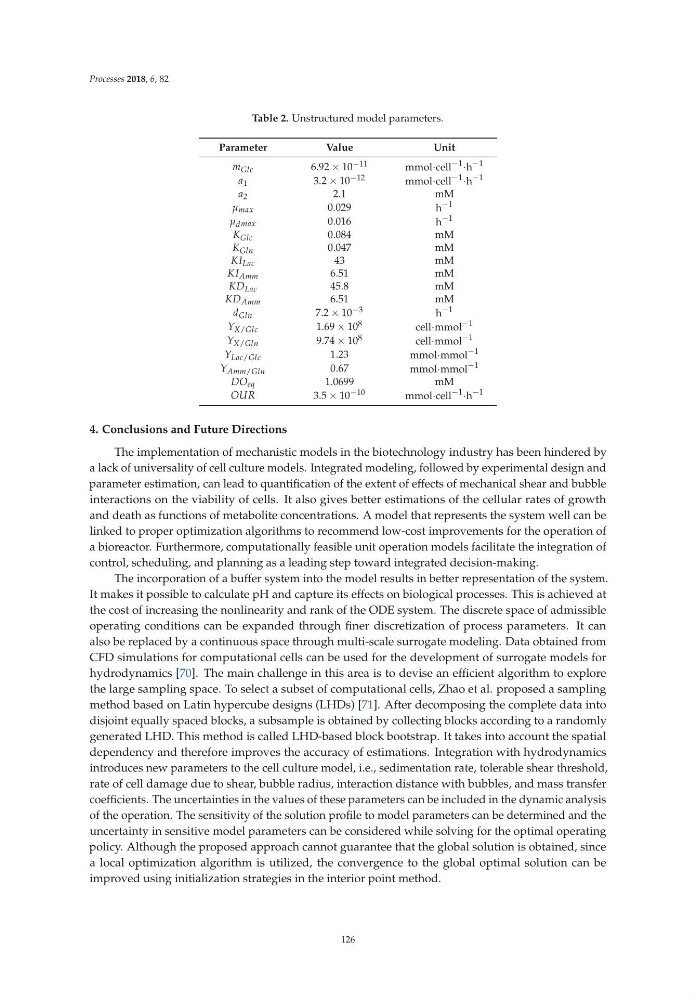
Table 2. Unstructured model parameters.
Parameter
Value
Unit
m Glc
6.92 × 10 −11
mmol·cell
−1 ·h
−1
a 1
3.2 × 10 −12
mmol·cell
−1 ·h
−1
a 2
2.1
mM
μ max
0.029
h
−1
μ dmax
0.016
h
−1
K Glc
0.084
mM
K Gln
0.047
mM
KI Lac
43
mM
KI Amm
6.51
mM
KD Lac
45.8
mM
KD Amm
6.51
mM
d Gln
7.2 × 10 −3
h
−1
Y X/Glc
1.69 × 10 8
cell·mmol
−1
Y X/Gln
9.74 × 10 8
cell·mmol
−1
Y Lac/Glc
1.23
mmol·mmol
−1
Y Amm/Gln
0.67
mmol·mmol
−1
DO eq
1.0699
mM
OUR
3.5 × 10 −10
mmol·cell
−1 ·h
−1
4. Conclusions and Future Directions
The implementation of mechanistic models in the biotechnology industry has been hindered by
a lack of universality of cell culture models. Integrated modeling, followed by experimental design and
parameter estimation, can lead to quantification of the extent of effects of mechanical shear and bubble
interactions on the viability of cells. It also gives better estimations of the cellular rates of growth
and death as functions of metabolite concentrations. A model that represents the system well can be
linked to proper optimization algorithms to recommend low-cost improvements for the operation of
a bioreactor. Furthermore, computationally feasible unit operation models facilitate the integration of
control, scheduling, and planning as a leading step toward integrated decision-making.
The incorporation of a buffer system into the model results in better representation of the system.
It makes it possible to calculate pH and capture its effects on biological processes. This is achieved at
the cost of increasing the nonlinearity and rank of the ODE system. The discrete space of admissible
operating conditions can be expanded through finer discretization of process parameters. It can
also be replaced by a continuous space through multi-scale surrogate modeling. Data obtained from
CFD simulations for computational cells can be used for the development of surrogate models for
hydrodynamics [70]. The main challenge in this area is to devise an efficient algorithm to explore
the large sampling space. To select a subset of computational cells, Zhao et al. proposed a sampling
method based on Latin hypercube designs (LHDs) [71]. After decomposing the complete data into
disjoint equally spaced blocks, a subsample is obtained by collecting blocks according to a randomly
generated LHD. This method is called LHD-based block bootstrap. It takes into account the spatial
dependency and therefore improves the accuracy of estimations. Integration with hydrodynamics
introduces new parameters to the cell culture model, i.e., sedimentation rate, tolerable shear threshold,
rate of cell damage due to shear, bubble radius, interaction distance with bubbles, and mass transfer
coefficients. The uncertainties in the values of these parameters can be included in the dynamic analysis
of the operation. The sensitivity of the solution profile to model parameters can be determined and the
uncertainty in sensitive model parameters can be considered while solving for the optimal operating
policy. Although the proposed approach cannot guarantee that the global solution is obtained, since
a local optimization algorithm is utilized, the convergence to the global optimal solution can be
improved using initialization strategies in the interior point method.
126
Table 2. Unstructured model parameters.
Parameter
Value
Unit
m Glc
6.92 × 10 −11
mmol·cell
−1 ·h
−1
a 1
3.2 × 10 −12
mmol·cell
−1 ·h
−1
a 2
2.1
mM
μ max
0.029
h
−1
μ dmax
0.016
h
−1
K Glc
0.084
mM
K Gln
0.047
mM
KI Lac
43
mM
KI Amm
6.51
mM
KD Lac
45.8
mM
KD Amm
6.51
mM
d Gln
7.2 × 10 −3
h
−1
Y X/Glc
1.69 × 10 8
cell·mmol
−1
Y X/Gln
9.74 × 10 8
cell·mmol
−1
Y Lac/Glc
1.23
mmol·mmol
−1
Y Amm/Gln
0.67
mmol·mmol
−1
DO eq
1.0699
mM
OUR
3.5 × 10 −10
mmol·cell
−1 ·h
−1
4. Conclusions and Future Directions
The implementation of mechanistic models in the biotechnology industry has been hindered by
a lack of universality of cell culture models. Integrated modeling, followed by experimental design and
parameter estimation, can lead to quantification of the extent of effects of mechanical shear and bubble
interactions on the viability of cells. It also gives better estimations of the cellular rates of growth
and death as functions of metabolite concentrations. A model that represents the system well can be
linked to proper optimization algorithms to recommend low-cost improvements for the operation of
a bioreactor. Furthermore, computationally feasible unit operation models facilitate the integration of
control, scheduling, and planning as a leading step toward integrated decision-making.
The incorporation of a buffer system into the model results in better representation of the system.
It makes it possible to calculate pH and capture its effects on biological processes. This is achieved at
the cost of increasing the nonlinearity and rank of the ODE system. The discrete space of admissible
operating conditions can be expanded through finer discretization of process parameters. It can
also be replaced by a continuous space through multi-scale surrogate modeling. Data obtained from
CFD simulations for computational cells can be used for the development of surrogate models for
hydrodynamics [70]. The main challenge in this area is to devise an efficient algorithm to explore
the large sampling space. To select a subset of computational cells, Zhao et al. proposed a sampling
method based on Latin hypercube designs (LHDs) [71]. After decomposing the complete data into
disjoint equally spaced blocks, a subsample is obtained by collecting blocks according to a randomly
generated LHD. This method is called LHD-based block bootstrap. It takes into account the spatial
dependency and therefore improves the accuracy of estimations. Integration with hydrodynamics
introduces new parameters to the cell culture model, i.e., sedimentation rate, tolerable shear threshold,
rate of cell damage due to shear, bubble radius, interaction distance with bubbles, and mass transfer
coefficients. The uncertainties in the values of these parameters can be included in the dynamic analysis
of the operation. The sensitivity of the solution profile to model parameters can be determined and the
uncertainty in sensitive model parameters can be considered while solving for the optimal operating
policy. Although the proposed approach cannot guarantee that the global solution is obtained, since
a local optimization algorithm is utilized, the convergence to the global optimal solution can be
improved using initialization strategies in the interior point method.
126