

Processes 2018, 6,82
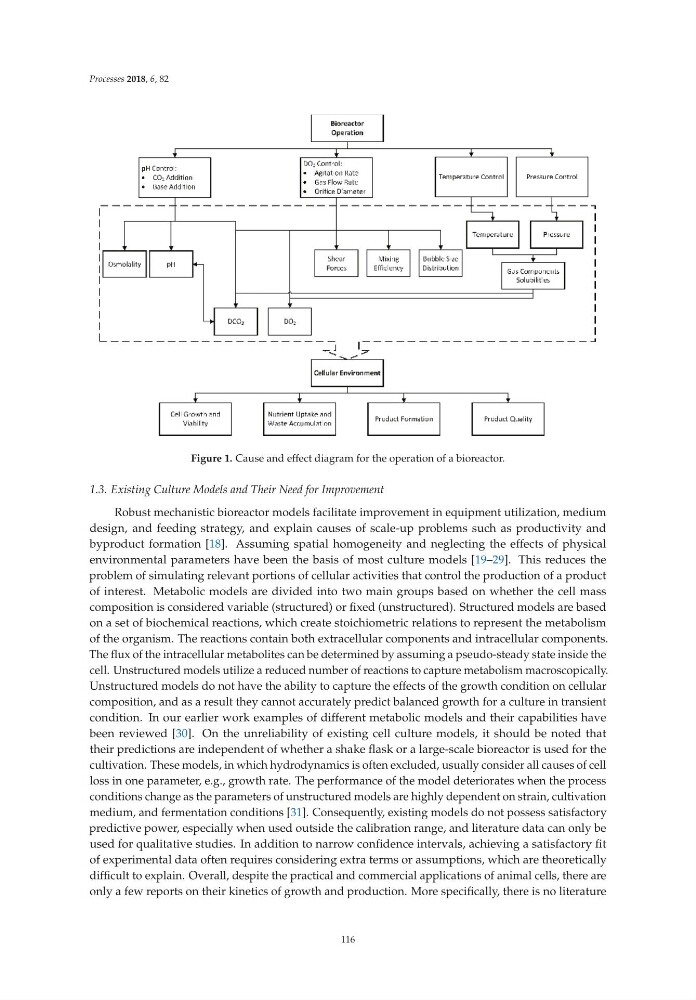
Figure 1. Cause and effect diagram for the operation of a bioreactor.
1.3. Existing Culture Models and Their Need for Improvement
Robust mechanistic bioreactor models facilitate improvement in equipment utilization, medium
design, and feeding strategy, and explain causes of scale-up problems such as productivity and
byproduct formation [18]. Assuming spatial homogeneity and neglecting the effects of physical
environmental parameters have been the basis of most culture models [19–29]. This reduces the
problem of simulating relevant portions of cellular activities that control the production of a product
of interest. Metabolic models are divided into two main groups based on whether the cell mass
composition is considered variable (structured) or fixed (unstructured). Structured models are based
on a set of biochemical reactions, which create stoichiometric relations to represent the metabolism
of the organism. The reactions contain both extracellular components and intracellular components.
The flux of the intracellular metabolites can be determined by assuming a pseudo-steady state inside the
cell. Unstructured models utilize a reduced number of reactions to capture metabolism macroscopically.
Unstructured models do not have the ability to capture the effects of the growth condition on cellular
composition, and as a result they cannot accurately predict balanced growth for a culture in transient
condition. In our earlier work examples of different metabolic models and their capabilities have
been reviewed [30]. On the unreliability of existing cell culture models, it should be noted that
their predictions are independent of whether a shake flask or a large-scale bioreactor is used for the
cultivation. These models, in which hydrodynamics is often excluded, usually consider all causes of cell
loss in one parameter, e.g., growth rate. The performance of the model deteriorates when the process
conditions change as the parameters of unstructured models are highly dependent on strain, cultivation
medium, and fermentation conditions [31]. Consequently, existing models do not possess satisfactory
predictive power, especially when used outside the calibration range, and literature data can only be
used for qualitative studies. In addition to narrow confidence intervals, achieving a satisfactory fit
of experimental data often requires considering extra terms or assumptions, which are theoretically
difficult to explain. Overall, despite the practical and commercial applications of animal cells, there are
only a few reports on their kinetics of growth and production. More specifically, there is no literature
116
Figure 1. Cause and effect diagram for the operation of a bioreactor.
1.3. Existing Culture Models and Their Need for Improvement
Robust mechanistic bioreactor models facilitate improvement in equipment utilization, medium
design, and feeding strategy, and explain causes of scale-up problems such as productivity and
byproduct formation [18]. Assuming spatial homogeneity and neglecting the effects of physical
environmental parameters have been the basis of most culture models [19–29]. This reduces the
problem of simulating relevant portions of cellular activities that control the production of a product
of interest. Metabolic models are divided into two main groups based on whether the cell mass
composition is considered variable (structured) or fixed (unstructured). Structured models are based
on a set of biochemical reactions, which create stoichiometric relations to represent the metabolism
of the organism. The reactions contain both extracellular components and intracellular components.
The flux of the intracellular metabolites can be determined by assuming a pseudo-steady state inside the
cell. Unstructured models utilize a reduced number of reactions to capture metabolism macroscopically.
Unstructured models do not have the ability to capture the effects of the growth condition on cellular
composition, and as a result they cannot accurately predict balanced growth for a culture in transient
condition. In our earlier work examples of different metabolic models and their capabilities have
been reviewed [30]. On the unreliability of existing cell culture models, it should be noted that
their predictions are independent of whether a shake flask or a large-scale bioreactor is used for the
cultivation. These models, in which hydrodynamics is often excluded, usually consider all causes of cell
loss in one parameter, e.g., growth rate. The performance of the model deteriorates when the process
conditions change as the parameters of unstructured models are highly dependent on strain, cultivation
medium, and fermentation conditions [31]. Consequently, existing models do not possess satisfactory
predictive power, especially when used outside the calibration range, and literature data can only be
used for qualitative studies. In addition to narrow confidence intervals, achieving a satisfactory fit
of experimental data often requires considering extra terms or assumptions, which are theoretically
difficult to explain. Overall, despite the practical and commercial applications of animal cells, there are
only a few reports on their kinetics of growth and production. More specifically, there is no literature
116