

Processes 2018, 6, 134
effect on the concentration of extracellular LDL and VLDL, both of which are major risk factors for
health conditions such as CVD. Therefore we know the receptor mechanism plays an important role in
lipoprotein clearance which agrees with experimental evidence [39].
The amount of cholesterol within an LDL or VLDL molecule (R chol
l
, R chol
v ) was found to have
very little effect on intracellular cholesterol levels. However, when R chol
l
and R chol
v
were increased,
the concentration of HMGCR mRNA and LDLR mRNA were reduced. For 10-fold increased cholesterol
in VLDL, HMGCR mRNA was reduced by nearly 20% and receptor mRNA reduced by around
5%. To induce similar levels of mRNA reduction, the cholesterol content of LDL needs to be
increased 100-fold. This is due to the increased amount of cholesterol being brought in to the cell
via receptor mediated endocytosis and shows very tight genetic regulatory control of intracellular
cholesterol concentrations.
We have also found for certain values that parameters linked with cholesterol and receptor
biosynthesis (μ mh , μ h , μ c , κ mh , δ mh , μ mr , μ r , J, x h and x c ) can produce damped periodic behaviour;
the damping a result of the difference in the volumes of the cell nucleus and cytoplasm.
Sensitivity analysis of the VLDL-LDL delipidation parameter, χ v , provided some interesting
results. Increasing the rate of delipidation results in a 40% decrease in extracellular VLDL
concentrations, but a 450% increase in extracellular LDL concentrations. Conversely, however, a 10-fold
decrease in the delipidation rate produces around an 8% increase in extracellular VLDL concentrations
but, significantly, nearly a 90% decrease in extracellular LDL concentrations. Furthermore, there is no
other significant changes in the rest of the system due to the perturbation of χ v . Our model would
suggest, then, that delipidation of VLDL to LDL would be a good candidate as a target for LDL
reduction therapies.
3.3. Investigating Familial Hypercholesterolaemia (FH)
In this section we investigate whether our model is able to reproduce the known effects of the
disease Familial Hypercholesterolaemia (FH), the aetiology of which is well known. By altering specific
model parameters we can quantitatively represent the effect of genetic mutations on extracellular
VLDL and LDL levels.
FH is a genetic disorder, primarily of the LDL receptor gene and is characterised by high levels of
circulating LDL cholesterol. In certain populations (including French and Canadians) 1 in 67 people
suffer FH, with an increased risk of heart disease 20 times greater than non-sufferers [40]. Furthermore,
almost all people with FH will require plasma cholesterol-lowering drugs.
The gene pertaining to the LDL receptor is located on chromosome 19 and a number of mutations
have been identified in the DNA of individuals affected by this disorder [41]. Hobbs et al. [42]
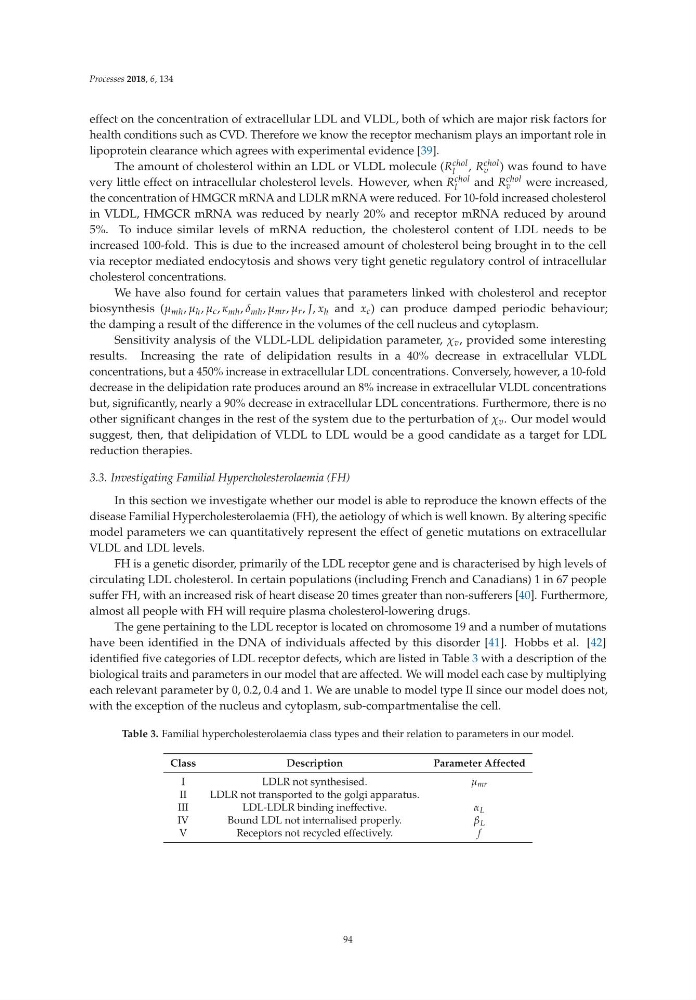
identified five categories of LDL receptor defects, which are listed in Table 3 with a description of the
biological traits and parameters in our model that are affected. We will model each case by multiplying
each relevant parameter by 0, 0.2, 0.4 and 1. We are unable to model type II since our model does not,
with the exception of the nucleus and cytoplasm, sub-compartmentalise the cell.
Table 3. Familial hypercholesterolaemia class types and their relation to parameters in our model.
Class
Description
Parameter Affected
I
LDLR not synthesised.
μ mr
II
LDLR not transported to the golgi apparatus.
III
LDL-LDLR binding ineffective.
α L
IV
Bound LDL not internalised properly.
β L
V
Receptors not recycled effectively.
f
94
effect on the concentration of extracellular LDL and VLDL, both of which are major risk factors for
health conditions such as CVD. Therefore we know the receptor mechanism plays an important role in
lipoprotein clearance which agrees with experimental evidence [39].
The amount of cholesterol within an LDL or VLDL molecule (R chol
l
, R chol
v ) was found to have
very little effect on intracellular cholesterol levels. However, when R chol
l
and R chol
v
were increased,
the concentration of HMGCR mRNA and LDLR mRNA were reduced. For 10-fold increased cholesterol
in VLDL, HMGCR mRNA was reduced by nearly 20% and receptor mRNA reduced by around
5%. To induce similar levels of mRNA reduction, the cholesterol content of LDL needs to be
increased 100-fold. This is due to the increased amount of cholesterol being brought in to the cell
via receptor mediated endocytosis and shows very tight genetic regulatory control of intracellular
cholesterol concentrations.
We have also found for certain values that parameters linked with cholesterol and receptor
biosynthesis (μ mh , μ h , μ c , κ mh , δ mh , μ mr , μ r , J, x h and x c ) can produce damped periodic behaviour;
the damping a result of the difference in the volumes of the cell nucleus and cytoplasm.
Sensitivity analysis of the VLDL-LDL delipidation parameter, χ v , provided some interesting
results. Increasing the rate of delipidation results in a 40% decrease in extracellular VLDL
concentrations, but a 450% increase in extracellular LDL concentrations. Conversely, however, a 10-fold
decrease in the delipidation rate produces around an 8% increase in extracellular VLDL concentrations
but, significantly, nearly a 90% decrease in extracellular LDL concentrations. Furthermore, there is no
other significant changes in the rest of the system due to the perturbation of χ v . Our model would
suggest, then, that delipidation of VLDL to LDL would be a good candidate as a target for LDL
reduction therapies.
3.3. Investigating Familial Hypercholesterolaemia (FH)
In this section we investigate whether our model is able to reproduce the known effects of the
disease Familial Hypercholesterolaemia (FH), the aetiology of which is well known. By altering specific
model parameters we can quantitatively represent the effect of genetic mutations on extracellular
VLDL and LDL levels.
FH is a genetic disorder, primarily of the LDL receptor gene and is characterised by high levels of
circulating LDL cholesterol. In certain populations (including French and Canadians) 1 in 67 people
suffer FH, with an increased risk of heart disease 20 times greater than non-sufferers [40]. Furthermore,
almost all people with FH will require plasma cholesterol-lowering drugs.
The gene pertaining to the LDL receptor is located on chromosome 19 and a number of mutations
have been identified in the DNA of individuals affected by this disorder [41]. Hobbs et al. [42]
identified five categories of LDL receptor defects, which are listed in Table 3 with a description of the
biological traits and parameters in our model that are affected. We will model each case by multiplying
each relevant parameter by 0, 0.2, 0.4 and 1. We are unable to model type II since our model does not,
with the exception of the nucleus and cytoplasm, sub-compartmentalise the cell.
Table 3. Familial hypercholesterolaemia class types and their relation to parameters in our model.
Class
Description
Parameter Affected
I
LDLR not synthesised.
μ mr
II
LDLR not transported to the golgi apparatus.
III
LDL-LDLR binding ineffective.
α L
IV
Bound LDL not internalised properly.
β L
V
Receptors not recycled effectively.
f
94