

Processes 2018, 6, 134
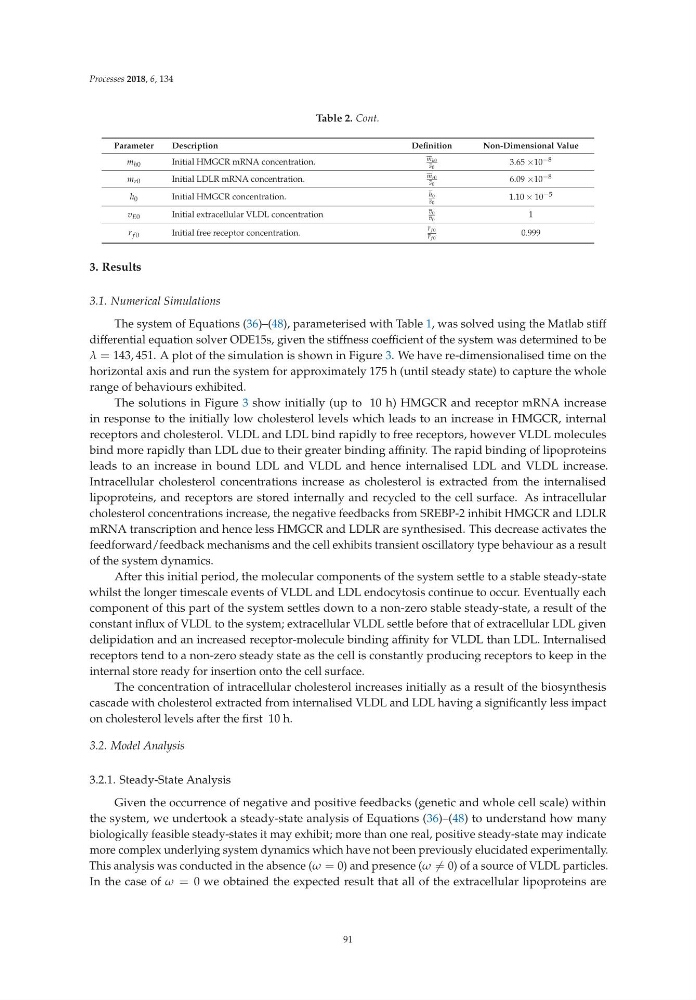
Table 2. Cont.
Parameter
Description
Definition
Non-Dimensional Value
m h0
Initial HMGCR mRNA concentration.
mh0
s0
3.65 ×10 −8
m r0
Initial LDLR mRNA concentration.
mr0
s0
6.09 ×10 −8
h 0
Initial HMGCR concentration.
h0
s0
1.10 × 10 −5
v E0
Initial extracellular VLDL concentration
v0
v0
1
r f 0
Initial free receptor concentration.
r f 0
r f 0
0.999
3. Results
3.1. Numerical Simulations
The system of Equations (36)–(48), parameterised with Table 1, was solved using the Matlab stiff
differential equation solver ODE15s, given the stiffness coefficient of the system was determined to be
λ = 143, 451. A plot of the simulation is shown in Figure 3. We have re-dimensionalised time on the
horizontal axis and run the system for approximately 175 h (until steady state) to capture the whole
range of behaviours exhibited.
The solutions in Figure 3 show initially (up to 10 h) HMGCR and receptor mRNA increase
in response to the initially low cholesterol levels which leads to an increase in HMGCR, internal
receptors and cholesterol. VLDL and LDL bind rapidly to free receptors, however VLDL molecules
bind more rapidly than LDL due to their greater binding affinity. The rapid binding of lipoproteins
leads to an increase in bound LDL and VLDL and hence internalised LDL and VLDL increase.
Intracellular cholesterol concentrations increase as cholesterol is extracted from the internalised
lipoproteins, and receptors are stored internally and recycled to the cell surface. As intracellular
cholesterol concentrations increase, the negative feedbacks from SREBP-2 inhibit HMGCR and LDLR
mRNA transcription and hence less HMGCR and LDLR are synthesised. This decrease activates the
feedforward/feedback mechanisms and the cell exhibits transient oscillatory type behaviour as a result
of the system dynamics.
After this initial period, the molecular components of the system settle to a stable steady-state
whilst the longer timescale events of VLDL and LDL endocytosis continue to occur. Eventually each
component of this part of the system settles down to a non-zero stable steady-state, a result of the
constant influx of VLDL to the system; extracellular VLDL settle before that of extracellular LDL given
delipidation and an increased receptor-molecule binding affinity for VLDL than LDL. Internalised
receptors tend to a non-zero steady state as the cell is constantly producing receptors to keep in the
internal store ready for insertion onto the cell surface.
The concentration of intracellular cholesterol increases initially as a result of the biosynthesis
cascade with cholesterol extracted from internalised VLDL and LDL having a significantly less impact
on cholesterol levels after the first 10 h.
3.2. Model Analysis
3.2.1. Steady-State Analysis
Given the occurrence of negative and positive feedbacks (genetic and whole cell scale) within
the system, we undertook a steady-state analysis of Equations (36)–(48) to understand how many
biologically feasible steady-states it may exhibit; more than one real, positive steady-state may indicate
more complex underlying system dynamics which have not been previously elucidated experimentally.
This analysis was conducted in the absence (ω = 0) and presence (ω = 0) of a source of VLDL particles.
In the case of ω = 0 we obtained the expected result that all of the extracellular lipoproteins are
91
Table 2. Cont.
Parameter
Description
Definition
Non-Dimensional Value
m h0
Initial HMGCR mRNA concentration.
mh0
s0
3.65 ×10 −8
m r0
Initial LDLR mRNA concentration.
mr0
s0
6.09 ×10 −8
h 0
Initial HMGCR concentration.
h0
s0
1.10 × 10 −5
v E0
Initial extracellular VLDL concentration
v0
v0
1
r f 0
Initial free receptor concentration.
r f 0
r f 0
0.999
3. Results
3.1. Numerical Simulations
The system of Equations (36)–(48), parameterised with Table 1, was solved using the Matlab stiff
differential equation solver ODE15s, given the stiffness coefficient of the system was determined to be
λ = 143, 451. A plot of the simulation is shown in Figure 3. We have re-dimensionalised time on the
horizontal axis and run the system for approximately 175 h (until steady state) to capture the whole
range of behaviours exhibited.
The solutions in Figure 3 show initially (up to 10 h) HMGCR and receptor mRNA increase
in response to the initially low cholesterol levels which leads to an increase in HMGCR, internal
receptors and cholesterol. VLDL and LDL bind rapidly to free receptors, however VLDL molecules
bind more rapidly than LDL due to their greater binding affinity. The rapid binding of lipoproteins
leads to an increase in bound LDL and VLDL and hence internalised LDL and VLDL increase.
Intracellular cholesterol concentrations increase as cholesterol is extracted from the internalised
lipoproteins, and receptors are stored internally and recycled to the cell surface. As intracellular
cholesterol concentrations increase, the negative feedbacks from SREBP-2 inhibit HMGCR and LDLR
mRNA transcription and hence less HMGCR and LDLR are synthesised. This decrease activates the
feedforward/feedback mechanisms and the cell exhibits transient oscillatory type behaviour as a result
of the system dynamics.
After this initial period, the molecular components of the system settle to a stable steady-state
whilst the longer timescale events of VLDL and LDL endocytosis continue to occur. Eventually each
component of this part of the system settles down to a non-zero stable steady-state, a result of the
constant influx of VLDL to the system; extracellular VLDL settle before that of extracellular LDL given
delipidation and an increased receptor-molecule binding affinity for VLDL than LDL. Internalised
receptors tend to a non-zero steady state as the cell is constantly producing receptors to keep in the
internal store ready for insertion onto the cell surface.
The concentration of intracellular cholesterol increases initially as a result of the biosynthesis
cascade with cholesterol extracted from internalised VLDL and LDL having a significantly less impact
on cholesterol levels after the first 10 h.
3.2. Model Analysis
3.2.1. Steady-State Analysis
Given the occurrence of negative and positive feedbacks (genetic and whole cell scale) within
the system, we undertook a steady-state analysis of Equations (36)–(48) to understand how many
biologically feasible steady-states it may exhibit; more than one real, positive steady-state may indicate
more complex underlying system dynamics which have not been previously elucidated experimentally.
This analysis was conducted in the absence (ω = 0) and presence (ω = 0) of a source of VLDL particles.
In the case of ω = 0 we obtained the expected result that all of the extracellular lipoproteins are
91