

24
Phytotechnology with Biomass Production
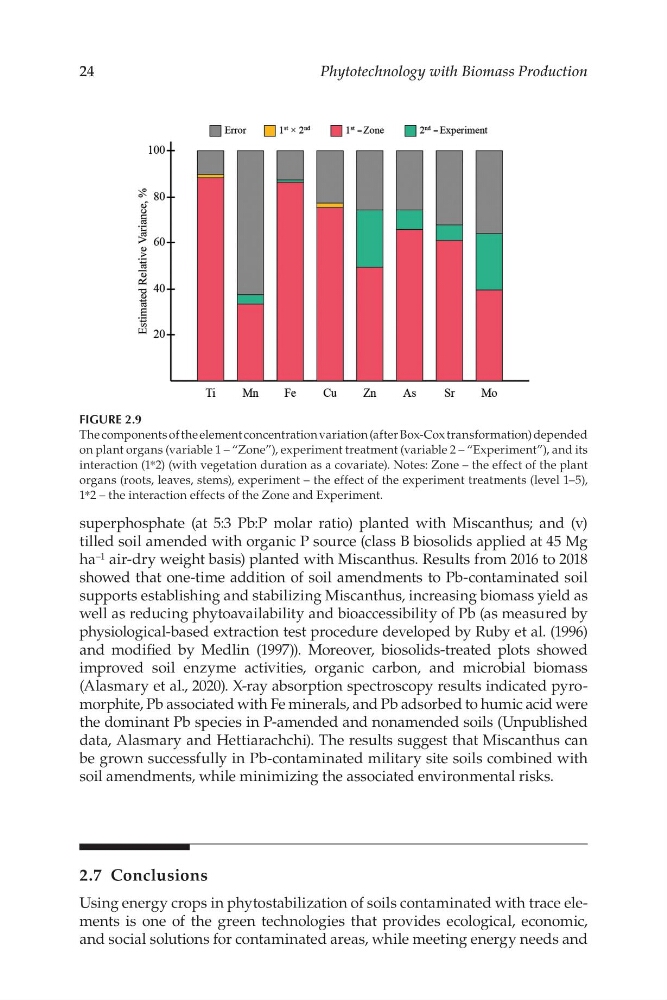
FIGURE 2.9
The components of the element concentration variation (after Box-Cox transformation) depended
on plant organs (variable 1 – “Zone”), experiment treatment (variable 2 – “Experiment”), and its
interaction (1*2) (with vegetation duration as a covariate). Notes: Zone – the effect of the plant
organs (roots, leaves, stems), experiment – the effect of the experiment treatments (level 1–5),
1*2 – the interaction effects of the Zone and Experiment.
superphosphate (at 5:3 Pb:P molar ratio) planted with Miscanthus; and (v)
tilled soil amended with organic P source (class B biosolids applied at 45 Mg
ha −1 air-dry weight basis) planted with Miscanthus. Results from 2016 to 2018
showed that one-time addition of soil amendments to Pb-contaminated soil
supports establishing and stabilizing Miscanthus, increasing biomass yield as
well as reducing phytoavailability and bioaccessibility of Pb (as measured by
physiological-based extraction test procedure developed by Ruby et al. (1996)
and modified by Medlin (1997)). Moreover, biosolids-treated plots showed
improved soil enzyme activities, organic carbon, and microbial biomass
(Alasmary et al., 2020). X-ray absorption spectroscopy results indicated pyromorphite, Pb associated with Fe minerals, and Pb adsorbed to humic acid were
the dominant Pb species in P-amended and nonamended soils (Unpublished
data, Alasmary and Hettiarachchi). The results suggest that Miscanthus can
be grown successfully in Pb-contaminated military site soils combined with
soil amendments, while minimizing the associated environmental risks.
2.7 Conclusions
Using energy crops in phytostabilization of soils contaminated with trace elements is one of the green technologies that provides ecological, economic,
and social solutions for contaminated areas, while meeting energy needs and
Phytotechnology with Biomass Production
FIGURE 2.9
The components of the element concentration variation (after Box-Cox transformation) depended
on plant organs (variable 1 – “Zone”), experiment treatment (variable 2 – “Experiment”), and its
interaction (1*2) (with vegetation duration as a covariate). Notes: Zone – the effect of the plant
organs (roots, leaves, stems), experiment – the effect of the experiment treatments (level 1–5),
1*2 – the interaction effects of the Zone and Experiment.
superphosphate (at 5:3 Pb:P molar ratio) planted with Miscanthus; and (v)
tilled soil amended with organic P source (class B biosolids applied at 45 Mg
ha −1 air-dry weight basis) planted with Miscanthus. Results from 2016 to 2018
showed that one-time addition of soil amendments to Pb-contaminated soil
supports establishing and stabilizing Miscanthus, increasing biomass yield as
well as reducing phytoavailability and bioaccessibility of Pb (as measured by
physiological-based extraction test procedure developed by Ruby et al. (1996)
and modified by Medlin (1997)). Moreover, biosolids-treated plots showed
improved soil enzyme activities, organic carbon, and microbial biomass
(Alasmary et al., 2020). X-ray absorption spectroscopy results indicated pyromorphite, Pb associated with Fe minerals, and Pb adsorbed to humic acid were
the dominant Pb species in P-amended and nonamended soils (Unpublished
data, Alasmary and Hettiarachchi). The results suggest that Miscanthus can
be grown successfully in Pb-contaminated military site soils combined with
soil amendments, while minimizing the associated environmental risks.
2.7 Conclusions
Using energy crops in phytostabilization of soils contaminated with trace elements is one of the green technologies that provides ecological, economic,
and social solutions for contaminated areas, while meeting energy needs and