

23
Phytotechnologies for Site Remediation
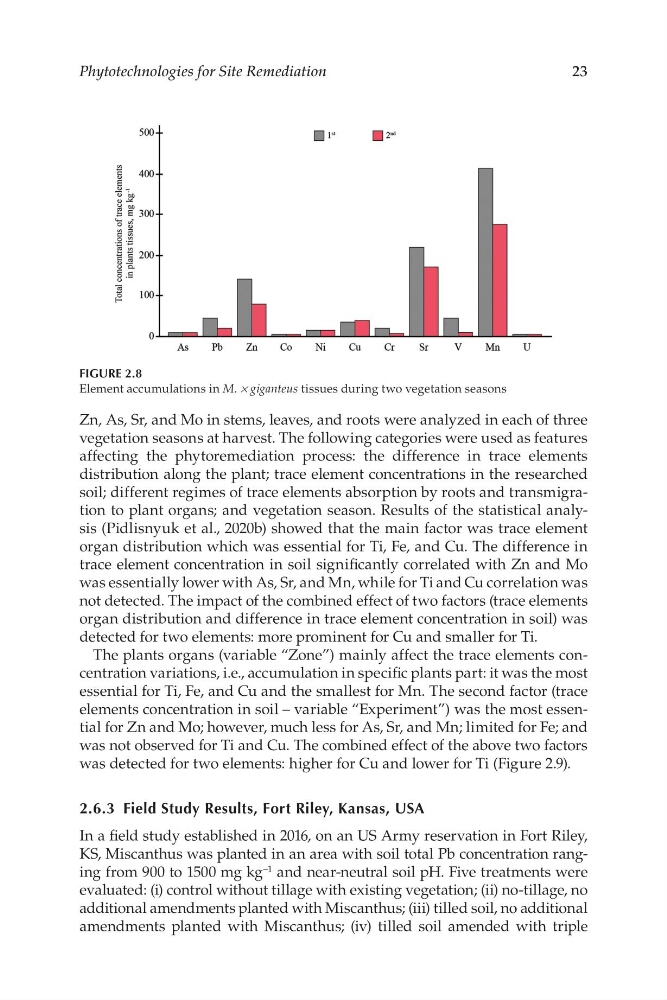
FIGURE 2.8
Element accumulations in M. × giganteus tissues during two vegetation seasons
Zn, As, Sr, and Mo in stems, leaves, and roots were analyzed in each of three
vegetation seasons at harvest. The following categories were used as features
affecting the phytoremediation process: the difference in trace elements
distribution along the plant; trace element concentrations in the researched
soil; different regimes of trace elements absorption by roots and transmigration to plant organs; and vegetation season. Results of the statistical analysis (Pidlisnyuk et al., 2020b) showed that the main factor was trace element
organ distribution which was essential for Ti, Fe, and Cu. The difference in
trace element concentration in soil significantly correlated with Zn and Mo
was essentially lower with As, Sr, and Mn, while for Ti and Cu correlation was
not detected. The impact of the combined effect of two factors (trace elements
organ distribution and difference in trace element concentration in soil) was
detected for two elements: more prominent for Cu and smaller for Ti.
The plants organs (variable “Zone”) mainly affect the trace elements concentration variations, i.e., accumulation in specific plants part: it was the most
essential for Ti, Fe, and Cu and the smallest for Mn. The second factor (trace
elements concentration in soil – variable “Experiment”) was the most essential for Zn and Mo; however, much less for As, Sr, and Mn; limited for Fe; and
was not observed for Ti and Cu. The combined effect of the above two factors
was detected for two elements: higher for Cu and lower for Ti (Figure 2.9).
2.6.3 Field Study Results, Fort Riley, Kansas, USA
In a field study established in 2016, on an US Army reservation in Fort Riley,
KS, Miscanthus was planted in an area with soil total Pb concentration ranging from 900 to 1500 mg kg −1 and near-neutral soil pH. Five treatments were
evaluated: (i) control without tillage with existing vegetation; (ii) no-tillage, no
additional amendments planted with Miscanthus; (iii) tilled soil, no additional
amendments planted with Miscanthus; (iv) tilled soil amended with triple
Phytotechnologies for Site Remediation
FIGURE 2.8
Element accumulations in M. × giganteus tissues during two vegetation seasons
Zn, As, Sr, and Mo in stems, leaves, and roots were analyzed in each of three
vegetation seasons at harvest. The following categories were used as features
affecting the phytoremediation process: the difference in trace elements
distribution along the plant; trace element concentrations in the researched
soil; different regimes of trace elements absorption by roots and transmigration to plant organs; and vegetation season. Results of the statistical analysis (Pidlisnyuk et al., 2020b) showed that the main factor was trace element
organ distribution which was essential for Ti, Fe, and Cu. The difference in
trace element concentration in soil significantly correlated with Zn and Mo
was essentially lower with As, Sr, and Mn, while for Ti and Cu correlation was
not detected. The impact of the combined effect of two factors (trace elements
organ distribution and difference in trace element concentration in soil) was
detected for two elements: more prominent for Cu and smaller for Ti.
The plants organs (variable “Zone”) mainly affect the trace elements concentration variations, i.e., accumulation in specific plants part: it was the most
essential for Ti, Fe, and Cu and the smallest for Mn. The second factor (trace
elements concentration in soil – variable “Experiment”) was the most essential for Zn and Mo; however, much less for As, Sr, and Mn; limited for Fe; and
was not observed for Ti and Cu. The combined effect of the above two factors
was detected for two elements: higher for Cu and lower for Ti (Figure 2.9).
2.6.3 Field Study Results, Fort Riley, Kansas, USA
In a field study established in 2016, on an US Army reservation in Fort Riley,
KS, Miscanthus was planted in an area with soil total Pb concentration ranging from 900 to 1500 mg kg −1 and near-neutral soil pH. Five treatments were
evaluated: (i) control without tillage with existing vegetation; (ii) no-tillage, no
additional amendments planted with Miscanthus; (iii) tilled soil, no additional
amendments planted with Miscanthus; (iv) tilled soil amended with triple