

19
Phytotechnologies for Site Remediation
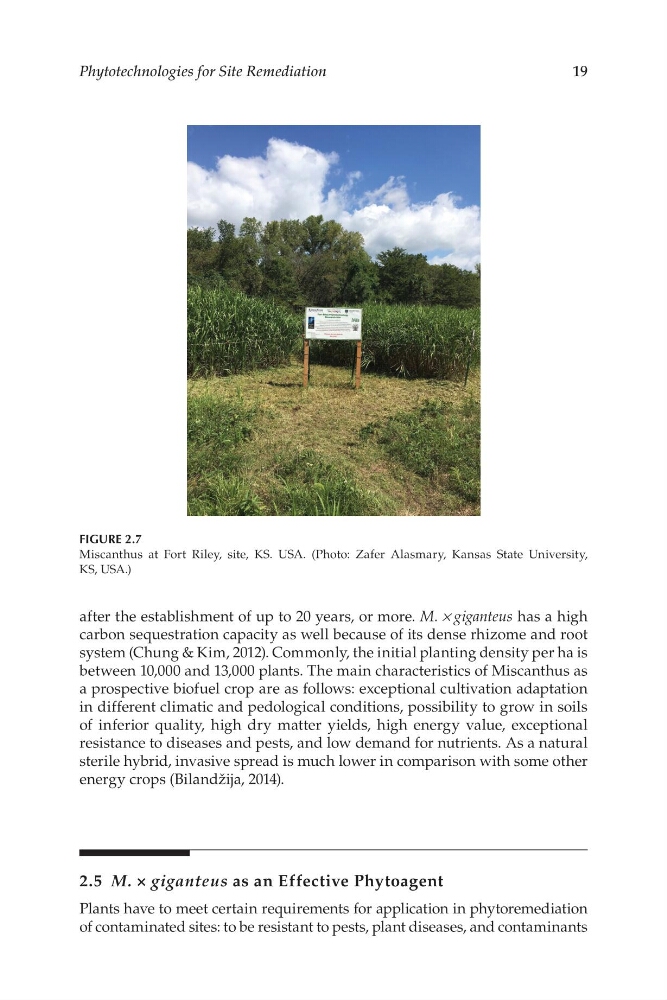
FIGURE 2.7
Miscanthus at Fort Riley, site, KS. USA. (Photo: Zafer Alasmary, Kansas State University,
KS, USA.)
after the establishment of up to 20 years, or more. M. × giganteus has a high
carbon sequestration capacity as well because of its dense rhizome and root
system (Chung & Kim, 2012). Commonly, the initial planting density per ha is
between 10,000 and 13,000 plants. The main characteristics of Miscanthus as
a prospective biofuel crop are as follows: exceptional cultivation adaptation
in different climatic and pedological conditions, possibility to grow in soils
of inferior quality, high dry matter yields, high energy value, exceptional
resistance to diseases and pests, and low demand for nutrients. As a natural
sterile hybrid, invasive spread is much lower in comparison with some other
energy crops (Bilandžija, 2014).
2.5 M. × giganteus as an Effective Phytoagent
Plants have to meet certain requirements for application in phytoremediation
of contaminated sites: to be resistant to pests, plant diseases, and contaminants